

Origami MEMS
213
of the faces (shown in Fig. 8). A typical example is a strip of bimorph with two rigid
panels at the face regions. The bending predominantly happens at the folds since
the faces are reinforced with an additional layer of material. As an extension of this
folding technique, bi-directional folding (mountains and valleys) can be achieved if
a soft material is sandwiched between two sheets having patterned openings on the
top and bottom layers. This ability to fold in both directions allows for the fabrication
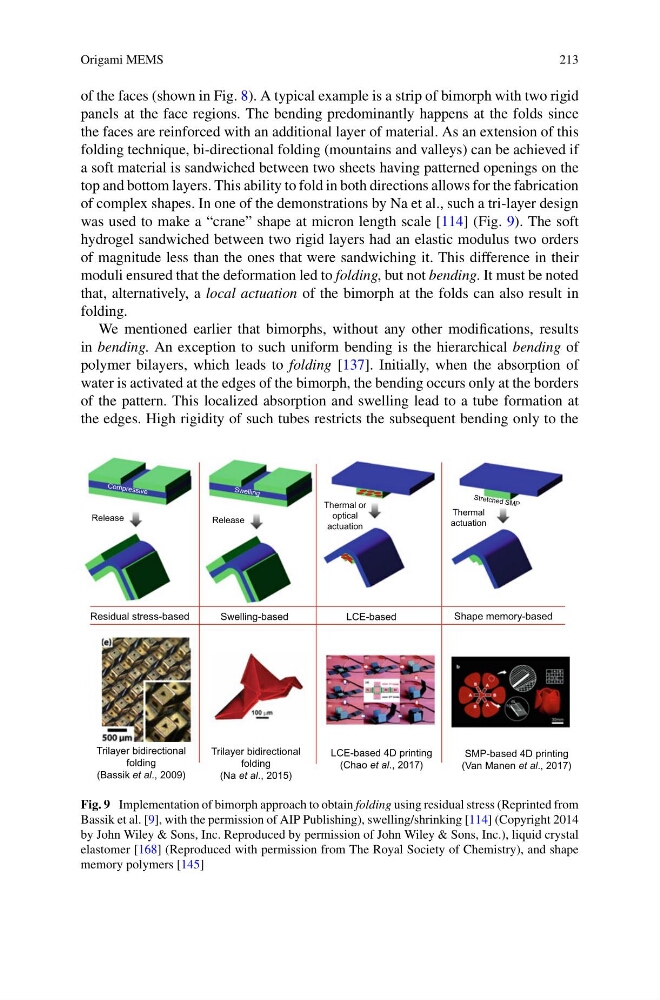
of complex shapes. In one of the demonstrations by Na et al., such a tri-layer design
was used to make a “crane” shape at micron length scale [114] (Fig. 9). The soft
hydrogel sandwiched between two rigid layers had an elastic modulus two orders
of magnitude less than the ones that were sandwiching it. This difference in their
moduli ensured that the deformation led to folding, but not bending. It must be noted
that, alternatively, a local actuation of the bimorph at the folds can also result in
folding.
We mentioned earlier that bimorphs, without any other modifications, results
in bending. An exception to such uniform bending is the hierarchical bending of
polymer bilayers, which leads to folding [137]. Initially, when the absorption of
water is activated at the edges of the bimorph, the bending occurs only at the borders
of the pattern. This localized absorption and swelling lead to a tube formation at
the edges. High rigidity of such tubes restricts the subsequent bending only to the
Release
Thermal
actuation
Thermal or
optical
actuation
Residual stress-based
Swelling-based
LCE-based
Shape memory-based
Release
Trilayer bidirectional
folding
(Bassik et al., 2009)
Trilayer bidirectional
folding
(Na et al., 2015)
LCE-based 4D printing
(Chao et al., 2017)
SMP-based 4D printing
(Van Manen et al., 2017)
Fig. 9 Implementation of bimorph approach to obtain folding using residual stress (Reprinted from
Bassik et al. [9], with the permission of AIP Publishing), swelling/shrinking [114] (Copyright 2014
by John Wiley & Sons, Inc. Reproduced by permission of John Wiley & Sons, Inc.), liquid crystal
elastomer [168] (Reproduced with permission from The Royal Society of Chemistry), and shape
memory polymers [145]
213
of the faces (shown in Fig. 8). A typical example is a strip of bimorph with two rigid
panels at the face regions. The bending predominantly happens at the folds since
the faces are reinforced with an additional layer of material. As an extension of this
folding technique, bi-directional folding (mountains and valleys) can be achieved if
a soft material is sandwiched between two sheets having patterned openings on the
top and bottom layers. This ability to fold in both directions allows for the fabrication
of complex shapes. In one of the demonstrations by Na et al., such a tri-layer design
was used to make a “crane” shape at micron length scale [114] (Fig. 9). The soft
hydrogel sandwiched between two rigid layers had an elastic modulus two orders
of magnitude less than the ones that were sandwiching it. This difference in their
moduli ensured that the deformation led to folding, but not bending. It must be noted
that, alternatively, a local actuation of the bimorph at the folds can also result in
folding.
We mentioned earlier that bimorphs, without any other modifications, results
in bending. An exception to such uniform bending is the hierarchical bending of
polymer bilayers, which leads to folding [137]. Initially, when the absorption of
water is activated at the edges of the bimorph, the bending occurs only at the borders
of the pattern. This localized absorption and swelling lead to a tube formation at
the edges. High rigidity of such tubes restricts the subsequent bending only to the
Release
Thermal
actuation
Thermal or
optical
actuation
Residual stress-based
Swelling-based
LCE-based
Shape memory-based
Release
Trilayer bidirectional
folding
(Bassik et al., 2009)
Trilayer bidirectional
folding
(Na et al., 2015)
LCE-based 4D printing
(Chao et al., 2017)
SMP-based 4D printing
(Van Manen et al., 2017)
Fig. 9 Implementation of bimorph approach to obtain folding using residual stress (Reprinted from
Bassik et al. [9], with the permission of AIP Publishing), swelling/shrinking [114] (Copyright 2014
by John Wiley & Sons, Inc. Reproduced by permission of John Wiley & Sons, Inc.), liquid crystal
elastomer [168] (Reproduced with permission from The Royal Society of Chemistry), and shape
memory polymers [145]