

202
D. George and M. J. Madou
swelling, shrinkage, thermal expansion, piezoelectric effect, configuration change
in a liquid crystal elastomer, or shape memory effect (Table 2). In the second case,
an external force prompts bending or buckling of sheets that are isotropic in nature.
Driving forces of such geometrical transformation include surface tension-based
actuation, magnetic actuation, mechanical actuation, or electrical actuation (Table
2).
Bending and buckling are achieved in the submillimeter length scales using the
following strategies (Fig. 4).
(1) By introducing different strain values on two attached sheet materials—
Bimorph approach.
(2) By introducing differential strain across the thickness of a single material by
designing different material properties across its thickness—Material gradient
approach.
(3) By using external fields on a material with uniform properties across the thickness—External field approach. (Note: External fields may be required for the
activation of both #1 and #2, but the material property across the thickness is
not uniform in either of them.)
3.1 Bimorph Approach
Materials often display deformation when heated. Generally, dimensional changes
generated in a material due to changes in temperature are homogeneous, leading to
simple stretching or compression. However, when two such sheets (Generally, metals
in the case of larger length scales) having distinct thermal expansions are bonded
together (e.g., bimetallic strip), the resulting structure bends upon heating because
of their strain mismatch [32]. The bending is such that it forms a convex curvature on
the side having material with relatively higher thermal expansion material. Curvature
formation by heating of bimetallic strips is one of the conventional approaches for
bending thin constructs at scales larger than a millimeter (Fig. 5). The curvature, κ,
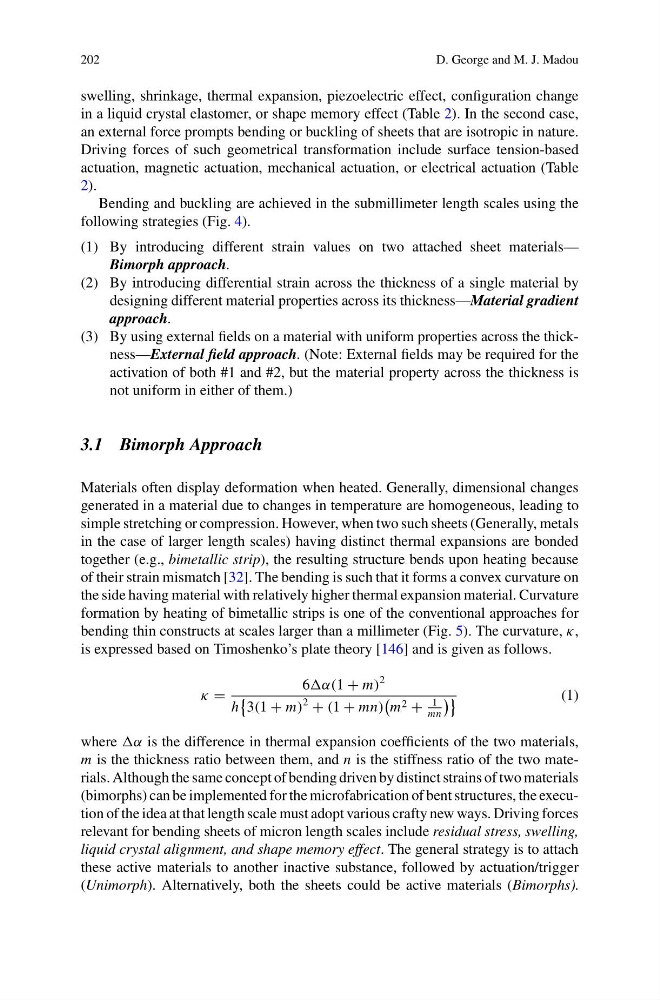
is expressed based on Timoshenko’s plate theory [146] and is given as follows.
κ =
6α(1 + m)
2
h
3(1 + m)
2
+ (1 + mn)
m 2 +
1
mn
(1)
where α is the difference in thermal expansion coefficients of the two materials,
m is the thickness ratio between them, and n is the stiffness ratio of the two materials. Although the same concept of bending driven by distinct strains of two materials
(bimorphs) can be implemented for the microfabrication of bent structures, the execution of the idea at that length scale must adopt various crafty new ways. Driving forces
relevant for bending sheets of micron length scales include residual stress, swelling,
liquid crystal alignment, and shape memory effect. The general strategy is to attach
these active materials to another inactive substance, followed by actuation/trigger
(Unimorph). Alternatively, both the sheets could be active materials (Bimorphs).
D. George and M. J. Madou
swelling, shrinkage, thermal expansion, piezoelectric effect, configuration change
in a liquid crystal elastomer, or shape memory effect (Table 2). In the second case,
an external force prompts bending or buckling of sheets that are isotropic in nature.
Driving forces of such geometrical transformation include surface tension-based
actuation, magnetic actuation, mechanical actuation, or electrical actuation (Table
2).
Bending and buckling are achieved in the submillimeter length scales using the
following strategies (Fig. 4).
(1) By introducing different strain values on two attached sheet materials—
Bimorph approach.
(2) By introducing differential strain across the thickness of a single material by
designing different material properties across its thickness—Material gradient
approach.
(3) By using external fields on a material with uniform properties across the thickness—External field approach. (Note: External fields may be required for the
activation of both #1 and #2, but the material property across the thickness is
not uniform in either of them.)
3.1 Bimorph Approach
Materials often display deformation when heated. Generally, dimensional changes
generated in a material due to changes in temperature are homogeneous, leading to
simple stretching or compression. However, when two such sheets (Generally, metals
in the case of larger length scales) having distinct thermal expansions are bonded
together (e.g., bimetallic strip), the resulting structure bends upon heating because
of their strain mismatch [32]. The bending is such that it forms a convex curvature on
the side having material with relatively higher thermal expansion material. Curvature
formation by heating of bimetallic strips is one of the conventional approaches for
bending thin constructs at scales larger than a millimeter (Fig. 5). The curvature, κ,
is expressed based on Timoshenko’s plate theory [146] and is given as follows.
κ =
6α(1 + m)
2
h
3(1 + m)
2
+ (1 + mn)
m 2 +
1
mn
(1)
where α is the difference in thermal expansion coefficients of the two materials,
m is the thickness ratio between them, and n is the stiffness ratio of the two materials. Although the same concept of bending driven by distinct strains of two materials
(bimorphs) can be implemented for the microfabrication of bent structures, the execution of the idea at that length scale must adopt various crafty new ways. Driving forces
relevant for bending sheets of micron length scales include residual stress, swelling,
liquid crystal alignment, and shape memory effect. The general strategy is to attach
these active materials to another inactive substance, followed by actuation/trigger
(Unimorph). Alternatively, both the sheets could be active materials (Bimorphs).