

Origami MEMS
199
excluded here (details on the technique can be found in Hong et al. [53]). What we
do focus on here are sheets other than paper for micro-sized origami.
2 Fabrication of Precursor Thin Sheets for Submillimeter
Origami
Fabrication methods, including photolithography, direct writing, and sheet cutting,
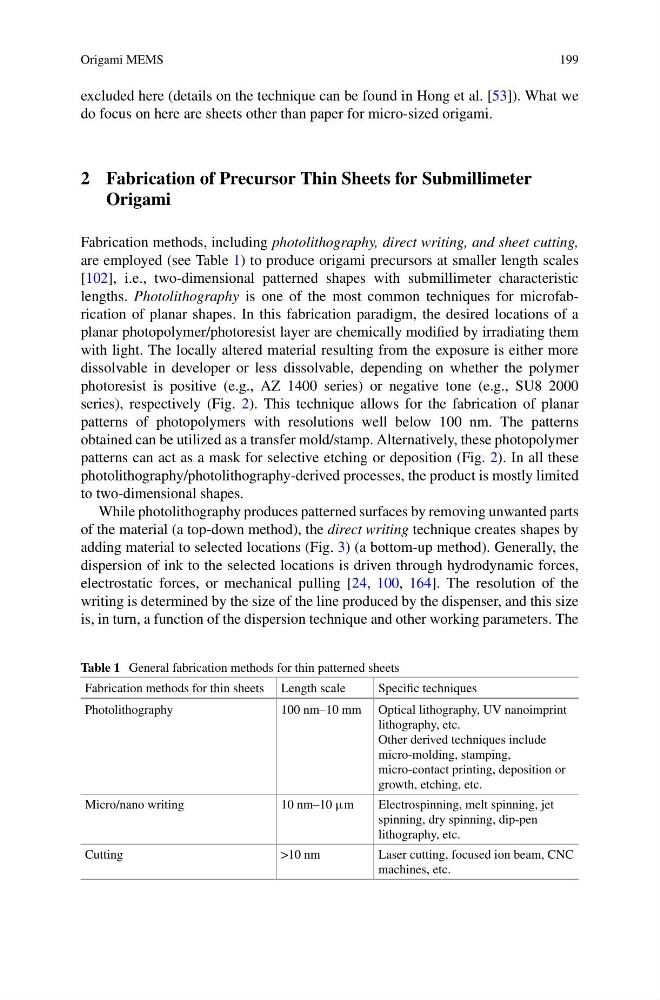
are employed (see Table 1) to produce origami precursors at smaller length scales
[102], i.e., two-dimensional patterned shapes with submillimeter characteristic
lengths. Photolithography is one of the most common techniques for microfabrication of planar shapes. In this fabrication paradigm, the desired locations of a
planar photopolymer/photoresist layer are chemically modified by irradiating them
with light. The locally altered material resulting from the exposure is either more
dissolvable in developer or less dissolvable, depending on whether the polymer
photoresist is positive (e.g., AZ 1400 series) or negative tone (e.g., SU8 2000
series), respectively (Fig. 2). This technique allows for the fabrication of planar
patterns of photopolymers with resolutions well below 100 nm. The patterns
obtained can be utilized as a transfer mold/stamp. Alternatively, these photopolymer
patterns can act as a mask for selective etching or deposition (Fig. 2). In all these
photolithography/photolithography-derived processes, the product is mostly limited
to two-dimensional shapes.
While photolithography produces patterned surfaces by removing unwanted parts
of the material (a top-down method), the direct writing technique creates shapes by
adding material to selected locations (Fig. 3) (a bottom-up method). Generally, the
dispersion of ink to the selected locations is driven through hydrodynamic forces,
electrostatic forces, or mechanical pulling [24, 100, 164]. The resolution of the
writing is determined by the size of the line produced by the dispenser, and this size
is, in turn, a function of the dispersion technique and other working parameters. The
Table 1 General fabrication methods for thin patterned sheets
Fabrication methods for thin sheets Length scale
Specific techniques
Photolithography
100 nm–10 mm Optical lithography, UV nanoimprint
lithography, etc.
Other derived techniques include
micro-molding, stamping,
micro-contact printing, deposition or
growth, etching, etc.
Micro/nano writing
10 nm–10 µm
Electrospinning, melt spinning, jet
spinning, dry spinning, dip-pen
lithography, etc.
Cutting
>10 nm
Laser cutting, focused ion beam, CNC
machines, etc.
199
excluded here (details on the technique can be found in Hong et al. [53]). What we
do focus on here are sheets other than paper for micro-sized origami.
2 Fabrication of Precursor Thin Sheets for Submillimeter
Origami
Fabrication methods, including photolithography, direct writing, and sheet cutting,
are employed (see Table 1) to produce origami precursors at smaller length scales
[102], i.e., two-dimensional patterned shapes with submillimeter characteristic
lengths. Photolithography is one of the most common techniques for microfabrication of planar shapes. In this fabrication paradigm, the desired locations of a
planar photopolymer/photoresist layer are chemically modified by irradiating them
with light. The locally altered material resulting from the exposure is either more
dissolvable in developer or less dissolvable, depending on whether the polymer
photoresist is positive (e.g., AZ 1400 series) or negative tone (e.g., SU8 2000
series), respectively (Fig. 2). This technique allows for the fabrication of planar
patterns of photopolymers with resolutions well below 100 nm. The patterns
obtained can be utilized as a transfer mold/stamp. Alternatively, these photopolymer
patterns can act as a mask for selective etching or deposition (Fig. 2). In all these
photolithography/photolithography-derived processes, the product is mostly limited
to two-dimensional shapes.
While photolithography produces patterned surfaces by removing unwanted parts
of the material (a top-down method), the direct writing technique creates shapes by
adding material to selected locations (Fig. 3) (a bottom-up method). Generally, the
dispersion of ink to the selected locations is driven through hydrodynamic forces,
electrostatic forces, or mechanical pulling [24, 100, 164]. The resolution of the
writing is determined by the size of the line produced by the dispenser, and this size
is, in turn, a function of the dispersion technique and other working parameters. The
Table 1 General fabrication methods for thin patterned sheets
Fabrication methods for thin sheets Length scale
Specific techniques
Photolithography
100 nm–10 mm Optical lithography, UV nanoimprint
lithography, etc.
Other derived techniques include
micro-molding, stamping,
micro-contact printing, deposition or
growth, etching, etc.
Micro/nano writing
10 nm–10 µm
Electrospinning, melt spinning, jet
spinning, dry spinning, dip-pen
lithography, etc.
Cutting
>10 nm
Laser cutting, focused ion beam, CNC
machines, etc.