

198
D. George and M. J. Madou
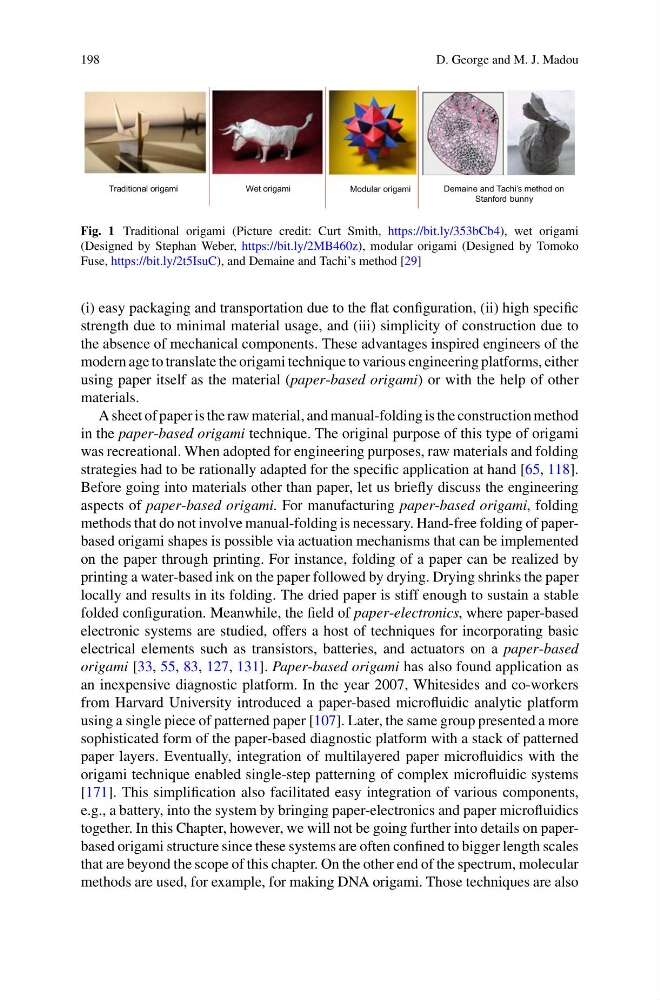
Traditional origami
Wet origami
Modular origami
Demaine and Tachi’s method on
Stanford bunny
Fig. 1 Traditional origami (Picture credit: Curt Smith, https://bit.ly/353bCb4), wet origami
(Designed by Stephan Weber, https://bit.ly/2MB460z), modular origami (Designed by Tomoko
Fuse, https://bit.ly/2t5IsuC), and Demaine and Tachi’s method [29]
(i) easy packaging and transportation due to the flat configuration, (ii) high specific
strength due to minimal material usage, and (iii) simplicity of construction due to
the absence of mechanical components. These advantages inspired engineers of the
modern age to translate the origami technique to various engineering platforms, either
using paper itself as the material (paper-based origami) or with the help of other
materials.
A sheet of paper is the raw material, and manual-folding is the construction method
in the paper-based origami technique. The original purpose of this type of origami
was recreational. When adopted for engineering purposes, raw materials and folding
strategies had to be rationally adapted for the specific application at hand [65, 118].
Before going into materials other than paper, let us briefly discuss the engineering
aspects of paper-based origami. For manufacturing paper-based origami, folding
methods that do not involve manual-folding is necessary. Hand-free folding of paperbased origami shapes is possible via actuation mechanisms that can be implemented
on the paper through printing. For instance, folding of a paper can be realized by
printing a water-based ink on the paper followed by drying. Drying shrinks the paper
locally and results in its folding. The dried paper is stiff enough to sustain a stable
folded configuration. Meanwhile, the field of paper-electronics, where paper-based
electronic systems are studied, offers a host of techniques for incorporating basic
electrical elements such as transistors, batteries, and actuators on a paper-based
origami [33, 55, 83, 127, 131]. Paper-based origami has also found application as
an inexpensive diagnostic platform. In the year 2007, Whitesides and co-workers
from Harvard University introduced a paper-based microfluidic analytic platform
using a single piece of patterned paper [107]. Later, the same group presented a more
sophisticated form of the paper-based diagnostic platform with a stack of patterned
paper layers. Eventually, integration of multilayered paper microfluidics with the
origami technique enabled single-step patterning of complex microfluidic systems
[171]. This simplification also facilitated easy integration of various components,
e.g., a battery, into the system by bringing paper-electronics and paper microfluidics
together. In this Chapter, however, we will not be going further into details on paperbased origami structure since these systems are often confined to bigger length scales
that are beyond the scope of this chapter. On the other end of the spectrum, molecular
methods are used, for example, for making DNA origami. Those techniques are also
D. George and M. J. Madou
Traditional origami
Wet origami
Modular origami
Demaine and Tachi’s method on
Stanford bunny
Fig. 1 Traditional origami (Picture credit: Curt Smith, https://bit.ly/353bCb4), wet origami
(Designed by Stephan Weber, https://bit.ly/2MB460z), modular origami (Designed by Tomoko
Fuse, https://bit.ly/2t5IsuC), and Demaine and Tachi’s method [29]
(i) easy packaging and transportation due to the flat configuration, (ii) high specific
strength due to minimal material usage, and (iii) simplicity of construction due to
the absence of mechanical components. These advantages inspired engineers of the
modern age to translate the origami technique to various engineering platforms, either
using paper itself as the material (paper-based origami) or with the help of other
materials.
A sheet of paper is the raw material, and manual-folding is the construction method
in the paper-based origami technique. The original purpose of this type of origami
was recreational. When adopted for engineering purposes, raw materials and folding
strategies had to be rationally adapted for the specific application at hand [65, 118].
Before going into materials other than paper, let us briefly discuss the engineering
aspects of paper-based origami. For manufacturing paper-based origami, folding
methods that do not involve manual-folding is necessary. Hand-free folding of paperbased origami shapes is possible via actuation mechanisms that can be implemented
on the paper through printing. For instance, folding of a paper can be realized by
printing a water-based ink on the paper followed by drying. Drying shrinks the paper
locally and results in its folding. The dried paper is stiff enough to sustain a stable
folded configuration. Meanwhile, the field of paper-electronics, where paper-based
electronic systems are studied, offers a host of techniques for incorporating basic
electrical elements such as transistors, batteries, and actuators on a paper-based
origami [33, 55, 83, 127, 131]. Paper-based origami has also found application as
an inexpensive diagnostic platform. In the year 2007, Whitesides and co-workers
from Harvard University introduced a paper-based microfluidic analytic platform
using a single piece of patterned paper [107]. Later, the same group presented a more
sophisticated form of the paper-based diagnostic platform with a stack of patterned
paper layers. Eventually, integration of multilayered paper microfluidics with the
origami technique enabled single-step patterning of complex microfluidic systems
[171]. This simplification also facilitated easy integration of various components,
e.g., a battery, into the system by bringing paper-electronics and paper microfluidics
together. In this Chapter, however, we will not be going further into details on paperbased origami structure since these systems are often confined to bigger length scales
that are beyond the scope of this chapter. On the other end of the spectrum, molecular
methods are used, for example, for making DNA origami. Those techniques are also