

174
V. Laxmi et al.
the inlet port by whole blood and absorption of air due to low-pressure environment.
Blood passes over the filter trench and owing to the sedimentation process plasma is
extracted. Subsequently, plasma protein can be detected in the detection zone having
pre-immobilized proteins capture. The device was used for successful detection of
fluorescently labeled biotin.
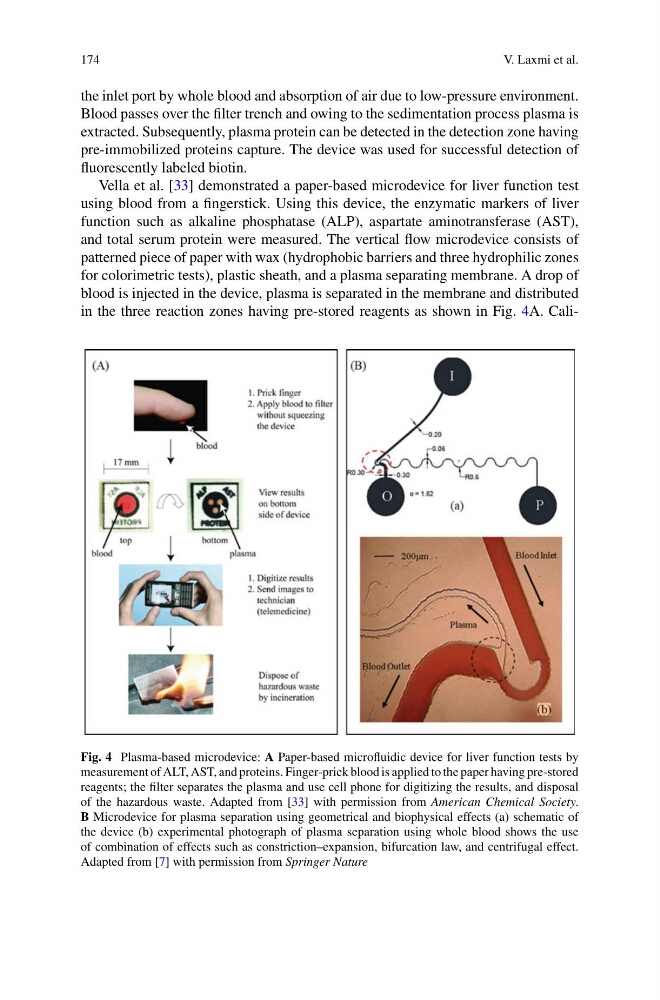
Vella et al. [33] demonstrated a paper-based microdevice for liver function test
using blood from a fingerstick. Using this device, the enzymatic markers of liver
function such as alkaline phosphatase (ALP), aspartate aminotransferase (AST),
and total serum protein were measured. The vertical flow microdevice consists of
patterned piece of paper with wax (hydrophobic barriers and three hydrophilic zones
for colorimetric tests), plastic sheath, and a plasma separating membrane. A drop of
blood is injected in the device, plasma is separated in the membrane and distributed
in the three reaction zones having pre-stored reagents as shown in Fig. 4A. CaliFig. 4 Plasma-based microdevice: A Paper-based microfluidic device for liver function tests by
measurement of ALT, AST, and proteins. Finger-prick blood is applied to the paper having pre-stored
reagents; the filter separates the plasma and use cell phone for digitizing the results, and disposal
of the hazardous waste. Adapted from [33] with permission from American Chemical Society.
B Microdevice for plasma separation using geometrical and biophysical effects (a) schematic of
the device (b) experimental photograph of plasma separation using whole blood shows the use
of combination of effects such as constriction–expansion, bifurcation law, and centrifugal effect.
Adapted from [7] with permission from Springer Nature
V. Laxmi et al.
the inlet port by whole blood and absorption of air due to low-pressure environment.
Blood passes over the filter trench and owing to the sedimentation process plasma is
extracted. Subsequently, plasma protein can be detected in the detection zone having
pre-immobilized proteins capture. The device was used for successful detection of
fluorescently labeled biotin.
Vella et al. [33] demonstrated a paper-based microdevice for liver function test
using blood from a fingerstick. Using this device, the enzymatic markers of liver
function such as alkaline phosphatase (ALP), aspartate aminotransferase (AST),
and total serum protein were measured. The vertical flow microdevice consists of
patterned piece of paper with wax (hydrophobic barriers and three hydrophilic zones
for colorimetric tests), plastic sheath, and a plasma separating membrane. A drop of
blood is injected in the device, plasma is separated in the membrane and distributed
in the three reaction zones having pre-stored reagents as shown in Fig. 4A. CaliFig. 4 Plasma-based microdevice: A Paper-based microfluidic device for liver function tests by
measurement of ALT, AST, and proteins. Finger-prick blood is applied to the paper having pre-stored
reagents; the filter separates the plasma and use cell phone for digitizing the results, and disposal
of the hazardous waste. Adapted from [33] with permission from American Chemical Society.
B Microdevice for plasma separation using geometrical and biophysical effects (a) schematic of
the device (b) experimental photograph of plasma separation using whole blood shows the use
of combination of effects such as constriction–expansion, bifurcation law, and centrifugal effect.
Adapted from [7] with permission from Springer Nature