

Fluid Dynamics in Deformable Microchannels
165
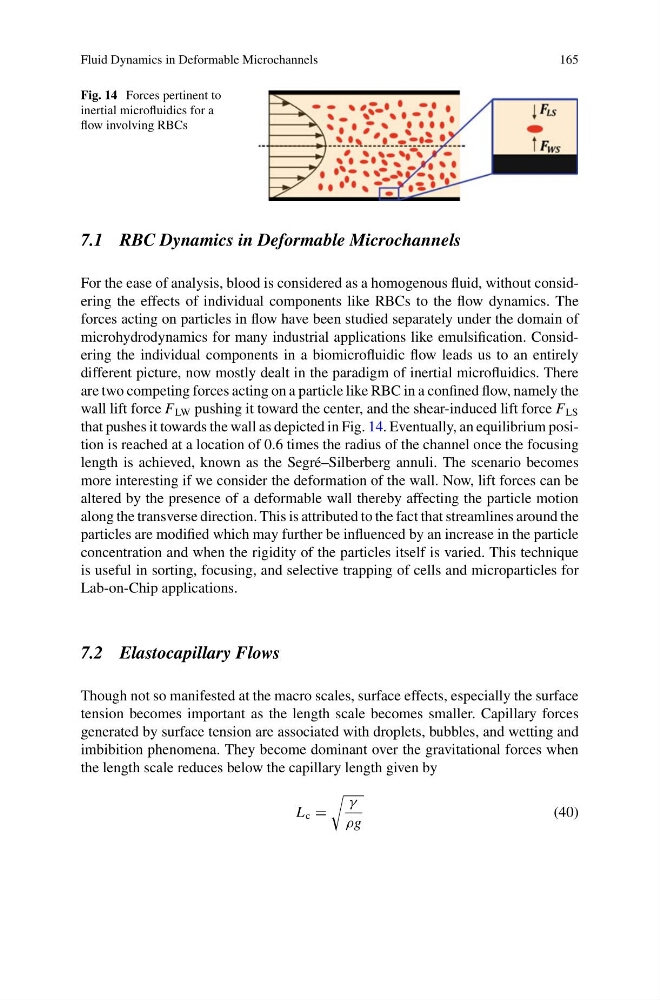
Fig. 14 Forces pertinent to
inertial microfluidics for a
flow involving RBCs
7.1 RBC Dynamics in Deformable Microchannels
For the ease of analysis, blood is considered as a homogenous fluid, without considering the effects of individual components like RBCs to the flow dynamics. The
forces acting on particles in flow have been studied separately under the domain of
microhydrodynamics for many industrial applications like emulsification. Considering the individual components in a biomicrofluidic flow leads us to an entirely
different picture, now mostly dealt in the paradigm of inertial microfluidics. There
are two competing forces acting on a particle like RBC in a confined flow, namely the
wall lift force F LW pushing it toward the center, and the shear-induced lift force F LS
that pushes it towards the wall as depicted in Fig. 14. Eventually, an equilibrium position is reached at a location of 0.6 times the radius of the channel once the focusing
length is achieved, known as the Segré–Silberberg annuli. The scenario becomes
more interesting if we consider the deformation of the wall. Now, lift forces can be
altered by the presence of a deformable wall thereby affecting the particle motion
along the transverse direction. This is attributed to the fact that streamlines around the
particles are modified which may further be influenced by an increase in the particle
concentration and when the rigidity of the particles itself is varied. This technique
is useful in sorting, focusing, and selective trapping of cells and microparticles for
Lab-on-Chip applications.
7.2 Elastocapillary Flows
Though not so manifested at the macro scales, surface effects, especially the surface
tension becomes important as the length scale becomes smaller. Capillary forces
generated by surface tension are associated with droplets, bubbles, and wetting and
imbibition phenomena. They become dominant over the gravitational forces when
the length scale reduces below the capillary length given by
L c =
γ
ρg
(40)
165
Fig. 14 Forces pertinent to
inertial microfluidics for a
flow involving RBCs
7.1 RBC Dynamics in Deformable Microchannels
For the ease of analysis, blood is considered as a homogenous fluid, without considering the effects of individual components like RBCs to the flow dynamics. The
forces acting on particles in flow have been studied separately under the domain of
microhydrodynamics for many industrial applications like emulsification. Considering the individual components in a biomicrofluidic flow leads us to an entirely
different picture, now mostly dealt in the paradigm of inertial microfluidics. There
are two competing forces acting on a particle like RBC in a confined flow, namely the
wall lift force F LW pushing it toward the center, and the shear-induced lift force F LS
that pushes it towards the wall as depicted in Fig. 14. Eventually, an equilibrium position is reached at a location of 0.6 times the radius of the channel once the focusing
length is achieved, known as the Segré–Silberberg annuli. The scenario becomes
more interesting if we consider the deformation of the wall. Now, lift forces can be
altered by the presence of a deformable wall thereby affecting the particle motion
along the transverse direction. This is attributed to the fact that streamlines around the
particles are modified which may further be influenced by an increase in the particle
concentration and when the rigidity of the particles itself is varied. This technique
is useful in sorting, focusing, and selective trapping of cells and microparticles for
Lab-on-Chip applications.
7.2 Elastocapillary Flows
Though not so manifested at the macro scales, surface effects, especially the surface
tension becomes important as the length scale becomes smaller. Capillary forces
generated by surface tension are associated with droplets, bubbles, and wetting and
imbibition phenomena. They become dominant over the gravitational forces when
the length scale reduces below the capillary length given by
L c =
γ
ρg
(40)