

164
M. Kiran Raj and S. Chakraborty
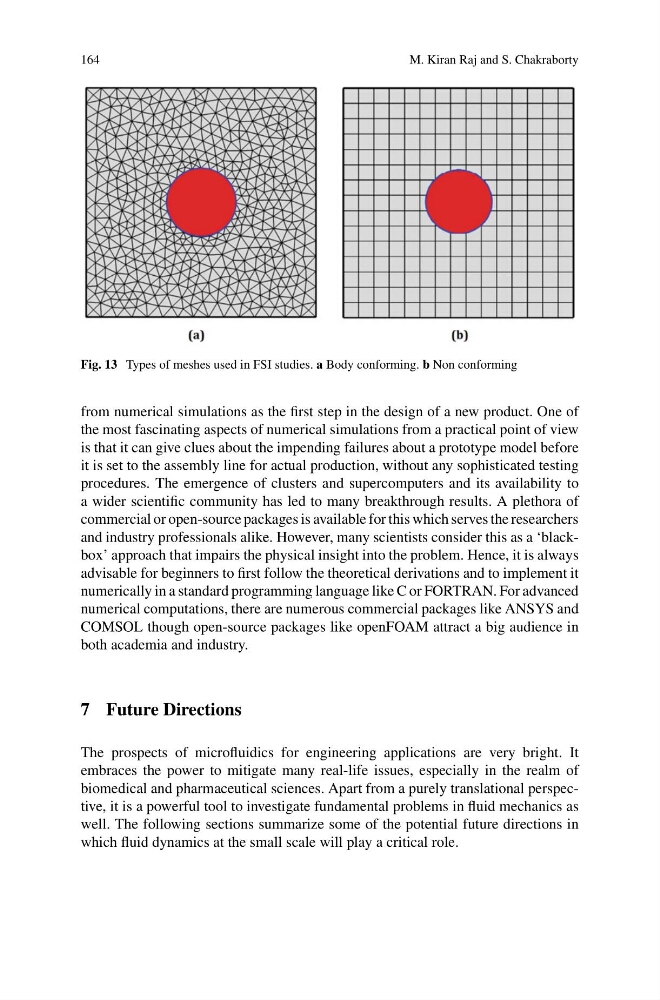
Fig. 13 Types of meshes used in FSI studies. a Body conforming. b Non conforming
from numerical simulations as the first step in the design of a new product. One of
the most fascinating aspects of numerical simulations from a practical point of view
is that it can give clues about the impending failures about a prototype model before
it is set to the assembly line for actual production, without any sophisticated testing
procedures. The emergence of clusters and supercomputers and its availability to
a wider scientific community has led to many breakthrough results. A plethora of
commercial or open-source packages is available for this which serves the researchers
and industry professionals alike. However, many scientists consider this as a ‘blackbox’ approach that impairs the physical insight into the problem. Hence, it is always
advisable for beginners to first follow the theoretical derivations and to implement it
numerically in a standard programming language like C or FORTRAN. For advanced
numerical computations, there are numerous commercial packages like ANSYS and
COMSOL though open-source packages like openFOAM attract a big audience in
both academia and industry.
7 Future Directions
The prospects of microfluidics for engineering applications are very bright. It
embraces the power to mitigate many real-life issues, especially in the realm of
biomedical and pharmaceutical sciences. Apart from a purely translational perspective, it is a powerful tool to investigate fundamental problems in fluid mechanics as
well. The following sections summarize some of the potential future directions in
which fluid dynamics at the small scale will play a critical role.
M. Kiran Raj and S. Chakraborty
Fig. 13 Types of meshes used in FSI studies. a Body conforming. b Non conforming
from numerical simulations as the first step in the design of a new product. One of
the most fascinating aspects of numerical simulations from a practical point of view
is that it can give clues about the impending failures about a prototype model before
it is set to the assembly line for actual production, without any sophisticated testing
procedures. The emergence of clusters and supercomputers and its availability to
a wider scientific community has led to many breakthrough results. A plethora of
commercial or open-source packages is available for this which serves the researchers
and industry professionals alike. However, many scientists consider this as a ‘blackbox’ approach that impairs the physical insight into the problem. Hence, it is always
advisable for beginners to first follow the theoretical derivations and to implement it
numerically in a standard programming language like C or FORTRAN. For advanced
numerical computations, there are numerous commercial packages like ANSYS and
COMSOL though open-source packages like openFOAM attract a big audience in
both academia and industry.
7 Future Directions
The prospects of microfluidics for engineering applications are very bright. It
embraces the power to mitigate many real-life issues, especially in the realm of
biomedical and pharmaceutical sciences. Apart from a purely translational perspective, it is a powerful tool to investigate fundamental problems in fluid mechanics as
well. The following sections summarize some of the potential future directions in
which fluid dynamics at the small scale will play a critical role.