

158
M. Kiran Raj and S. Chakraborty
4.3 Special Case of Non-Newtonian Fluids
To realize the full potential of mimicking the blood vessels, it is important to consider
the fluid and its constituents. As it is well established in the scientific literature, the
whole blood consists of a myriad of components like blood cells and platelets and
thus cannot be simply approximated as a Newtonian fluid. These components can
alter the very nature of the flow itself. In blood, this is mostly dictated by RBCs, which
forms the major portion of the volume fraction (also known as the Hematocrit). As an
elementary analysis, blood is considered as a shear-thinning liquid where the apparent
viscosity is expressed as a function of the applied shear rate as μ = m( ˙
γ )
n−1 where
m = 3–4 mPas and n = 0.5–0.8. Note that, in a cylindrical channel, it modifies the
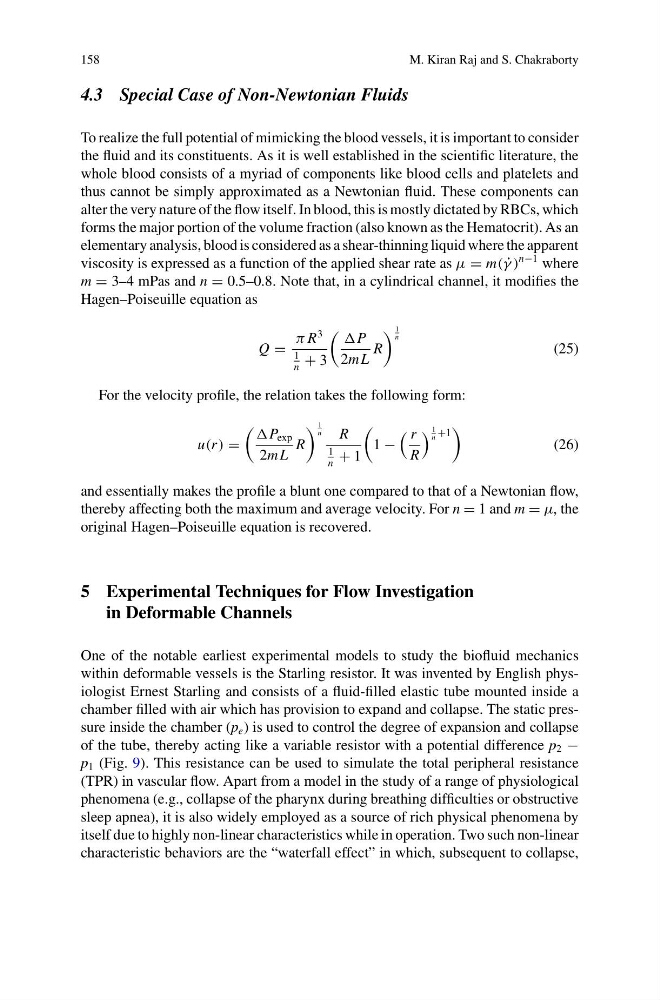
Hagen–Poiseuille equation as
Q =
π R
3
1
n
+ 3
P
2m L
R
1
n
(25)
For the velocity profile, the relation takes the following form:
u(r ) =
P exp
2m L
R
1
n
R
1
n
+ 1
1 −
r
R
1
n +1
(26)
and essentially makes the profile a blunt one compared to that of a Newtonian flow,
thereby affecting both the maximum and average velocity. For n = 1 and m = μ, the
original Hagen–Poiseuille equation is recovered.
5 Experimental Techniques for Flow Investigation
in Deformable Channels
One of the notable earliest experimental models to study the biofluid mechanics
within deformable vessels is the Starling resistor. It was invented by English physiologist Ernest Starling and consists of a fluid-filled elastic tube mounted inside a
chamber filled with air which has provision to expand and collapse. The static pressure inside the chamber (p e ) is used to control the degree of expansion and collapse
of the tube, thereby acting like a variable resistor with a potential difference p 2 −
p 1 (Fig. 9). This resistance can be used to simulate the total peripheral resistance
(TPR) in vascular flow. Apart from a model in the study of a range of physiological
phenomena (e.g., collapse of the pharynx during breathing difficulties or obstructive
sleep apnea), it is also widely employed as a source of rich physical phenomena by
itself due to highly non-linear characteristics while in operation. Two such non-linear
characteristic behaviors are the “waterfall effect” in which, subsequent to collapse,
M. Kiran Raj and S. Chakraborty
4.3 Special Case of Non-Newtonian Fluids
To realize the full potential of mimicking the blood vessels, it is important to consider
the fluid and its constituents. As it is well established in the scientific literature, the
whole blood consists of a myriad of components like blood cells and platelets and
thus cannot be simply approximated as a Newtonian fluid. These components can
alter the very nature of the flow itself. In blood, this is mostly dictated by RBCs, which
forms the major portion of the volume fraction (also known as the Hematocrit). As an
elementary analysis, blood is considered as a shear-thinning liquid where the apparent
viscosity is expressed as a function of the applied shear rate as μ = m( ˙
γ )
n−1 where
m = 3–4 mPas and n = 0.5–0.8. Note that, in a cylindrical channel, it modifies the
Hagen–Poiseuille equation as
Q =
π R
3
1
n
+ 3
P
2m L
R
1
n
(25)
For the velocity profile, the relation takes the following form:
u(r ) =
P exp
2m L
R
1
n
R
1
n
+ 1
1 −
r
R
1
n +1
(26)
and essentially makes the profile a blunt one compared to that of a Newtonian flow,
thereby affecting both the maximum and average velocity. For n = 1 and m = μ, the
original Hagen–Poiseuille equation is recovered.
5 Experimental Techniques for Flow Investigation
in Deformable Channels
One of the notable earliest experimental models to study the biofluid mechanics
within deformable vessels is the Starling resistor. It was invented by English physiologist Ernest Starling and consists of a fluid-filled elastic tube mounted inside a
chamber filled with air which has provision to expand and collapse. The static pressure inside the chamber (p e ) is used to control the degree of expansion and collapse
of the tube, thereby acting like a variable resistor with a potential difference p 2 −
p 1 (Fig. 9). This resistance can be used to simulate the total peripheral resistance
(TPR) in vascular flow. Apart from a model in the study of a range of physiological
phenomena (e.g., collapse of the pharynx during breathing difficulties or obstructive
sleep apnea), it is also widely employed as a source of rich physical phenomena by
itself due to highly non-linear characteristics while in operation. Two such non-linear
characteristic behaviors are the “waterfall effect” in which, subsequent to collapse,