

Fluid Dynamics in Deformable Microchannels
159
Fig. 9 Starling resistor with
a chamber pressure of p e
the flow through the tube becomes independent of the downstream pressure and the
self-excited oscillations, both having pronounced implications in the domain of FSI.
5.1 Modern Measurement and Analysis Techniques
With the advancement of technological innovations in instrumentation and imaging,
we have evolved far from pitot tubes for measuring pressure and dyes for visualization. Today, Particle Image Velocimetry (PIV) techniques are used for whole-field
visualization, while pressure drop experiments using piezoelectric sensors and edge
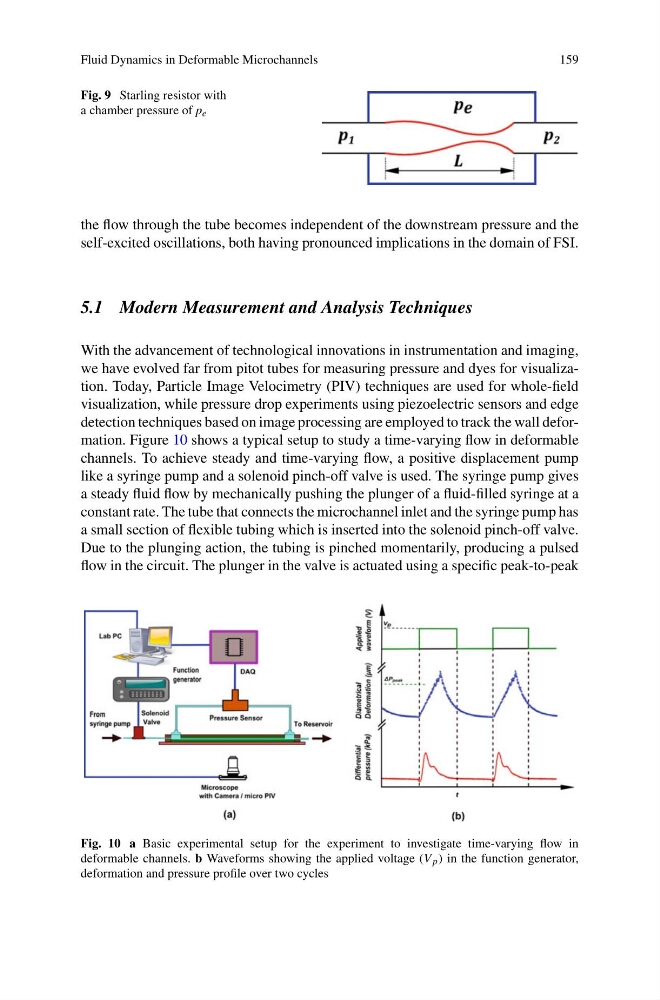
detection techniques based on image processing are employed to track the wall deformation. Figure 10 shows a typical setup to study a time-varying flow in deformable
channels. To achieve steady and time-varying flow, a positive displacement pump
like a syringe pump and a solenoid pinch-off valve is used. The syringe pump gives
a steady fluid flow by mechanically pushing the plunger of a fluid-filled syringe at a
constant rate. The tube that connects the microchannel inlet and the syringe pump has
a small section of flexible tubing which is inserted into the solenoid pinch-off valve.
Due to the plunging action, the tubing is pinched momentarily, producing a pulsed
flow in the circuit. The plunger in the valve is actuated using a specific peak-to-peak
Fig. 10 a Basic experimental setup for the experiment to investigate time-varying flow in
deformable channels. b Waveforms showing the applied voltage (V p ) in the function generator,
deformation and pressure profile over two cycles
159
Fig. 9 Starling resistor with
a chamber pressure of p e
the flow through the tube becomes independent of the downstream pressure and the
self-excited oscillations, both having pronounced implications in the domain of FSI.
5.1 Modern Measurement and Analysis Techniques
With the advancement of technological innovations in instrumentation and imaging,
we have evolved far from pitot tubes for measuring pressure and dyes for visualization. Today, Particle Image Velocimetry (PIV) techniques are used for whole-field
visualization, while pressure drop experiments using piezoelectric sensors and edge
detection techniques based on image processing are employed to track the wall deformation. Figure 10 shows a typical setup to study a time-varying flow in deformable
channels. To achieve steady and time-varying flow, a positive displacement pump
like a syringe pump and a solenoid pinch-off valve is used. The syringe pump gives
a steady fluid flow by mechanically pushing the plunger of a fluid-filled syringe at a
constant rate. The tube that connects the microchannel inlet and the syringe pump has
a small section of flexible tubing which is inserted into the solenoid pinch-off valve.
Due to the plunging action, the tubing is pinched momentarily, producing a pulsed
flow in the circuit. The plunger in the valve is actuated using a specific peak-to-peak
Fig. 10 a Basic experimental setup for the experiment to investigate time-varying flow in
deformable channels. b Waveforms showing the applied voltage (V p ) in the function generator,
deformation and pressure profile over two cycles