

154
M. Kiran Raj and S. Chakraborty
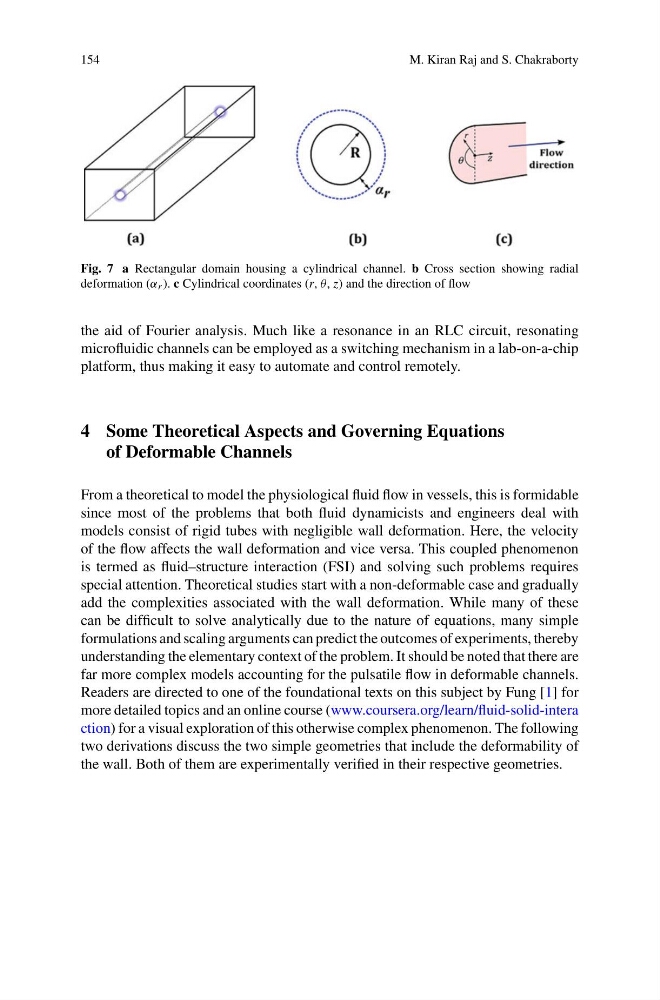
Fig. 7 a Rectangular domain housing a cylindrical channel. b Cross section showing radial
deformation (α r ). c Cylindrical coordinates (r, θ, z) and the direction of flow
the aid of Fourier analysis. Much like a resonance in an RLC circuit, resonating
microfluidic channels can be employed as a switching mechanism in a lab-on-a-chip
platform, thus making it easy to automate and control remotely.
4 Some Theoretical Aspects and Governing Equations
of Deformable Channels
From a theoretical to model the physiological fluid flow in vessels, this is formidable
since most of the problems that both fluid dynamicists and engineers deal with
models consist of rigid tubes with negligible wall deformation. Here, the velocity
of the flow affects the wall deformation and vice versa. This coupled phenomenon
is termed as fluid–structure interaction (FSI) and solving such problems requires
special attention. Theoretical studies start with a non-deformable case and gradually
add the complexities associated with the wall deformation. While many of these
can be difficult to solve analytically due to the nature of equations, many simple
formulations and scaling arguments can predict the outcomes of experiments, thereby
understanding the elementary context of the problem. It should be noted that there are
far more complex models accounting for the pulsatile flow in deformable channels.
Readers are directed to one of the foundational texts on this subject by Fung [1] for
more detailed topics and an online course (www.coursera.org/learn/fluid-solid-intera
ction) for a visual exploration of this otherwise complex phenomenon. The following
two derivations discuss the two simple geometries that include the deformability of
the wall. Both of them are experimentally verified in their respective geometries.
M. Kiran Raj and S. Chakraborty
Fig. 7 a Rectangular domain housing a cylindrical channel. b Cross section showing radial
deformation (α r ). c Cylindrical coordinates (r, θ, z) and the direction of flow
the aid of Fourier analysis. Much like a resonance in an RLC circuit, resonating
microfluidic channels can be employed as a switching mechanism in a lab-on-a-chip
platform, thus making it easy to automate and control remotely.
4 Some Theoretical Aspects and Governing Equations
of Deformable Channels
From a theoretical to model the physiological fluid flow in vessels, this is formidable
since most of the problems that both fluid dynamicists and engineers deal with
models consist of rigid tubes with negligible wall deformation. Here, the velocity
of the flow affects the wall deformation and vice versa. This coupled phenomenon
is termed as fluid–structure interaction (FSI) and solving such problems requires
special attention. Theoretical studies start with a non-deformable case and gradually
add the complexities associated with the wall deformation. While many of these
can be difficult to solve analytically due to the nature of equations, many simple
formulations and scaling arguments can predict the outcomes of experiments, thereby
understanding the elementary context of the problem. It should be noted that there are
far more complex models accounting for the pulsatile flow in deformable channels.
Readers are directed to one of the foundational texts on this subject by Fung [1] for
more detailed topics and an online course (www.coursera.org/learn/fluid-solid-intera
ction) for a visual exploration of this otherwise complex phenomenon. The following
two derivations discuss the two simple geometries that include the deformability of
the wall. Both of them are experimentally verified in their respective geometries.