

Fluid Dynamics in Deformable Microchannels
153
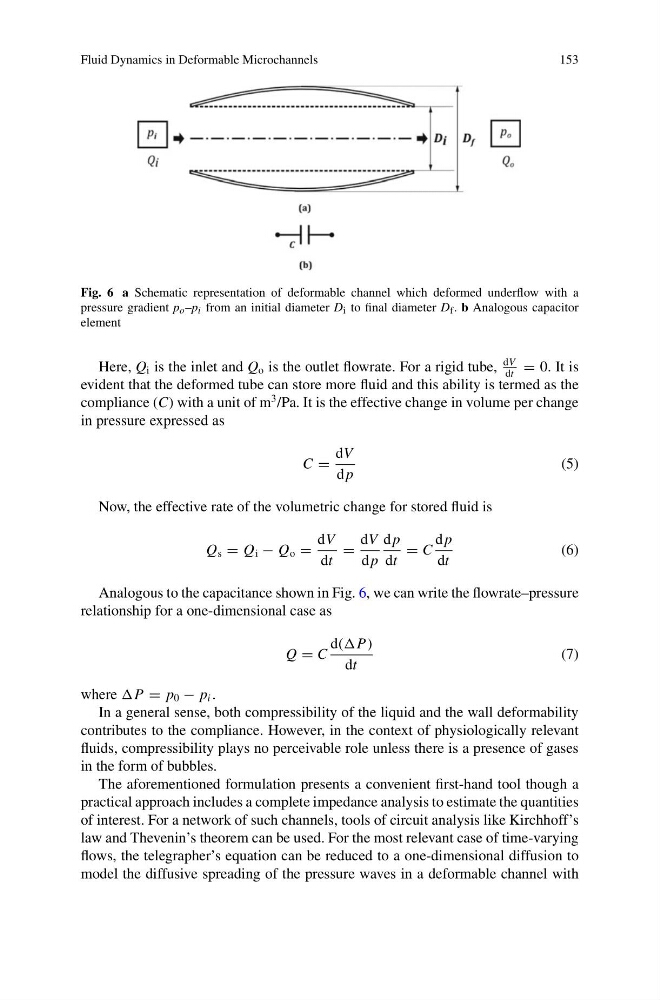
Fig. 6 a Schematic representation of deformable channel which deformed underflow with a
pressure gradient p o –p i from an initial diameter D i to final diameter D f . b Analogous capacitor
element
Here, Q i is the inlet and Q o is the outlet flowrate. For a rigid tube,
dV
dt
= 0. It is
evident that the deformed tube can store more fluid and this ability is termed as the
compliance (C) with a unit of m
3 /Pa. It is the effective change in volume per change
in pressure expressed as
C =
dV
d p
(5)
Now, the effective rate of the volumetric change for stored fluid is
Q s = Q i − Q o =
dV
dt
=
dV
d p
d p
dt
= C
d p
dt
(6)
Analogous to the capacitance shown in Fig. 6, we can write the flowrate–pressure
relationship for a one-dimensional case as
Q = C
d(P)
dt
(7)
where P = p 0 − p i .
In a general sense, both compressibility of the liquid and the wall deformability
contributes to the compliance. However, in the context of physiologically relevant
fluids, compressibility plays no perceivable role unless there is a presence of gases
in the form of bubbles.
The aforementioned formulation presents a convenient first-hand tool though a
practical approach includes a complete impedance analysis to estimate the quantities
of interest. For a network of such channels, tools of circuit analysis like Kirchhoff’s
law and Thevenin’s theorem can be used. For the most relevant case of time-varying
flows, the telegrapher’s equation can be reduced to a one-dimensional diffusion to
model the diffusive spreading of the pressure waves in a deformable channel with
153
Fig. 6 a Schematic representation of deformable channel which deformed underflow with a
pressure gradient p o –p i from an initial diameter D i to final diameter D f . b Analogous capacitor
element
Here, Q i is the inlet and Q o is the outlet flowrate. For a rigid tube,
dV
dt
= 0. It is
evident that the deformed tube can store more fluid and this ability is termed as the
compliance (C) with a unit of m
3 /Pa. It is the effective change in volume per change
in pressure expressed as
C =
dV
d p
(5)
Now, the effective rate of the volumetric change for stored fluid is
Q s = Q i − Q o =
dV
dt
=
dV
d p
d p
dt
= C
d p
dt
(6)
Analogous to the capacitance shown in Fig. 6, we can write the flowrate–pressure
relationship for a one-dimensional case as
Q = C
d(P)
dt
(7)
where P = p 0 − p i .
In a general sense, both compressibility of the liquid and the wall deformability
contributes to the compliance. However, in the context of physiologically relevant
fluids, compressibility plays no perceivable role unless there is a presence of gases
in the form of bubbles.
The aforementioned formulation presents a convenient first-hand tool though a
practical approach includes a complete impedance analysis to estimate the quantities
of interest. For a network of such channels, tools of circuit analysis like Kirchhoff’s
law and Thevenin’s theorem can be used. For the most relevant case of time-varying
flows, the telegrapher’s equation can be reduced to a one-dimensional diffusion to
model the diffusive spreading of the pressure waves in a deformable channel with