

152
M. Kiran Raj and S. Chakraborty
3.3 The Electronic Analogy—Programmable Microfluidic
Networks
One of the fascinating aspects of flow-through channels is its direct analogy with the
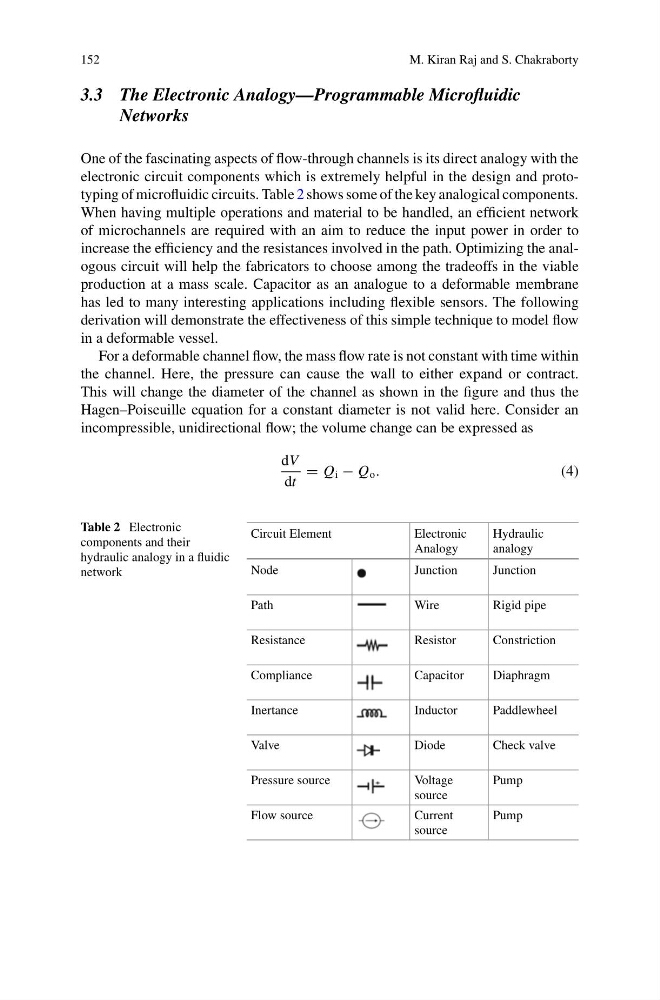
electronic circuit components which is extremely helpful in the design and prototyping of microfluidic circuits. Table 2 shows some of the key analogical components.
When having multiple operations and material to be handled, an efficient network
of microchannels are required with an aim to reduce the input power in order to
increase the efficiency and the resistances involved in the path. Optimizing the analogous circuit will help the fabricators to choose among the tradeoffs in the viable
production at a mass scale. Capacitor as an analogue to a deformable membrane
has led to many interesting applications including flexible sensors. The following
derivation will demonstrate the effectiveness of this simple technique to model flow
in a deformable vessel.
For a deformable channel flow, the mass flow rate is not constant with time within
the channel. Here, the pressure can cause the wall to either expand or contract.
This will change the diameter of the channel as shown in the figure and thus the
Hagen–Poiseuille equation for a constant diameter is not valid here. Consider an
incompressible, unidirectional flow; the volume change can be expressed as
dV
dt
= Q i − Q o .
(4)
Table 2 Electronic
components and their
hydraulic analogy in a fluidic
network
Circuit Element
Electronic
Analogy
Hydraulic
analogy
Node
Junction
Junction
Path
Wire
Rigid pipe
Resistance
Resistor
Constriction
Compliance
Capacitor
Diaphragm
Inertance
Inductor
Paddlewheel
Valve
Diode
Check valve
Pressure source
Voltage
source
Pump
Flow source
Current
source
Pump
M. Kiran Raj and S. Chakraborty
3.3 The Electronic Analogy—Programmable Microfluidic
Networks
One of the fascinating aspects of flow-through channels is its direct analogy with the
electronic circuit components which is extremely helpful in the design and prototyping of microfluidic circuits. Table 2 shows some of the key analogical components.
When having multiple operations and material to be handled, an efficient network
of microchannels are required with an aim to reduce the input power in order to
increase the efficiency and the resistances involved in the path. Optimizing the analogous circuit will help the fabricators to choose among the tradeoffs in the viable
production at a mass scale. Capacitor as an analogue to a deformable membrane
has led to many interesting applications including flexible sensors. The following
derivation will demonstrate the effectiveness of this simple technique to model flow
in a deformable vessel.
For a deformable channel flow, the mass flow rate is not constant with time within
the channel. Here, the pressure can cause the wall to either expand or contract.
This will change the diameter of the channel as shown in the figure and thus the
Hagen–Poiseuille equation for a constant diameter is not valid here. Consider an
incompressible, unidirectional flow; the volume change can be expressed as
dV
dt
= Q i − Q o .
(4)
Table 2 Electronic
components and their
hydraulic analogy in a fluidic
network
Circuit Element
Electronic
Analogy
Hydraulic
analogy
Node
Junction
Junction
Path
Wire
Rigid pipe
Resistance
Resistor
Constriction
Compliance
Capacitor
Diaphragm
Inertance
Inductor
Paddlewheel
Valve
Diode
Check valve
Pressure source
Voltage
source
Pump
Flow source
Current
source
Pump