

Fluid Dynamics in Deformable Microchannels
147
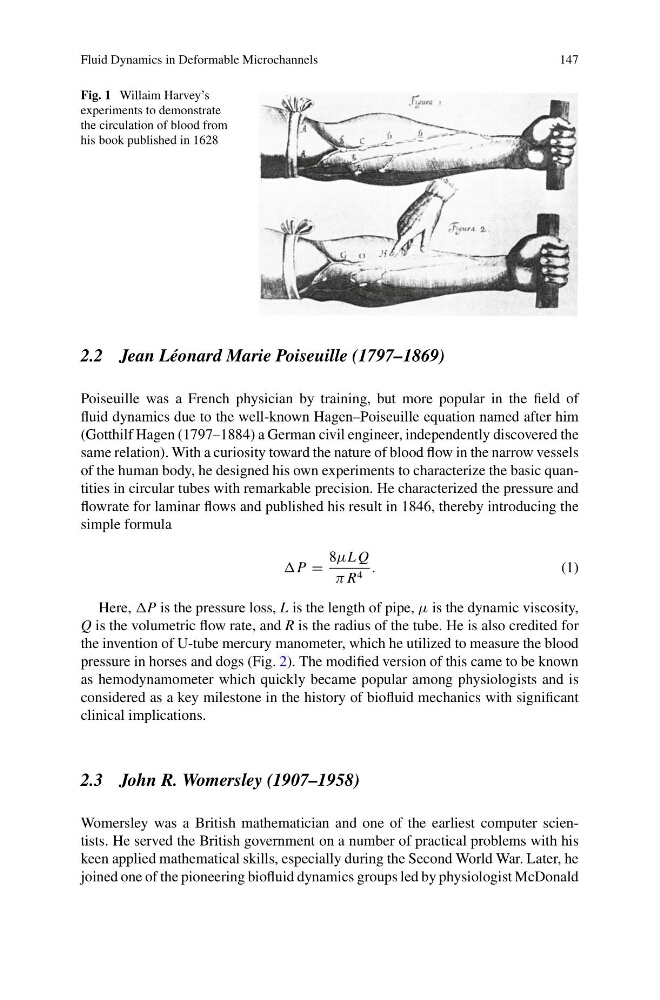
Fig. 1 Willaim Harvey’s
experiments to demonstrate
the circulation of blood from
his book published in 1628
2.2 Jean Léonard Marie Poiseuille (1797–1869)
Poiseuille was a French physician by training, but more popular in the field of
fluid dynamics due to the well-known Hagen–Poiseuille equation named after him
(Gotthilf Hagen (1797–1884) a German civil engineer, independently discovered the
same relation). With a curiosity toward the nature of blood flow in the narrow vessels
of the human body, he designed his own experiments to characterize the basic quantities in circular tubes with remarkable precision. He characterized the pressure and
flowrate for laminar flows and published his result in 1846, thereby introducing the
simple formula
P =
8μL Q
π R 4 .
(1)
Here, P is the pressure loss, L is the length of pipe, μ is the dynamic viscosity,
Q is the volumetric flow rate, and R is the radius of the tube. He is also credited for
the invention of U-tube mercury manometer, which he utilized to measure the blood
pressure in horses and dogs (Fig. 2). The modified version of this came to be known
as hemodynamometer which quickly became popular among physiologists and is
considered as a key milestone in the history of biofluid mechanics with significant
clinical implications.
2.3 John R. Womersley (1907–1958)
Womersley was a British mathematician and one of the earliest computer scientists. He served the British government on a number of practical problems with his
keen applied mathematical skills, especially during the Second World War. Later, he
joined one of the pioneering biofluid dynamics groups led by physiologist McDonald
147
Fig. 1 Willaim Harvey’s
experiments to demonstrate
the circulation of blood from
his book published in 1628
2.2 Jean Léonard Marie Poiseuille (1797–1869)
Poiseuille was a French physician by training, but more popular in the field of
fluid dynamics due to the well-known Hagen–Poiseuille equation named after him
(Gotthilf Hagen (1797–1884) a German civil engineer, independently discovered the
same relation). With a curiosity toward the nature of blood flow in the narrow vessels
of the human body, he designed his own experiments to characterize the basic quantities in circular tubes with remarkable precision. He characterized the pressure and
flowrate for laminar flows and published his result in 1846, thereby introducing the
simple formula
P =
8μL Q
π R 4 .
(1)
Here, P is the pressure loss, L is the length of pipe, μ is the dynamic viscosity,
Q is the volumetric flow rate, and R is the radius of the tube. He is also credited for
the invention of U-tube mercury manometer, which he utilized to measure the blood
pressure in horses and dogs (Fig. 2). The modified version of this came to be known
as hemodynamometer which quickly became popular among physiologists and is
considered as a key milestone in the history of biofluid mechanics with significant
clinical implications.
2.3 John R. Womersley (1907–1958)
Womersley was a British mathematician and one of the earliest computer scientists. He served the British government on a number of practical problems with his
keen applied mathematical skills, especially during the Second World War. Later, he
joined one of the pioneering biofluid dynamics groups led by physiologist McDonald