

146
M. Kiran Raj and S. Chakraborty
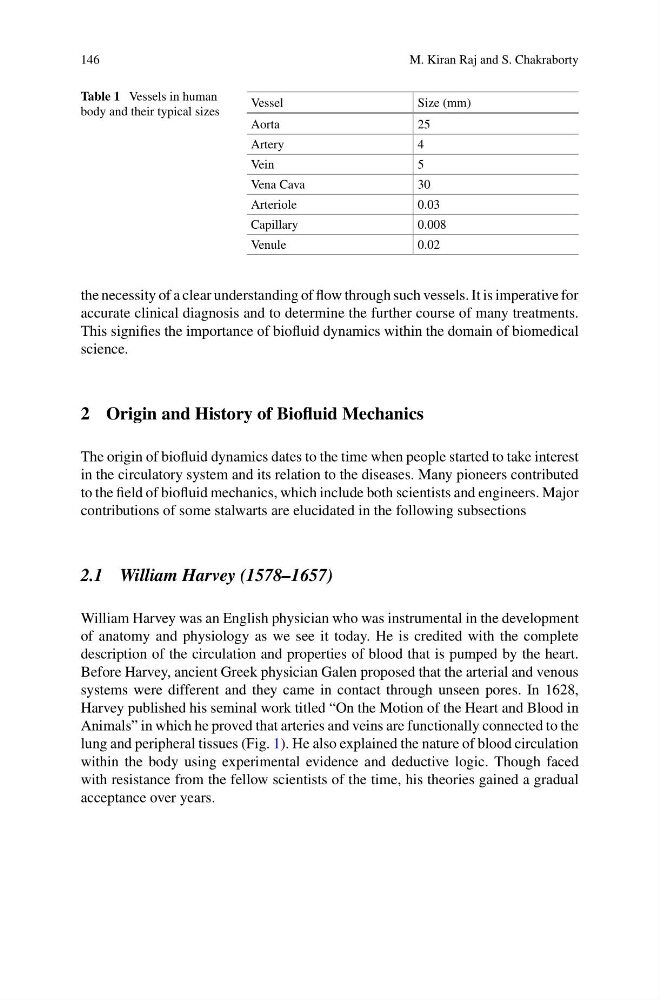
Table 1 Vessels in human
body and their typical sizes
Vessel
Size (mm)
Aorta
25
Artery
4
Vein
5
Vena Cava
30
Arteriole
0.03
Capillary
0.008
Venule
0.02
the necessity of a clear understanding of flow through such vessels. It is imperative for
accurate clinical diagnosis and to determine the further course of many treatments.
This signifies the importance of biofluid dynamics within the domain of biomedical
science.
2 Origin and History of Biofluid Mechanics
The origin of biofluid dynamics dates to the time when people started to take interest
in the circulatory system and its relation to the diseases. Many pioneers contributed
to the field of biofluid mechanics, which include both scientists and engineers. Major
contributions of some stalwarts are elucidated in the following subsections
2.1 William Harvey (1578–1657)
William Harvey was an English physician who was instrumental in the development
of anatomy and physiology as we see it today. He is credited with the complete
description of the circulation and properties of blood that is pumped by the heart.
Before Harvey, ancient Greek physician Galen proposed that the arterial and venous
systems were different and they came in contact through unseen pores. In 1628,
Harvey published his seminal work titled “On the Motion of the Heart and Blood in
Animals” in which he proved that arteries and veins are functionally connected to the
lung and peripheral tissues (Fig. 1). He also explained the nature of blood circulation
within the body using experimental evidence and deductive logic. Though faced
with resistance from the fellow scientists of the time, his theories gained a gradual
acceptance over years.
M. Kiran Raj and S. Chakraborty
Table 1 Vessels in human
body and their typical sizes
Vessel
Size (mm)
Aorta
25
Artery
4
Vein
5
Vena Cava
30
Arteriole
0.03
Capillary
0.008
Venule
0.02
the necessity of a clear understanding of flow through such vessels. It is imperative for
accurate clinical diagnosis and to determine the further course of many treatments.
This signifies the importance of biofluid dynamics within the domain of biomedical
science.
2 Origin and History of Biofluid Mechanics
The origin of biofluid dynamics dates to the time when people started to take interest
in the circulatory system and its relation to the diseases. Many pioneers contributed
to the field of biofluid mechanics, which include both scientists and engineers. Major
contributions of some stalwarts are elucidated in the following subsections
2.1 William Harvey (1578–1657)
William Harvey was an English physician who was instrumental in the development
of anatomy and physiology as we see it today. He is credited with the complete
description of the circulation and properties of blood that is pumped by the heart.
Before Harvey, ancient Greek physician Galen proposed that the arterial and venous
systems were different and they came in contact through unseen pores. In 1628,
Harvey published his seminal work titled “On the Motion of the Heart and Blood in
Animals” in which he proved that arteries and veins are functionally connected to the
lung and peripheral tissues (Fig. 1). He also explained the nature of blood circulation
within the body using experimental evidence and deductive logic. Though faced
with resistance from the fellow scientists of the time, his theories gained a gradual
acceptance over years.