

148
M. Kiran Raj and S. Chakraborty
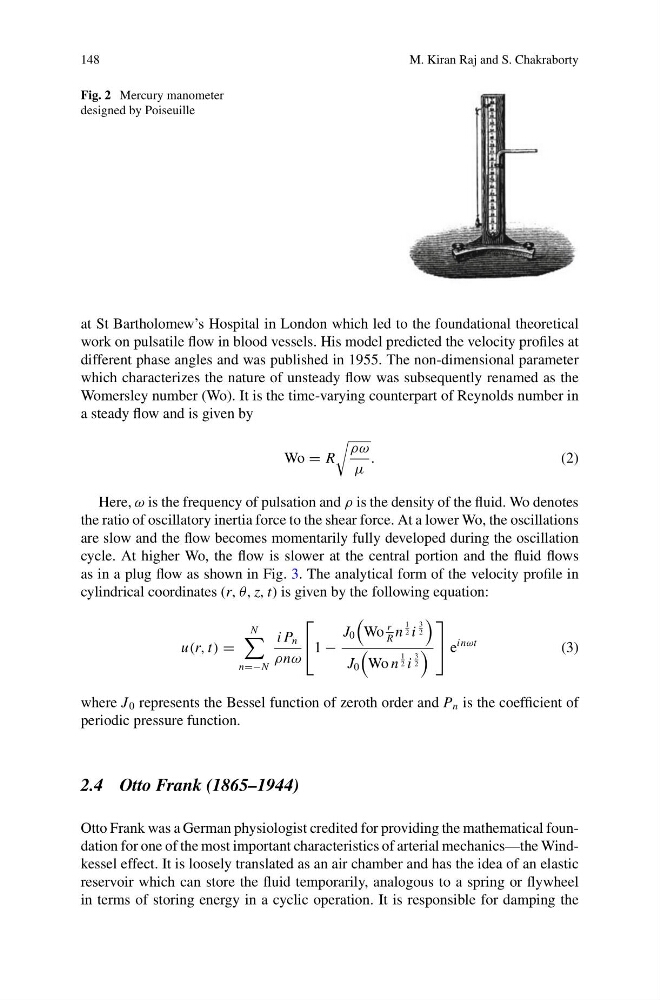
Fig. 2 Mercury manometer
designed by Poiseuille
at St Bartholomew’s Hospital in London which led to the foundational theoretical
work on pulsatile flow in blood vessels. His model predicted the velocity profiles at
different phase angles and was published in 1955. The non-dimensional parameter
which characterizes the nature of unsteady flow was subsequently renamed as the
Womersley number (Wo). It is the time-varying counterpart of Reynolds number in
a steady flow and is given by
Wo = R
ρω
μ
.
(2)
Here, ω is the frequency of pulsation and ρ is the density of the fluid. Wo denotes
the ratio of oscillatory inertia force to the shear force. At a lower Wo, the oscillations
are slow and the flow becomes momentarily fully developed during the oscillation
cycle. At higher Wo, the flow is slower at the central portion and the fluid flows
as in a plug flow as shown in Fig. 3. The analytical form of the velocity profile in
cylindrical coordinates (r, θ, z, t) is given by the following equation:
u(r, t) =
N
n=−N
i P n
ρnω
⎡
⎣ 1 −
J 0
Wo
r
R
n
1
2 i
3
2
J 0
Wo n
1
2 i
3
2
⎤
⎦ e
inωt
(3)
where J 0 represents the Bessel function of zeroth order and P n is the coefficient of
periodic pressure function.
2.4 Otto Frank (1865–1944)
Otto Frank was a German physiologist credited for providing the mathematical foundation for one of the most important characteristics of arterial mechanics—the Windkessel effect. It is loosely translated as an air chamber and has the idea of an elastic
reservoir which can store the fluid temporarily, analogous to a spring or flywheel
in terms of storing energy in a cyclic operation. It is responsible for damping the
M. Kiran Raj and S. Chakraborty
Fig. 2 Mercury manometer
designed by Poiseuille
at St Bartholomew’s Hospital in London which led to the foundational theoretical
work on pulsatile flow in blood vessels. His model predicted the velocity profiles at
different phase angles and was published in 1955. The non-dimensional parameter
which characterizes the nature of unsteady flow was subsequently renamed as the
Womersley number (Wo). It is the time-varying counterpart of Reynolds number in
a steady flow and is given by
Wo = R
ρω
μ
.
(2)
Here, ω is the frequency of pulsation and ρ is the density of the fluid. Wo denotes
the ratio of oscillatory inertia force to the shear force. At a lower Wo, the oscillations
are slow and the flow becomes momentarily fully developed during the oscillation
cycle. At higher Wo, the flow is slower at the central portion and the fluid flows
as in a plug flow as shown in Fig. 3. The analytical form of the velocity profile in
cylindrical coordinates (r, θ, z, t) is given by the following equation:
u(r, t) =
N
n=−N
i P n
ρnω
⎡
⎣ 1 −
J 0
Wo
r
R
n
1
2 i
3
2
J 0
Wo n
1
2 i
3
2
⎤
⎦ e
inωt
(3)
where J 0 represents the Bessel function of zeroth order and P n is the coefficient of
periodic pressure function.
2.4 Otto Frank (1865–1944)
Otto Frank was a German physiologist credited for providing the mathematical foundation for one of the most important characteristics of arterial mechanics—the Windkessel effect. It is loosely translated as an air chamber and has the idea of an elastic
reservoir which can store the fluid temporarily, analogous to a spring or flywheel
in terms of storing energy in a cyclic operation. It is responsible for damping the