

Recent Advances in Free Surface Flows
131
t = 0.01
t
t
t
t
t
t
= 0.25
= 0.50
= 0.75
= 1.0
= 1.25
= 1.75
t = 1.5
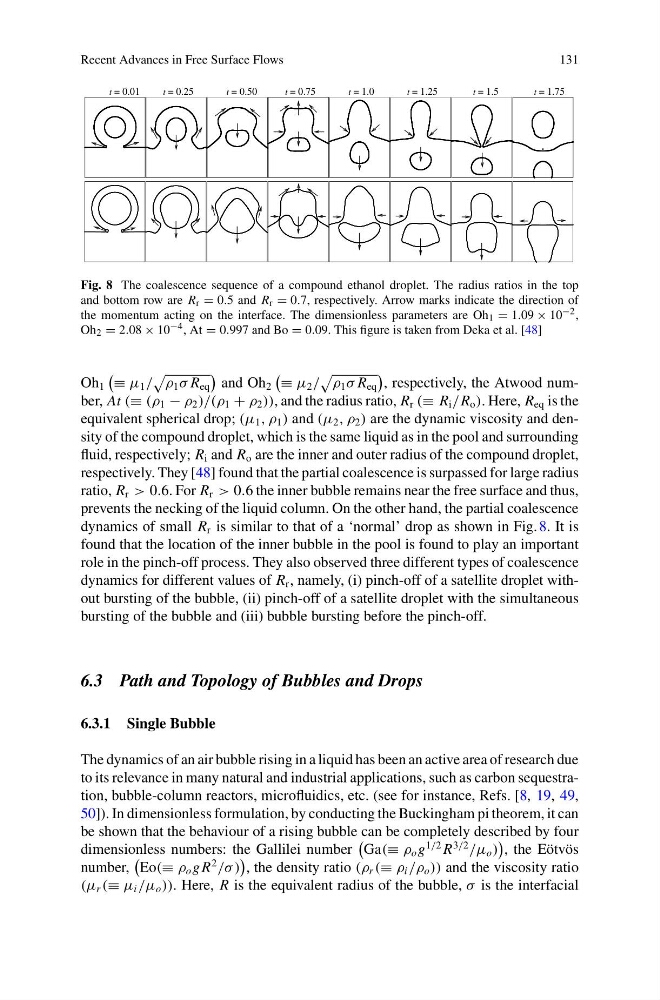
Fig. 8 The coalescence sequence of a compound ethanol droplet. The radius ratios in the top
and bottom row are R r = 0.5 and R r = 0.7, respectively. Arrow marks indicate the direction of
the momentum acting on the interface. The dimensionless parameters are Oh 1 = 1.09 × 10 −2 ,
Oh 2 = 2.08 × 10 −4 , At = 0.997 and Bo = 0.09. This figure is taken from Deka et al. [48]
Oh 1
≡ μ 1 /
ρ 1 σ R eq
and Oh 2
≡ μ 2 /
ρ 1 σ R eq
, respectively, the Atwood number, At (≡ (ρ 1 − ρ 2 )/(ρ 1 + ρ 2 )), and the radius ratio, R r (≡ R i /R o ). Here, R eq is the
equivalent spherical drop; (μ 1 , ρ 1 ) and (μ 2 , ρ 2 ) are the dynamic viscosity and density of the compound droplet, which is the same liquid as in the pool and surrounding
fluid, respectively; R i and R o are the inner and outer radius of the compound droplet,
respectively. They [48] found that the partial coalescence is surpassed for large radius
ratio, R r > 0.6. For R r > 0.6 the inner bubble remains near the free surface and thus,
prevents the necking of the liquid column. On the other hand, the partial coalescence
dynamics of small R r is similar to that of a ‘normal’ drop as shown in Fig. 8. It is
found that the location of the inner bubble in the pool is found to play an important
role in the pinch-off process. They also observed three different types of coalescence
dynamics for different values of R r , namely, (i) pinch-off of a satellite droplet without bursting of the bubble, (ii) pinch-off of a satellite droplet with the simultaneous
bursting of the bubble and (iii) bubble bursting before the pinch-off.
6.3 Path and Topology of Bubbles and Drops
6.3.1 Single Bubble
The dynamics of an air bubble rising in a liquid has been an active area of research due
to its relevance in many natural and industrial applications, such as carbon sequestration, bubble-column reactors, microfluidics, etc. (see for instance, Refs. [8, 19, 49,
50]). In dimensionless formulation, by conducting the Buckingham pi theorem, it can
be shown that the behaviour of a rising bubble can be completely described by four
dimensionless numbers: the Gallilei number
Ga(≡ ρ o g
1/2 R
3/2
/μ o )
, the Eötvös
number,
Eo(≡ ρ o g R
2
/σ )
, the density ratio (ρ r (≡ ρ i /ρ o )) and the viscosity ratio
(μ r (≡ μ i /μ o )). Here, R is the equivalent radius of the bubble, σ is the interfacial
131
t = 0.01
t
t
t
t
t
t
= 0.25
= 0.50
= 0.75
= 1.0
= 1.25
= 1.75
t = 1.5
Fig. 8 The coalescence sequence of a compound ethanol droplet. The radius ratios in the top
and bottom row are R r = 0.5 and R r = 0.7, respectively. Arrow marks indicate the direction of
the momentum acting on the interface. The dimensionless parameters are Oh 1 = 1.09 × 10 −2 ,
Oh 2 = 2.08 × 10 −4 , At = 0.997 and Bo = 0.09. This figure is taken from Deka et al. [48]
Oh 1
≡ μ 1 /
ρ 1 σ R eq
and Oh 2
≡ μ 2 /
ρ 1 σ R eq
, respectively, the Atwood number, At (≡ (ρ 1 − ρ 2 )/(ρ 1 + ρ 2 )), and the radius ratio, R r (≡ R i /R o ). Here, R eq is the
equivalent spherical drop; (μ 1 , ρ 1 ) and (μ 2 , ρ 2 ) are the dynamic viscosity and density of the compound droplet, which is the same liquid as in the pool and surrounding
fluid, respectively; R i and R o are the inner and outer radius of the compound droplet,
respectively. They [48] found that the partial coalescence is surpassed for large radius
ratio, R r > 0.6. For R r > 0.6 the inner bubble remains near the free surface and thus,
prevents the necking of the liquid column. On the other hand, the partial coalescence
dynamics of small R r is similar to that of a ‘normal’ drop as shown in Fig. 8. It is
found that the location of the inner bubble in the pool is found to play an important
role in the pinch-off process. They also observed three different types of coalescence
dynamics for different values of R r , namely, (i) pinch-off of a satellite droplet without bursting of the bubble, (ii) pinch-off of a satellite droplet with the simultaneous
bursting of the bubble and (iii) bubble bursting before the pinch-off.
6.3 Path and Topology of Bubbles and Drops
6.3.1 Single Bubble
The dynamics of an air bubble rising in a liquid has been an active area of research due
to its relevance in many natural and industrial applications, such as carbon sequestration, bubble-column reactors, microfluidics, etc. (see for instance, Refs. [8, 19, 49,
50]). In dimensionless formulation, by conducting the Buckingham pi theorem, it can
be shown that the behaviour of a rising bubble can be completely described by four
dimensionless numbers: the Gallilei number
Ga(≡ ρ o g
1/2 R
3/2
/μ o )
, the Eötvös
number,
Eo(≡ ρ o g R
2
/σ )
, the density ratio (ρ r (≡ ρ i /ρ o )) and the viscosity ratio
(μ r (≡ μ i /μ o )). Here, R is the equivalent radius of the bubble, σ is the interfacial