

Recent Advances in Free Surface Flows
129
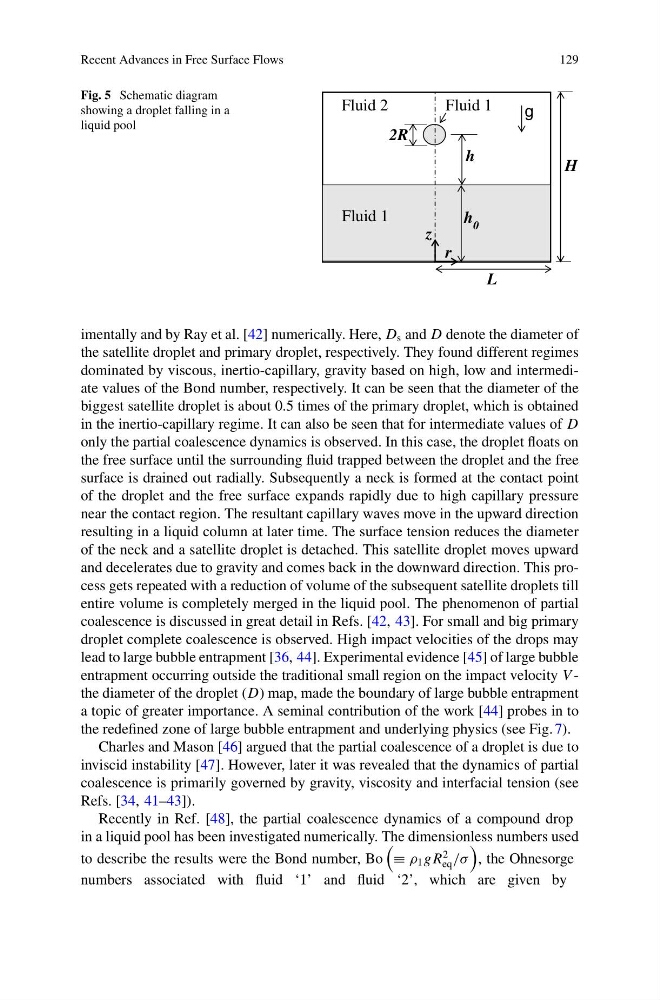
Fig. 5 Schematic diagram
showing a droplet falling in a
liquid pool
h
H
L
Fluid 2
Fluid 1
Fluid 1
2R
g
h 0
r
z
imentally and by Ray et al. [42] numerically. Here, D s and D denote the diameter of
the satellite droplet and primary droplet, respectively. They found different regimes
dominated by viscous, inertio-capillary, gravity based on high, low and intermediate values of the Bond number, respectively. It can be seen that the diameter of the
biggest satellite droplet is about 0.5 times of the primary droplet, which is obtained
in the inertio-capillary regime. It can also be seen that for intermediate values of D
only the partial coalescence dynamics is observed. In this case, the droplet floats on
the free surface until the surrounding fluid trapped between the droplet and the free
surface is drained out radially. Subsequently a neck is formed at the contact point
of the droplet and the free surface expands rapidly due to high capillary pressure
near the contact region. The resultant capillary waves move in the upward direction
resulting in a liquid column at later time. The surface tension reduces the diameter
of the neck and a satellite droplet is detached. This satellite droplet moves upward
and decelerates due to gravity and comes back in the downward direction. This process gets repeated with a reduction of volume of the subsequent satellite droplets till
entire volume is completely merged in the liquid pool. The phenomenon of partial
coalescence is discussed in great detail in Refs. [42, 43]. For small and big primary
droplet complete coalescence is observed. High impact velocities of the drops may
lead to large bubble entrapment [36, 44]. Experimental evidence [45] of large bubble
entrapment occurring outside the traditional small region on the impact velocity V -
the diameter of the droplet (D) map, made the boundary of large bubble entrapment
a topic of greater importance. A seminal contribution of the work [44] probes in to
the redefined zone of large bubble entrapment and underlying physics (see Fig. 7).
Charles and Mason [46] argued that the partial coalescence of a droplet is due to
inviscid instability [47]. However, later it was revealed that the dynamics of partial
coalescence is primarily governed by gravity, viscosity and interfacial tension (see
Refs. [34, 41–43]).
Recently in Ref. [48], the partial coalescence dynamics of a compound drop
in a liquid pool has been investigated numerically. The dimensionless numbers used
to describe the results were the Bond number, Bo
≡ ρ 1 g R
2
eq /σ
, the Ohnesorge
numbers associated with fluid ‘1’ and fluid ‘2’, which are given by
129
Fig. 5 Schematic diagram
showing a droplet falling in a
liquid pool
h
H
L
Fluid 2
Fluid 1
Fluid 1
2R
g
h 0
r
z
imentally and by Ray et al. [42] numerically. Here, D s and D denote the diameter of
the satellite droplet and primary droplet, respectively. They found different regimes
dominated by viscous, inertio-capillary, gravity based on high, low and intermediate values of the Bond number, respectively. It can be seen that the diameter of the
biggest satellite droplet is about 0.5 times of the primary droplet, which is obtained
in the inertio-capillary regime. It can also be seen that for intermediate values of D
only the partial coalescence dynamics is observed. In this case, the droplet floats on
the free surface until the surrounding fluid trapped between the droplet and the free
surface is drained out radially. Subsequently a neck is formed at the contact point
of the droplet and the free surface expands rapidly due to high capillary pressure
near the contact region. The resultant capillary waves move in the upward direction
resulting in a liquid column at later time. The surface tension reduces the diameter
of the neck and a satellite droplet is detached. This satellite droplet moves upward
and decelerates due to gravity and comes back in the downward direction. This process gets repeated with a reduction of volume of the subsequent satellite droplets till
entire volume is completely merged in the liquid pool. The phenomenon of partial
coalescence is discussed in great detail in Refs. [42, 43]. For small and big primary
droplet complete coalescence is observed. High impact velocities of the drops may
lead to large bubble entrapment [36, 44]. Experimental evidence [45] of large bubble
entrapment occurring outside the traditional small region on the impact velocity V -
the diameter of the droplet (D) map, made the boundary of large bubble entrapment
a topic of greater importance. A seminal contribution of the work [44] probes in to
the redefined zone of large bubble entrapment and underlying physics (see Fig. 7).
Charles and Mason [46] argued that the partial coalescence of a droplet is due to
inviscid instability [47]. However, later it was revealed that the dynamics of partial
coalescence is primarily governed by gravity, viscosity and interfacial tension (see
Refs. [34, 41–43]).
Recently in Ref. [48], the partial coalescence dynamics of a compound drop
in a liquid pool has been investigated numerically. The dimensionless numbers used
to describe the results were the Bond number, Bo
≡ ρ 1 g R
2
eq /σ
, the Ohnesorge
numbers associated with fluid ‘1’ and fluid ‘2’, which are given by