

128
G. Biswas and K. C. Sahu
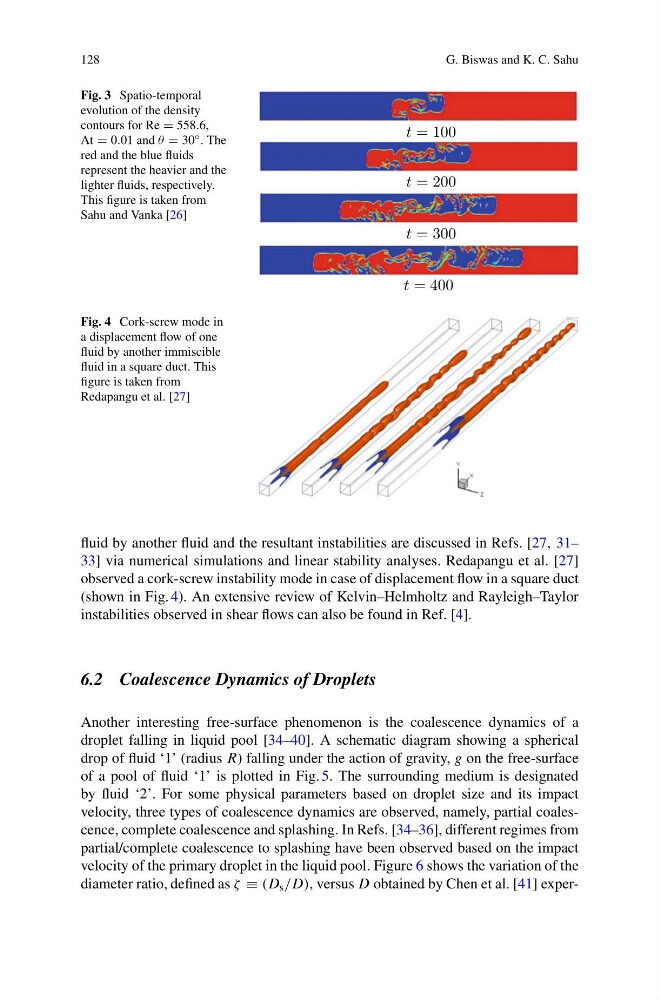
Fig. 3 Spatio-temporal
evolution of the density
contours for Re = 558.6,
At = 0.01 and θ = 30 ◦ . The
red and the blue fluids
represent the heavier and the
lighter fluids, respectively.
This figure is taken from
Sahu and Vanka [26]
t = 100
t = 200
t = 300
t = 400
Fig. 4 Cork-screw mode in
a displacement flow of one
fluid by another immiscible
fluid in a square duct. This
figure is taken from
Redapangu et al. [27]
fluid by another fluid and the resultant instabilities are discussed in Refs. [27, 31–
33] via numerical simulations and linear stability analyses. Redapangu et al. [27]
observed a cork-screw instability mode in case of displacement flow in a square duct
(shown in Fig. 4). An extensive review of Kelvin–Helmholtz and Rayleigh–Taylor
instabilities observed in shear flows can also be found in Ref. [4].
6.2 Coalescence Dynamics of Droplets
Another interesting free-surface phenomenon is the coalescence dynamics of a
droplet falling in liquid pool [34–40]. A schematic diagram showing a spherical
drop of fluid ‘1’ (radius R) falling under the action of gravity, g on the free-surface
of a pool of fluid ‘1’ is plotted in Fig. 5. The surrounding medium is designated
by fluid ‘2’. For some physical parameters based on droplet size and its impact
velocity, three types of coalescence dynamics are observed, namely, partial coalescence, complete coalescence and splashing. In Refs. [34–36], different regimes from
partial/complete coalescence to splashing have been observed based on the impact
velocity of the primary droplet in the liquid pool. Figure 6 shows the variation of the
diameter ratio, defined as ζ ≡ (D s /D), versus D obtained by Chen et al. [41] exper-
G. Biswas and K. C. Sahu
Fig. 3 Spatio-temporal
evolution of the density
contours for Re = 558.6,
At = 0.01 and θ = 30 ◦ . The
red and the blue fluids
represent the heavier and the
lighter fluids, respectively.
This figure is taken from
Sahu and Vanka [26]
t = 100
t = 200
t = 300
t = 400
Fig. 4 Cork-screw mode in
a displacement flow of one
fluid by another immiscible
fluid in a square duct. This
figure is taken from
Redapangu et al. [27]
fluid by another fluid and the resultant instabilities are discussed in Refs. [27, 31–
33] via numerical simulations and linear stability analyses. Redapangu et al. [27]
observed a cork-screw instability mode in case of displacement flow in a square duct
(shown in Fig. 4). An extensive review of Kelvin–Helmholtz and Rayleigh–Taylor
instabilities observed in shear flows can also be found in Ref. [4].
6.2 Coalescence Dynamics of Droplets
Another interesting free-surface phenomenon is the coalescence dynamics of a
droplet falling in liquid pool [34–40]. A schematic diagram showing a spherical
drop of fluid ‘1’ (radius R) falling under the action of gravity, g on the free-surface
of a pool of fluid ‘1’ is plotted in Fig. 5. The surrounding medium is designated
by fluid ‘2’. For some physical parameters based on droplet size and its impact
velocity, three types of coalescence dynamics are observed, namely, partial coalescence, complete coalescence and splashing. In Refs. [34–36], different regimes from
partial/complete coalescence to splashing have been observed based on the impact
velocity of the primary droplet in the liquid pool. Figure 6 shows the variation of the
diameter ratio, defined as ζ ≡ (D s /D), versus D obtained by Chen et al. [41] exper-