

Recent Advances in Free Surface Flows
127
6.1 Rayleigh–Taylor Instabilities and Gravity Currents
The Rayleigh–Taylor instability occurs at the interface separating two fluids with
an unstable density stratification, i.e. when a heavier fluid overlays a lighter fluid.
Due to the action of gravity, the heavier fluid penetrates into the region of the lighter
fluid, while the lighter fluid moves up in order to maintain the conservation of mass,
causing the interface to deform. The Rayleigh–Taylor instability has been a subject
of considerable interest due to its relevance in many natural phenomena and practical
applications [23, 24]. In nature, they are found in ocean tides, the accelerated interstellar clouds driven by newborn stars and black holes, supernova events, sinking of
slabs of tectonic plates, in volcanic activities [25], to name a few.
A model problem to study the Rayleigh–Taylor instability is the transient mixing
of two unstably-density-stratified fluids confined in a tilted enclosure, commonly
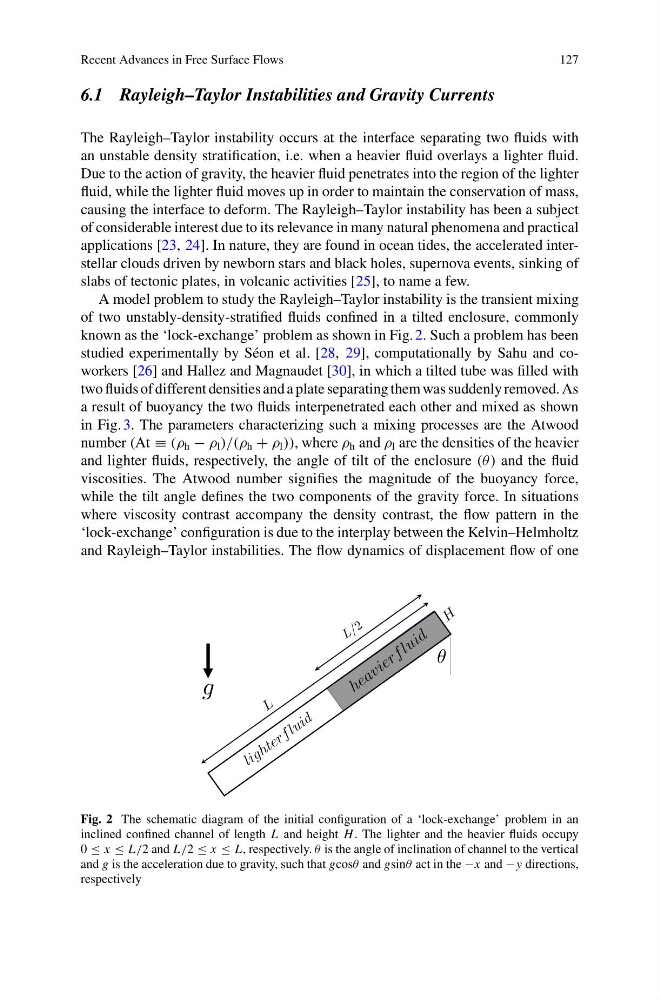
known as the ‘lock-exchange’ problem as shown in Fig. 2. Such a problem has been
studied experimentally by Séon et al. [28, 29], computationally by Sahu and coworkers [26] and Hallez and Magnaudet [30], in which a tilted tube was filled with
two fluids of different densities and a plate separating them was suddenly removed. As
a result of buoyancy the two fluids interpenetrated each other and mixed as shown
in Fig. 3. The parameters characterizing such a mixing processes are the Atwood
number (At ≡ (ρ h − ρ l )/(ρ h + ρ l )), where ρ h and ρ l are the densities of the heavier
and lighter fluids, respectively, the angle of tilt of the enclosure (θ ) and the fluid
viscosities. The Atwood number signifies the magnitude of the buoyancy force,
while the tilt angle defines the two components of the gravity force. In situations
where viscosity contrast accompany the density contrast, the flow pattern in the
‘lock-exchange’ configuration is due to the interplay between the Kelvin–Helmholtz
and Rayleigh–Taylor instabilities. The flow dynamics of displacement flow of one
Fig. 2 The schematic diagram of the initial configuration of a ‘lock-exchange’ problem in an
inclined confined channel of length L and height H . The lighter and the heavier fluids occupy
0 ≤ x ≤ L/2 and L/2 ≤ x ≤ L, respectively. θ is the angle of inclination of channel to the vertical
and g is the acceleration due to gravity, such that gcosθ and gsinθ act in the −x and −y directions,
respectively
127
6.1 Rayleigh–Taylor Instabilities and Gravity Currents
The Rayleigh–Taylor instability occurs at the interface separating two fluids with
an unstable density stratification, i.e. when a heavier fluid overlays a lighter fluid.
Due to the action of gravity, the heavier fluid penetrates into the region of the lighter
fluid, while the lighter fluid moves up in order to maintain the conservation of mass,
causing the interface to deform. The Rayleigh–Taylor instability has been a subject
of considerable interest due to its relevance in many natural phenomena and practical
applications [23, 24]. In nature, they are found in ocean tides, the accelerated interstellar clouds driven by newborn stars and black holes, supernova events, sinking of
slabs of tectonic plates, in volcanic activities [25], to name a few.
A model problem to study the Rayleigh–Taylor instability is the transient mixing
of two unstably-density-stratified fluids confined in a tilted enclosure, commonly
known as the ‘lock-exchange’ problem as shown in Fig. 2. Such a problem has been
studied experimentally by Séon et al. [28, 29], computationally by Sahu and coworkers [26] and Hallez and Magnaudet [30], in which a tilted tube was filled with
two fluids of different densities and a plate separating them was suddenly removed. As
a result of buoyancy the two fluids interpenetrated each other and mixed as shown
in Fig. 3. The parameters characterizing such a mixing processes are the Atwood
number (At ≡ (ρ h − ρ l )/(ρ h + ρ l )), where ρ h and ρ l are the densities of the heavier
and lighter fluids, respectively, the angle of tilt of the enclosure (θ ) and the fluid
viscosities. The Atwood number signifies the magnitude of the buoyancy force,
while the tilt angle defines the two components of the gravity force. In situations
where viscosity contrast accompany the density contrast, the flow pattern in the
‘lock-exchange’ configuration is due to the interplay between the Kelvin–Helmholtz
and Rayleigh–Taylor instabilities. The flow dynamics of displacement flow of one
Fig. 2 The schematic diagram of the initial configuration of a ‘lock-exchange’ problem in an
inclined confined channel of length L and height H . The lighter and the heavier fluids occupy
0 ≤ x ≤ L/2 and L/2 ≤ x ≤ L, respectively. θ is the angle of inclination of channel to the vertical
and g is the acceleration due to gravity, such that gcosθ and gsinθ act in the −x and −y directions,
respectively