

Recent Advances in Free Surface Flows
125
in the normal stress balance boundary condition at the interface (see Eq. (3)). The
surface tension force per unit volume can also be added as an interfacial body force
term in the Navier–Stokes equations (see the term, δ(x − x f )σ κn in Eq. (13)) using
the continuum surface force (CSF) formulation proposed by Brackbill et al. [11].
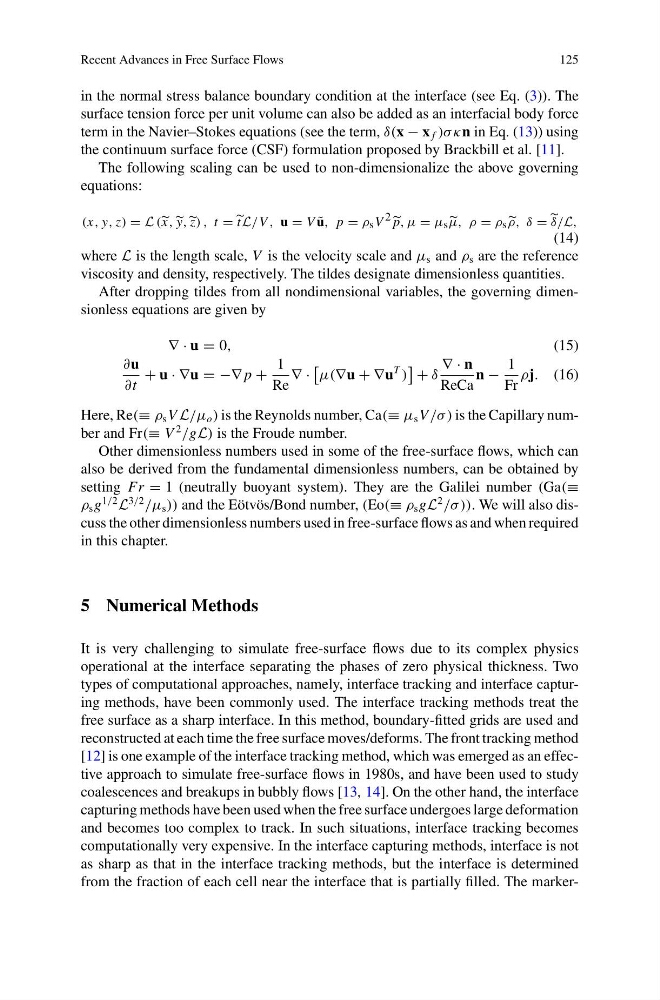
The following scaling can be used to non-dimensionalize the above governing
equations:
(x, y, z) = L ( x, y, z) , t = tL/V , u = V ˜
u, p = ρ s V 2 p, μ = μ s μ, ρ = ρ s
ρ, δ = δ/L,
(14)
where L is the length scale, V is the velocity scale and μ s and ρ s are the reference
viscosity and density, respectively. The tildes designate dimensionless quantities.
After dropping tildes from all nondimensional variables, the governing dimensionless equations are given by
∇ · u = 0,
(15)
∂u
∂t
+ u · ∇u = −∇ p +
1
Re
∇ ·
μ(∇u + ∇u
T
)
+ δ
∇ · n
ReCa
n −
1
Fr
ρj. (16)
Here, Re(≡ ρ s V L/μ o ) is the Reynolds number, Ca(≡ μ s V /σ ) is the Capillary number and Fr(≡ V
2
/gL) is the Froude number.
Other dimensionless numbers used in some of the free-surface flows, which can
also be derived from the fundamental dimensionless numbers, can be obtained by
setting Fr = 1 (neutrally buoyant system). They are the Galilei number (Ga(≡
ρ s g
1/2
L
3/2
/μ s )) and the Eötvös/Bond number, (Eo(≡ ρ s gL
2
/σ )). We will also discuss the other dimensionless numbers used in free-surface flows as and when required
in this chapter.
5 Numerical Methods
It is very challenging to simulate free-surface flows due to its complex physics
operational at the interface separating the phases of zero physical thickness. Two
types of computational approaches, namely, interface tracking and interface capturing methods, have been commonly used. The interface tracking methods treat the
free surface as a sharp interface. In this method, boundary-fitted grids are used and
reconstructed at each time the free surface moves/deforms. The front tracking method
[12] is one example of the interface tracking method, which was emerged as an effective approach to simulate free-surface flows in 1980s, and have been used to study
coalescences and breakups in bubbly flows [13, 14]. On the other hand, the interface
capturing methods have been used when the free surface undergoes large deformation
and becomes too complex to track. In such situations, interface tracking becomes
computationally very expensive. In the interface capturing methods, interface is not
as sharp as that in the interface tracking methods, but the interface is determined
from the fraction of each cell near the interface that is partially filled. The marker-
125
in the normal stress balance boundary condition at the interface (see Eq. (3)). The
surface tension force per unit volume can also be added as an interfacial body force
term in the Navier–Stokes equations (see the term, δ(x − x f )σ κn in Eq. (13)) using
the continuum surface force (CSF) formulation proposed by Brackbill et al. [11].
The following scaling can be used to non-dimensionalize the above governing
equations:
(x, y, z) = L ( x, y, z) , t = tL/V , u = V ˜
u, p = ρ s V 2 p, μ = μ s μ, ρ = ρ s
ρ, δ = δ/L,
(14)
where L is the length scale, V is the velocity scale and μ s and ρ s are the reference
viscosity and density, respectively. The tildes designate dimensionless quantities.
After dropping tildes from all nondimensional variables, the governing dimensionless equations are given by
∇ · u = 0,
(15)
∂u
∂t
+ u · ∇u = −∇ p +
1
Re
∇ ·
μ(∇u + ∇u
T
)
+ δ
∇ · n
ReCa
n −
1
Fr
ρj. (16)
Here, Re(≡ ρ s V L/μ o ) is the Reynolds number, Ca(≡ μ s V /σ ) is the Capillary number and Fr(≡ V
2
/gL) is the Froude number.
Other dimensionless numbers used in some of the free-surface flows, which can
also be derived from the fundamental dimensionless numbers, can be obtained by
setting Fr = 1 (neutrally buoyant system). They are the Galilei number (Ga(≡
ρ s g
1/2
L
3/2
/μ s )) and the Eötvös/Bond number, (Eo(≡ ρ s gL
2
/σ )). We will also discuss the other dimensionless numbers used in free-surface flows as and when required
in this chapter.
5 Numerical Methods
It is very challenging to simulate free-surface flows due to its complex physics
operational at the interface separating the phases of zero physical thickness. Two
types of computational approaches, namely, interface tracking and interface capturing methods, have been commonly used. The interface tracking methods treat the
free surface as a sharp interface. In this method, boundary-fitted grids are used and
reconstructed at each time the free surface moves/deforms. The front tracking method
[12] is one example of the interface tracking method, which was emerged as an effective approach to simulate free-surface flows in 1980s, and have been used to study
coalescences and breakups in bubbly flows [13, 14]. On the other hand, the interface
capturing methods have been used when the free surface undergoes large deformation
and becomes too complex to track. In such situations, interface tracking becomes
computationally very expensive. In the interface capturing methods, interface is not
as sharp as that in the interface tracking methods, but the interface is determined
from the fraction of each cell near the interface that is partially filled. The marker-