

124
G. Biswas and K. C. Sahu
V t =
2
9
(ρ solid − ρ f )
μ f
R
2 g,
(10)
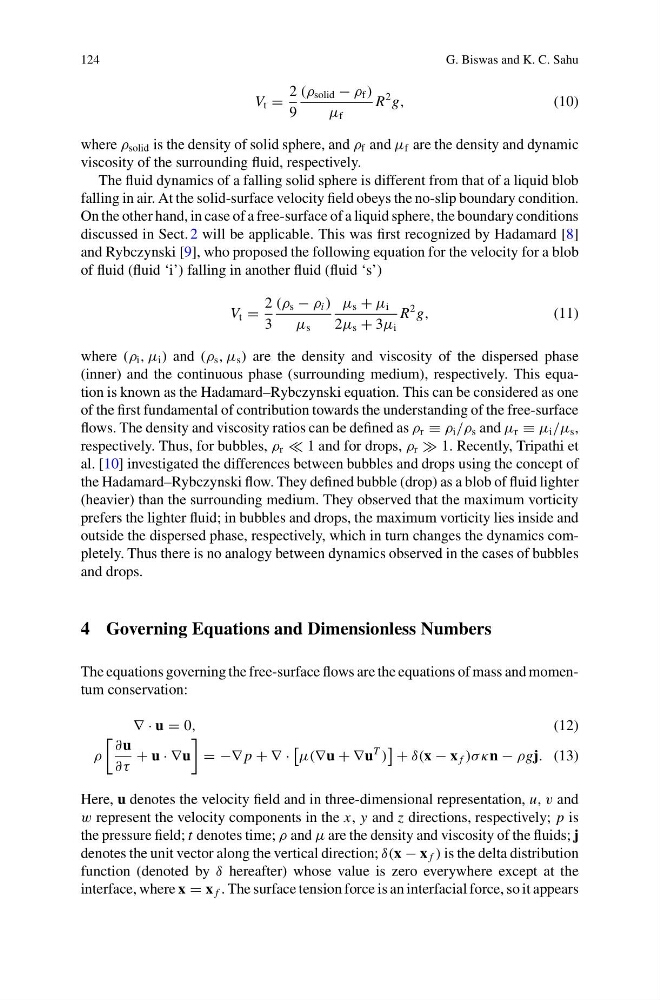
where ρ solid is the density of solid sphere, and ρ f and μ f are the density and dynamic
viscosity of the surrounding fluid, respectively.
The fluid dynamics of a falling solid sphere is different from that of a liquid blob
falling in air. At the solid-surface velocity field obeys the no-slip boundary condition.
On the other hand, in case of a free-surface of a liquid sphere, the boundary conditions
discussed in Sect. 2 will be applicable. This was first recognized by Hadamard [8]
and Rybczynski [9], who proposed the following equation for the velocity for a blob
of fluid (fluid ‘i’) falling in another fluid (fluid ‘s’)
V t =
2
3
(ρ s − ρ i )
μ s
μ s + μ i
2μ s + 3μ i
R
2 g,
(11)
where (ρ i , μ i ) and (ρ s , μ s ) are the density and viscosity of the dispersed phase
(inner) and the continuous phase (surrounding medium), respectively. This equation is known as the Hadamard–Rybczynski equation. This can be considered as one
of the first fundamental of contribution towards the understanding of the free-surface
flows. The density and viscosity ratios can be defined as ρ r ≡ ρ i /ρ s and μ r ≡ μ i /μ s ,
respectively. Thus, for bubbles, ρ r 1 and for drops, ρ r 1. Recently, Tripathi et
al. [10] investigated the differences between bubbles and drops using the concept of
the Hadamard–Rybczynski flow. They defined bubble (drop) as a blob of fluid lighter
(heavier) than the surrounding medium. They observed that the maximum vorticity
prefers the lighter fluid; in bubbles and drops, the maximum vorticity lies inside and
outside the dispersed phase, respectively, which in turn changes the dynamics completely. Thus there is no analogy between dynamics observed in the cases of bubbles
and drops.
4 Governing Equations and Dimensionless Numbers
The equations governing the free-surface flows are the equations of mass and momentum conservation:
∇ · u = 0,
(12)
ρ
∂u
∂τ
+ u · ∇u
= −∇ p + ∇ ·
μ(∇u + ∇u
T
)
+ δ(x − x f )σ κn − ρgj. (13)
Here, u denotes the velocity field and in three-dimensional representation, u, v and
w represent the velocity components in the x, y and z directions, respectively; p is
the pressure field; t denotes time; ρ and μ are the density and viscosity of the fluids; j
denotes the unit vector along the vertical direction; δ(x − x f ) is the delta distribution
function (denoted by δ hereafter) whose value is zero everywhere except at the
interface, where x = x f . The surface tension force is an interfacial force, so it appears
G. Biswas and K. C. Sahu
V t =
2
9
(ρ solid − ρ f )
μ f
R
2 g,
(10)
where ρ solid is the density of solid sphere, and ρ f and μ f are the density and dynamic
viscosity of the surrounding fluid, respectively.
The fluid dynamics of a falling solid sphere is different from that of a liquid blob
falling in air. At the solid-surface velocity field obeys the no-slip boundary condition.
On the other hand, in case of a free-surface of a liquid sphere, the boundary conditions
discussed in Sect. 2 will be applicable. This was first recognized by Hadamard [8]
and Rybczynski [9], who proposed the following equation for the velocity for a blob
of fluid (fluid ‘i’) falling in another fluid (fluid ‘s’)
V t =
2
3
(ρ s − ρ i )
μ s
μ s + μ i
2μ s + 3μ i
R
2 g,
(11)
where (ρ i , μ i ) and (ρ s , μ s ) are the density and viscosity of the dispersed phase
(inner) and the continuous phase (surrounding medium), respectively. This equation is known as the Hadamard–Rybczynski equation. This can be considered as one
of the first fundamental of contribution towards the understanding of the free-surface
flows. The density and viscosity ratios can be defined as ρ r ≡ ρ i /ρ s and μ r ≡ μ i /μ s ,
respectively. Thus, for bubbles, ρ r 1 and for drops, ρ r 1. Recently, Tripathi et
al. [10] investigated the differences between bubbles and drops using the concept of
the Hadamard–Rybczynski flow. They defined bubble (drop) as a blob of fluid lighter
(heavier) than the surrounding medium. They observed that the maximum vorticity
prefers the lighter fluid; in bubbles and drops, the maximum vorticity lies inside and
outside the dispersed phase, respectively, which in turn changes the dynamics completely. Thus there is no analogy between dynamics observed in the cases of bubbles
and drops.
4 Governing Equations and Dimensionless Numbers
The equations governing the free-surface flows are the equations of mass and momentum conservation:
∇ · u = 0,
(12)
ρ
∂u
∂τ
+ u · ∇u
= −∇ p + ∇ ·
μ(∇u + ∇u
T
)
+ δ(x − x f )σ κn − ρgj. (13)
Here, u denotes the velocity field and in three-dimensional representation, u, v and
w represent the velocity components in the x, y and z directions, respectively; p is
the pressure field; t denotes time; ρ and μ are the density and viscosity of the fluids; j
denotes the unit vector along the vertical direction; δ(x − x f ) is the delta distribution
function (denoted by δ hereafter) whose value is zero everywhere except at the
interface, where x = x f . The surface tension force is an interfacial force, so it appears