

108
A. K. Misra and S. Cohen
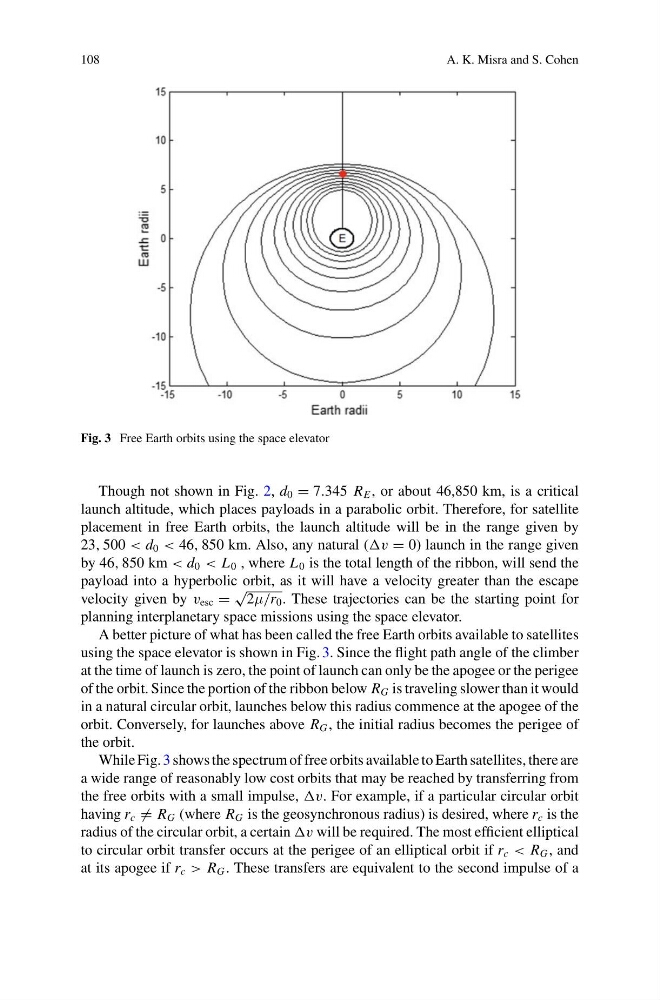
Fig. 3 Free Earth orbits using the space elevator
Though not shown in Fig. 2, d 0 = 7.345 R E , or about 46,850 km, is a critical
launch altitude, which places payloads in a parabolic orbit. Therefore, for satellite
placement in free Earth orbits, the launch altitude will be in the range given by
23, 500 < d 0 < 46, 850 km. Also, any natural (v = 0) launch in the range given
by 46, 850 km < d 0 < L 0 , where L 0 is the total length of the ribbon, will send the
payload into a hyperbolic orbit, as it will have a velocity greater than the escape
velocity given by v esc =
√
2μ/r 0 . These trajectories can be the starting point for
planning interplanetary space missions using the space elevator.
A better picture of what has been called the free Earth orbits available to satellites
using the space elevator is shown in Fig. 3. Since the flight path angle of the climber
at the time of launch is zero, the point of launch can only be the apogee or the perigee
of the orbit. Since the portion of the ribbon below R G is traveling slower than it would
in a natural circular orbit, launches below this radius commence at the apogee of the
orbit. Conversely, for launches above R G , the initial radius becomes the perigee of
the orbit.
While Fig. 3 shows the spectrum of free orbits available to Earth satellites, there are
a wide range of reasonably low cost orbits that may be reached by transferring from
the free orbits with a small impulse, v. For example, if a particular circular orbit
having r c = R G (where R G is the geosynchronous radius) is desired, where r c is the
radius of the circular orbit, a certain v will be required. The most efficient elliptical
to circular orbit transfer occurs at the perigee of an elliptical orbit if r c < R G , and
at its apogee if r c > R G . These transfers are equivalent to the second impulse of a
A. K. Misra and S. Cohen
Fig. 3 Free Earth orbits using the space elevator
Though not shown in Fig. 2, d 0 = 7.345 R E , or about 46,850 km, is a critical
launch altitude, which places payloads in a parabolic orbit. Therefore, for satellite
placement in free Earth orbits, the launch altitude will be in the range given by
23, 500 < d 0 < 46, 850 km. Also, any natural (v = 0) launch in the range given
by 46, 850 km < d 0 < L 0 , where L 0 is the total length of the ribbon, will send the
payload into a hyperbolic orbit, as it will have a velocity greater than the escape
velocity given by v esc =
√
2μ/r 0 . These trajectories can be the starting point for
planning interplanetary space missions using the space elevator.
A better picture of what has been called the free Earth orbits available to satellites
using the space elevator is shown in Fig. 3. Since the flight path angle of the climber
at the time of launch is zero, the point of launch can only be the apogee or the perigee
of the orbit. Since the portion of the ribbon below R G is traveling slower than it would
in a natural circular orbit, launches below this radius commence at the apogee of the
orbit. Conversely, for launches above R G , the initial radius becomes the perigee of
the orbit.
While Fig. 3 shows the spectrum of free orbits available to Earth satellites, there are
a wide range of reasonably low cost orbits that may be reached by transferring from
the free orbits with a small impulse, v. For example, if a particular circular orbit
having r c = R G (where R G is the geosynchronous radius) is desired, where r c is the
radius of the circular orbit, a certain v will be required. The most efficient elliptical
to circular orbit transfer occurs at the perigee of an elliptical orbit if r c < R G , and
at its apogee if r c > R G . These transfers are equivalent to the second impulse of a