

Space Elevator—A Revolutionary Space Transportation System
109
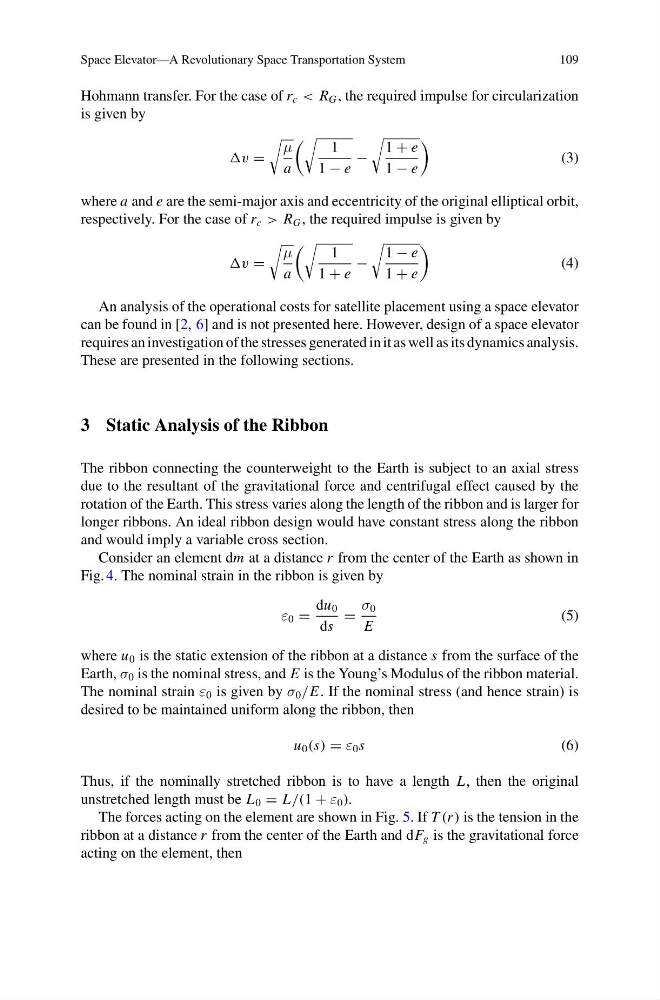
Hohmann transfer. For the case of r c < R G , the required impulse for circularization
is given by
v =
μ
a
1
1 − e
−
1 + e
1 − e
(3)
where a and e are the semi-major axis and eccentricity of the original elliptical orbit,
respectively. For the case of r c > R G , the required impulse is given by
v =
μ
a
1
1 + e
−
1 − e
1 + e
(4)
An analysis of the operational costs for satellite placement using a space elevator
can be found in [2, 6] and is not presented here. However, design of a space elevator
requires an investigation of the stresses generated in it as well as its dynamics analysis.
These are presented in the following sections.
3 Static Analysis of the Ribbon
The ribbon connecting the counterweight to the Earth is subject to an axial stress
due to the resultant of the gravitational force and centrifugal effect caused by the
rotation of the Earth. This stress varies along the length of the ribbon and is larger for
longer ribbons. An ideal ribbon design would have constant stress along the ribbon
and would imply a variable cross section.
Consider an element dm at a distance r from the center of the Earth as shown in
Fig. 4. The nominal strain in the ribbon is given by
ε 0 =
du 0
ds
=
σ 0
E
(5)
where u 0 is the static extension of the ribbon at a distance s from the surface of the
Earth, σ 0 is the nominal stress, and E is the Young’s Modulus of the ribbon material.
The nominal strain ε 0 is given by σ 0 /E. If the nominal stress (and hence strain) is
desired to be maintained uniform along the ribbon, then
u 0 (s) = ε 0 s
(6)
Thus, if the nominally stretched ribbon is to have a length L, then the original
unstretched length must be L 0 = L/(1 + ε 0 ).
The forces acting on the element are shown in Fig. 5. If T (r ) is the tension in the
ribbon at a distance r from the center of the Earth and dF g is the gravitational force
acting on the element, then
109
Hohmann transfer. For the case of r c < R G , the required impulse for circularization
is given by
v =
μ
a
1
1 − e
−
1 + e
1 − e
(3)
where a and e are the semi-major axis and eccentricity of the original elliptical orbit,
respectively. For the case of r c > R G , the required impulse is given by
v =
μ
a
1
1 + e
−
1 − e
1 + e
(4)
An analysis of the operational costs for satellite placement using a space elevator
can be found in [2, 6] and is not presented here. However, design of a space elevator
requires an investigation of the stresses generated in it as well as its dynamics analysis.
These are presented in the following sections.
3 Static Analysis of the Ribbon
The ribbon connecting the counterweight to the Earth is subject to an axial stress
due to the resultant of the gravitational force and centrifugal effect caused by the
rotation of the Earth. This stress varies along the length of the ribbon and is larger for
longer ribbons. An ideal ribbon design would have constant stress along the ribbon
and would imply a variable cross section.
Consider an element dm at a distance r from the center of the Earth as shown in
Fig. 4. The nominal strain in the ribbon is given by
ε 0 =
du 0
ds
=
σ 0
E
(5)
where u 0 is the static extension of the ribbon at a distance s from the surface of the
Earth, σ 0 is the nominal stress, and E is the Young’s Modulus of the ribbon material.
The nominal strain ε 0 is given by σ 0 /E. If the nominal stress (and hence strain) is
desired to be maintained uniform along the ribbon, then
u 0 (s) = ε 0 s
(6)
Thus, if the nominally stretched ribbon is to have a length L, then the original
unstretched length must be L 0 = L/(1 + ε 0 ).
The forces acting on the element are shown in Fig. 5. If T (r ) is the tension in the
ribbon at a distance r from the center of the Earth and dF g is the gravitational force
acting on the element, then