

624
P.-Y. S. Hsueh et al.
This gap surfaces the need to handle both explicit and implicit knowledge. While
the implicit knowledge is elusive and would often require the use of examples to
make such knowledge interpretable, the example-oriented approach did not cover
all the topics. Therefore, to characterize the rest of critical knowledge resources, the
assessment forms from the student model were used.
In particular, the student model utilizes two comprehensive assessment instruments: (1) the caregiver burden inventory (CBI) [99] and (2) a German survey
assessment (NBA) [100]. The first assessment instrument, as the name suggests,
measures the burden of a caregiver. It includes 24 items, which are divided into
five segments: time dependence, developmental burden, physical burden, social
burden and emotional burden. The regular use case of the second instrument,
the NBA, is the determination of the amount of financial relief due to persons’
needs of assistance. It spans six different areas, including mobility, cognitive
and communicative abilities, psychological problems, self-reliance and organizing
everyday life. In the use case’s student model, parts of it are used to infer from the
patient’s needs to the caregiver’s issues. All items of the assessment tools used in
the student model are represented as Boolean values.
To explicitly extract the implicit knowledge delivery strategies from the experts’
minds, they were asked to weigh each assessment item with the score of 0–3 for
every knowledge resource. Thereby, a zero weighting indicates that the item is not
important for the provision of this knowledge resource and a weighting of three
indicates that the item is highly important for the provisioning of the knowledge
resource. To make a statement about the importance of a knowledge resource for
a specific caregiver, the caregiver’s profile and the experts’ weighting must be
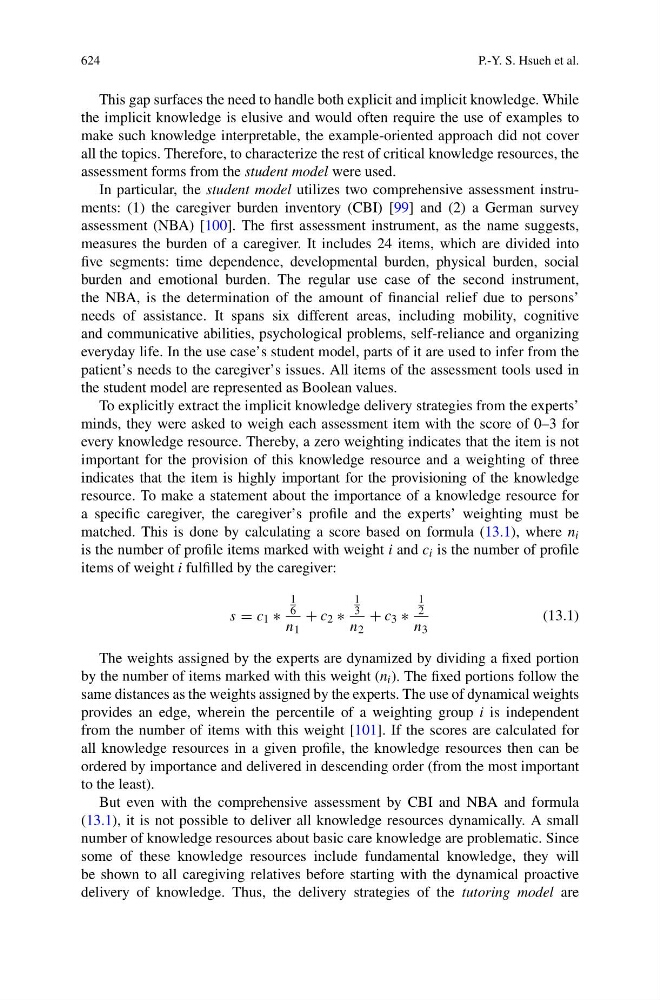
matched. This is done by calculating a score based on formula (13.1), where n i
is the number of profile items marked with weight i and c i is the number of profile
items of weight i fulfilled by the caregiver:
s = c 1 ∗
1
6
n 1
+ c 2 ∗
1
3
n 2
+ c 3 ∗
1
2
n 3
(13.1)
The weights assigned by the experts are dynamized by dividing a fixed portion
by the number of items marked with this weight (n i ). The fixed portions follow the
same distances as the weights assigned by the experts. The use of dynamical weights
provides an edge, wherein the percentile of a weighting group i is independent
from the number of items with this weight [101]. If the scores are calculated for
all knowledge resources in a given profile, the knowledge resources then can be
ordered by importance and delivered in descending order (from the most important
to the least).
But even with the comprehensive assessment by CBI and NBA and formula
(13.1), it is not possible to deliver all knowledge resources dynamically. A small
number of knowledge resources about basic care knowledge are problematic. Since
some of these knowledge resources include fundamental knowledge, they will
be shown to all caregiving relatives before starting with the dynamical proactive
delivery of knowledge. Thus, the delivery strategies of the tutoring model are
P.-Y. S. Hsueh et al.
This gap surfaces the need to handle both explicit and implicit knowledge. While
the implicit knowledge is elusive and would often require the use of examples to
make such knowledge interpretable, the example-oriented approach did not cover
all the topics. Therefore, to characterize the rest of critical knowledge resources, the
assessment forms from the student model were used.
In particular, the student model utilizes two comprehensive assessment instruments: (1) the caregiver burden inventory (CBI) [99] and (2) a German survey
assessment (NBA) [100]. The first assessment instrument, as the name suggests,
measures the burden of a caregiver. It includes 24 items, which are divided into
five segments: time dependence, developmental burden, physical burden, social
burden and emotional burden. The regular use case of the second instrument,
the NBA, is the determination of the amount of financial relief due to persons’
needs of assistance. It spans six different areas, including mobility, cognitive
and communicative abilities, psychological problems, self-reliance and organizing
everyday life. In the use case’s student model, parts of it are used to infer from the
patient’s needs to the caregiver’s issues. All items of the assessment tools used in
the student model are represented as Boolean values.
To explicitly extract the implicit knowledge delivery strategies from the experts’
minds, they were asked to weigh each assessment item with the score of 0–3 for
every knowledge resource. Thereby, a zero weighting indicates that the item is not
important for the provision of this knowledge resource and a weighting of three
indicates that the item is highly important for the provisioning of the knowledge
resource. To make a statement about the importance of a knowledge resource for
a specific caregiver, the caregiver’s profile and the experts’ weighting must be
matched. This is done by calculating a score based on formula (13.1), where n i
is the number of profile items marked with weight i and c i is the number of profile
items of weight i fulfilled by the caregiver:
s = c 1 ∗
1
6
n 1
+ c 2 ∗
1
3
n 2
+ c 3 ∗
1
2
n 3
(13.1)
The weights assigned by the experts are dynamized by dividing a fixed portion
by the number of items marked with this weight (n i ). The fixed portions follow the
same distances as the weights assigned by the experts. The use of dynamical weights
provides an edge, wherein the percentile of a weighting group i is independent
from the number of items with this weight [101]. If the scores are calculated for
all knowledge resources in a given profile, the knowledge resources then can be
ordered by importance and delivered in descending order (from the most important
to the least).
But even with the comprehensive assessment by CBI and NBA and formula
(13.1), it is not possible to deliver all knowledge resources dynamically. A small
number of knowledge resources about basic care knowledge are problematic. Since
some of these knowledge resources include fundamental knowledge, they will
be shown to all caregiving relatives before starting with the dynamical proactive
delivery of knowledge. Thus, the delivery strategies of the tutoring model are