

13 Smart Learning Using Big and Small Data for Mobile and IOT e-Health
625
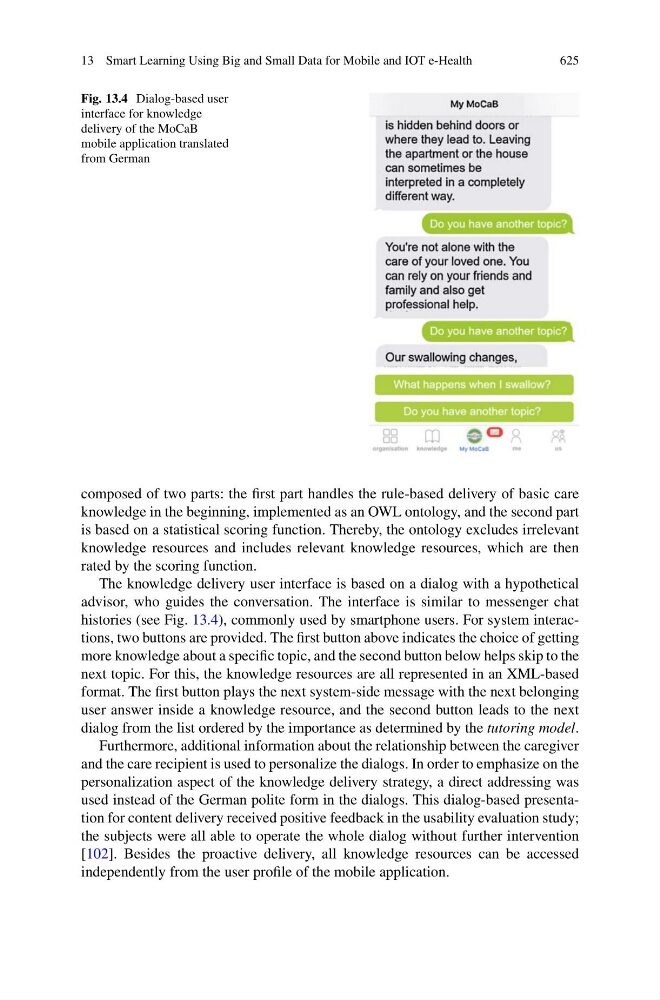
Fig. 13.4 Dialog-based user
interface for knowledge
delivery of the MoCaB
mobile application translated
from German
composed of two parts: the first part handles the rule-based delivery of basic care
knowledge in the beginning, implemented as an OWL ontology, and the second part
is based on a statistical scoring function. Thereby, the ontology excludes irrelevant
knowledge resources and includes relevant knowledge resources, which are then
rated by the scoring function.
The knowledge delivery user interface is based on a dialog with a hypothetical
advisor, who guides the conversation. The interface is similar to messenger chat
histories (see Fig. 13.4), commonly used by smartphone users. For system interactions, two buttons are provided. The first button above indicates the choice of getting
more knowledge about a specific topic, and the second button below helps skip to the
next topic. For this, the knowledge resources are all represented in an XML-based
format. The first button plays the next system-side message with the next belonging
user answer inside a knowledge resource, and the second button leads to the next
dialog from the list ordered by the importance as determined by the tutoring model.
Furthermore, additional information about the relationship between the caregiver
and the care recipient is used to personalize the dialogs. In order to emphasize on the
personalization aspect of the knowledge delivery strategy, a direct addressing was
used instead of the German polite form in the dialogs. This dialog-based presentation for content delivery received positive feedback in the usability evaluation study;
the subjects were all able to operate the whole dialog without further intervention
[102]. Besides the proactive delivery, all knowledge resources can be accessed
independently from the user profile of the mobile application.
625
Fig. 13.4 Dialog-based user
interface for knowledge
delivery of the MoCaB
mobile application translated
from German
composed of two parts: the first part handles the rule-based delivery of basic care
knowledge in the beginning, implemented as an OWL ontology, and the second part
is based on a statistical scoring function. Thereby, the ontology excludes irrelevant
knowledge resources and includes relevant knowledge resources, which are then
rated by the scoring function.
The knowledge delivery user interface is based on a dialog with a hypothetical
advisor, who guides the conversation. The interface is similar to messenger chat
histories (see Fig. 13.4), commonly used by smartphone users. For system interactions, two buttons are provided. The first button above indicates the choice of getting
more knowledge about a specific topic, and the second button below helps skip to the
next topic. For this, the knowledge resources are all represented in an XML-based
format. The first button plays the next system-side message with the next belonging
user answer inside a knowledge resource, and the second button leads to the next
dialog from the list ordered by the importance as determined by the tutoring model.
Furthermore, additional information about the relationship between the caregiver
and the care recipient is used to personalize the dialogs. In order to emphasize on the
personalization aspect of the knowledge delivery strategy, a direct addressing was
used instead of the German polite form in the dialogs. This dialog-based presentation for content delivery received positive feedback in the usability evaluation study;
the subjects were all able to operate the whole dialog without further intervention
[102]. Besides the proactive delivery, all knowledge resources can be accessed
independently from the user profile of the mobile application.