

52
F. Firouzi et al.
2.1 Definition and Architecture of Smart Things
The phrase “smart things” is sometimes used interchangeably with similar terms
including smart object, IoT device, IoT endpoint, endpoint device, smart sensor,
intelligent device, intelligent node/thing, or ubiquitous thing. Regardless of the term
used, a smart thing is an object with embedded electronics which can exchange data
over a network without any human interaction [1]. A typical smart thing is made up
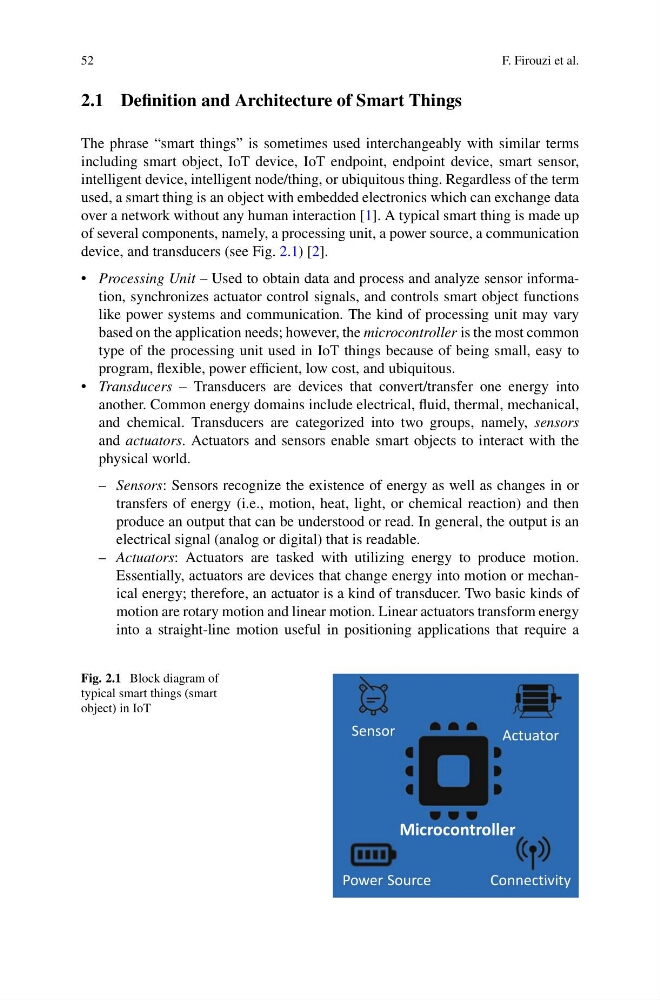
of several components, namely, a processing unit, a power source, a communication
device, and transducers (see Fig. 2.1) [2].
• Processing Unit – Used to obtain data and process and analyze sensor information, synchronizes actuator control signals, and controls smart object functions
like power systems and communication. The kind of processing unit may vary
based on the application needs; however, the microcontroller is the most common
type of the processing unit used in IoT things because of being small, easy to
program, flexible, power efficient, low cost, and ubiquitous.
• Transducers – Transducers are devices that convert/transfer one energy into
another. Common energy domains include electrical, fluid, thermal, mechanical,
and chemical. Transducers are categorized into two groups, namely, sensors
and actuators. Actuators and sensors enable smart objects to interact with the
physical world.
– Sensors: Sensors recognize the existence of energy as well as changes in or
transfers of energy (i.e., motion, heat, light, or chemical reaction) and then
produce an output that can be understood or read. In general, the output is an
electrical signal (analog or digital) that is readable.
– Actuators: Actuators are tasked with utilizing energy to produce motion.
Essentially, actuators are devices that change energy into motion or mechanical energy; therefore, an actuator is a kind of transducer. Two basic kinds of
motion are rotary motion and linear motion. Linear actuators transform energy
into a straight-line motion useful in positioning applications that require a
Fig. 2.1 Block diagram of
typical smart things (smart
object) in IoT
Sensor
Actuator
Connectivity
Power Source
Sensor
Actuator
Connectivity
Power Source
Microcontroller
F. Firouzi et al.
2.1 Definition and Architecture of Smart Things
The phrase “smart things” is sometimes used interchangeably with similar terms
including smart object, IoT device, IoT endpoint, endpoint device, smart sensor,
intelligent device, intelligent node/thing, or ubiquitous thing. Regardless of the term
used, a smart thing is an object with embedded electronics which can exchange data
over a network without any human interaction [1]. A typical smart thing is made up
of several components, namely, a processing unit, a power source, a communication
device, and transducers (see Fig. 2.1) [2].
• Processing Unit – Used to obtain data and process and analyze sensor information, synchronizes actuator control signals, and controls smart object functions
like power systems and communication. The kind of processing unit may vary
based on the application needs; however, the microcontroller is the most common
type of the processing unit used in IoT things because of being small, easy to
program, flexible, power efficient, low cost, and ubiquitous.
• Transducers – Transducers are devices that convert/transfer one energy into
another. Common energy domains include electrical, fluid, thermal, mechanical,
and chemical. Transducers are categorized into two groups, namely, sensors
and actuators. Actuators and sensors enable smart objects to interact with the
physical world.
– Sensors: Sensors recognize the existence of energy as well as changes in or
transfers of energy (i.e., motion, heat, light, or chemical reaction) and then
produce an output that can be understood or read. In general, the output is an
electrical signal (analog or digital) that is readable.
– Actuators: Actuators are tasked with utilizing energy to produce motion.
Essentially, actuators are devices that change energy into motion or mechanical energy; therefore, an actuator is a kind of transducer. Two basic kinds of
motion are rotary motion and linear motion. Linear actuators transform energy
into a straight-line motion useful in positioning applications that require a
Fig. 2.1 Block diagram of
typical smart things (smart
object) in IoT
Sensor
Actuator
Connectivity
Power Source
Sensor
Actuator
Connectivity
Power Source
Microcontroller