

2 The Smart “Things” in IoT
53
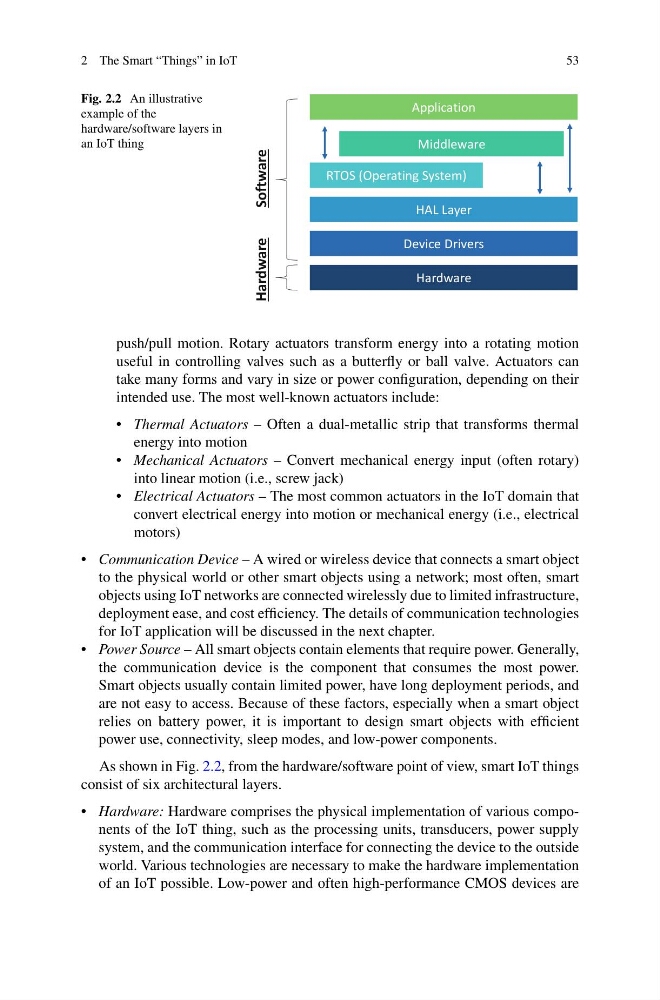
Fig. 2.2 An illustrative
example of the
hardware/software layers in
an IoT thing
Hardware
Device Drivers
HAL Layer
RTOS (Operating System)
Middleware
Application
Software
Hardware
push/pull motion. Rotary actuators transform energy into a rotating motion
useful in controlling valves such as a butterfly or ball valve. Actuators can
take many forms and vary in size or power configuration, depending on their
intended use. The most well-known actuators include:
• Thermal Actuators – Often a dual-metallic strip that transforms thermal
energy into motion
• Mechanical Actuators – Convert mechanical energy input (often rotary)
into linear motion (i.e., screw jack)
• Electrical Actuators – The most common actuators in the IoT domain that
convert electrical energy into motion or mechanical energy (i.e., electrical
motors)
• Communication Device – A wired or wireless device that connects a smart object
to the physical world or other smart objects using a network; most often, smart
objects using IoT networks are connected wirelessly due to limited infrastructure,
deployment ease, and cost efficiency. The details of communication technologies
for IoT application will be discussed in the next chapter.
• Power Source – All smart objects contain elements that require power. Generally,
the communication device is the component that consumes the most power.
Smart objects usually contain limited power, have long deployment periods, and
are not easy to access. Because of these factors, especially when a smart object
relies on battery power, it is important to design smart objects with efficient
power use, connectivity, sleep modes, and low-power components.
As shown in Fig. 2.2, from the hardware/software point of view, smart IoT things
consist of six architectural layers.
• Hardware: Hardware comprises the physical implementation of various components of the IoT thing, such as the processing units, transducers, power supply
system, and the communication interface for connecting the device to the outside
world. Various technologies are necessary to make the hardware implementation
of an IoT possible. Low-power and often high-performance CMOS devices are
53
Fig. 2.2 An illustrative
example of the
hardware/software layers in
an IoT thing
Hardware
Device Drivers
HAL Layer
RTOS (Operating System)
Middleware
Application
Software
Hardware
push/pull motion. Rotary actuators transform energy into a rotating motion
useful in controlling valves such as a butterfly or ball valve. Actuators can
take many forms and vary in size or power configuration, depending on their
intended use. The most well-known actuators include:
• Thermal Actuators – Often a dual-metallic strip that transforms thermal
energy into motion
• Mechanical Actuators – Convert mechanical energy input (often rotary)
into linear motion (i.e., screw jack)
• Electrical Actuators – The most common actuators in the IoT domain that
convert electrical energy into motion or mechanical energy (i.e., electrical
motors)
• Communication Device – A wired or wireless device that connects a smart object
to the physical world or other smart objects using a network; most often, smart
objects using IoT networks are connected wirelessly due to limited infrastructure,
deployment ease, and cost efficiency. The details of communication technologies
for IoT application will be discussed in the next chapter.
• Power Source – All smart objects contain elements that require power. Generally,
the communication device is the component that consumes the most power.
Smart objects usually contain limited power, have long deployment periods, and
are not easy to access. Because of these factors, especially when a smart object
relies on battery power, it is important to design smart objects with efficient
power use, connectivity, sleep modes, and low-power components.
As shown in Fig. 2.2, from the hardware/software point of view, smart IoT things
consist of six architectural layers.
• Hardware: Hardware comprises the physical implementation of various components of the IoT thing, such as the processing units, transducers, power supply
system, and the communication interface for connecting the device to the outside
world. Various technologies are necessary to make the hardware implementation
of an IoT possible. Low-power and often high-performance CMOS devices are