

12 Biomedical Engineering Fundamentals
593
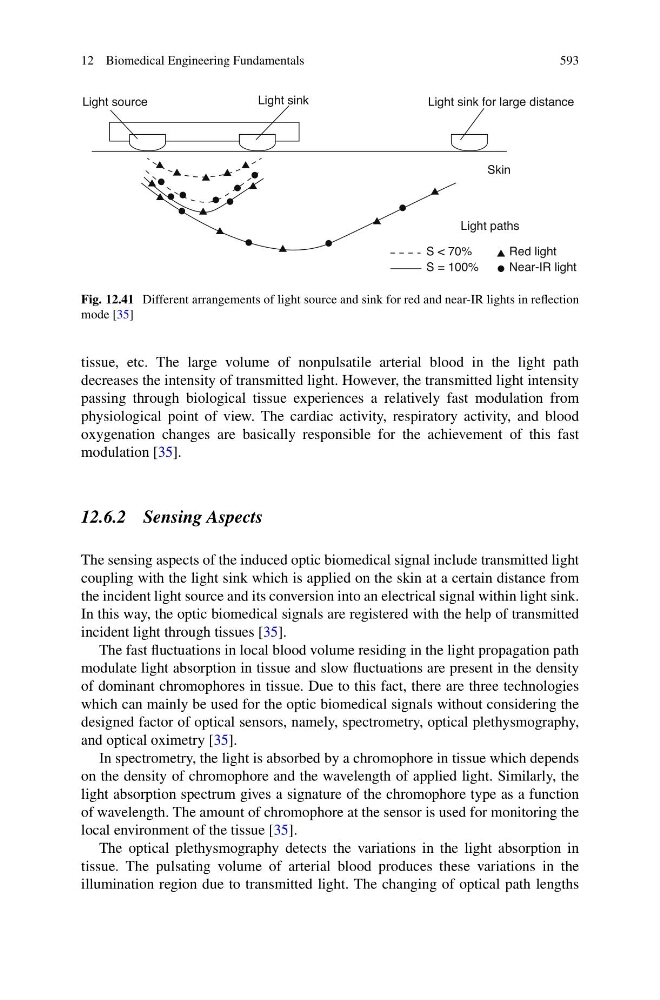
Light source
Light sink
Light sink for large distance
Skin
Light paths
S < 70%
Red light
Near-IR light
S = 100%
Fig. 12.41 Different arrangements of light source and sink for red and near-IR lights in reflection
mode [35]
tissue, etc. The large volume of nonpulsatile arterial blood in the light path
decreases the intensity of transmitted light. However, the transmitted light intensity
passing through biological tissue experiences a relatively fast modulation from
physiological point of view. The cardiac activity, respiratory activity, and blood
oxygenation changes are basically responsible for the achievement of this fast
modulation [35].
12.6.2 Sensing Aspects
The sensing aspects of the induced optic biomedical signal include transmitted light
coupling with the light sink which is applied on the skin at a certain distance from
the incident light source and its conversion into an electrical signal within light sink.
In this way, the optic biomedical signals are registered with the help of transmitted
incident light through tissues [35].
The fast fluctuations in local blood volume residing in the light propagation path
modulate light absorption in tissue and slow fluctuations are present in the density
of dominant chromophores in tissue. Due to this fact, there are three technologies
which can mainly be used for the optic biomedical signals without considering the
designed factor of optical sensors, namely, spectrometry, optical plethysmography,
and optical oximetry [35].
In spectrometry, the light is absorbed by a chromophore in tissue which depends
on the density of chromophore and the wavelength of applied light. Similarly, the
light absorption spectrum gives a signature of the chromophore type as a function
of wavelength. The amount of chromophore at the sensor is used for monitoring the
local environment of the tissue [35].
The optical plethysmography detects the variations in the light absorption in
tissue. The pulsating volume of arterial blood produces these variations in the
illumination region due to transmitted light. The changing of optical path lengths
593
Light source
Light sink
Light sink for large distance
Skin
Light paths
S < 70%
Red light
Near-IR light
S = 100%
Fig. 12.41 Different arrangements of light source and sink for red and near-IR lights in reflection
mode [35]
tissue, etc. The large volume of nonpulsatile arterial blood in the light path
decreases the intensity of transmitted light. However, the transmitted light intensity
passing through biological tissue experiences a relatively fast modulation from
physiological point of view. The cardiac activity, respiratory activity, and blood
oxygenation changes are basically responsible for the achievement of this fast
modulation [35].
12.6.2 Sensing Aspects
The sensing aspects of the induced optic biomedical signal include transmitted light
coupling with the light sink which is applied on the skin at a certain distance from
the incident light source and its conversion into an electrical signal within light sink.
In this way, the optic biomedical signals are registered with the help of transmitted
incident light through tissues [35].
The fast fluctuations in local blood volume residing in the light propagation path
modulate light absorption in tissue and slow fluctuations are present in the density
of dominant chromophores in tissue. Due to this fact, there are three technologies
which can mainly be used for the optic biomedical signals without considering the
designed factor of optical sensors, namely, spectrometry, optical plethysmography,
and optical oximetry [35].
In spectrometry, the light is absorbed by a chromophore in tissue which depends
on the density of chromophore and the wavelength of applied light. Similarly, the
light absorption spectrum gives a signature of the chromophore type as a function
of wavelength. The amount of chromophore at the sensor is used for monitoring the
local environment of the tissue [35].
The optical plethysmography detects the variations in the light absorption in
tissue. The pulsating volume of arterial blood produces these variations in the
illumination region due to transmitted light. The changing of optical path lengths