

576
R. B. Pachori and V. Gupta
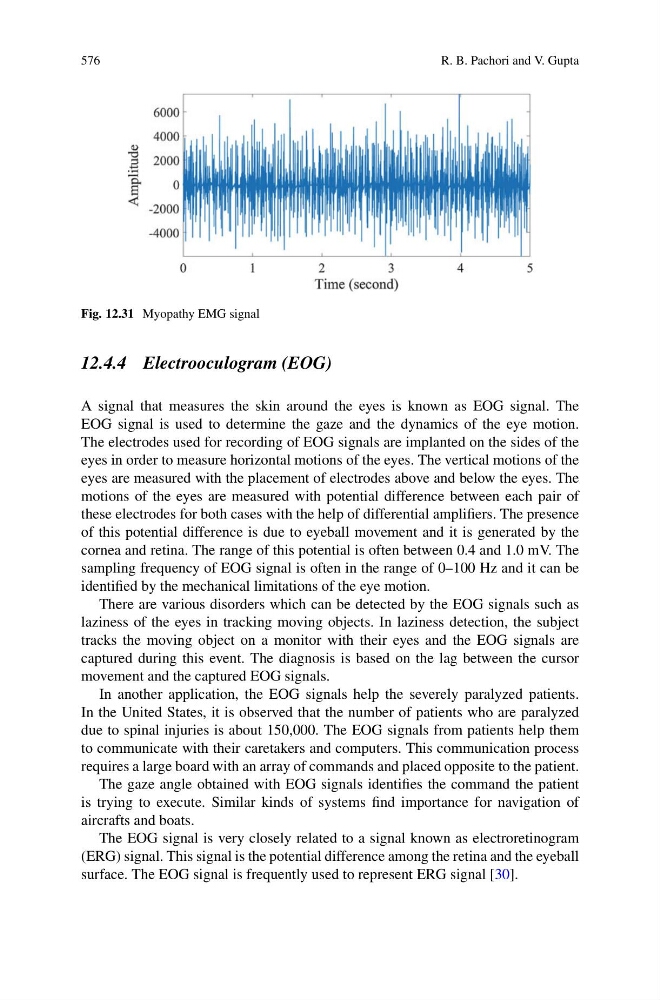
Fig. 12.31 Myopathy EMG signal
12.4.4 Electrooculogram (EOG)
A signal that measures the skin around the eyes is known as EOG signal. The
EOG signal is used to determine the gaze and the dynamics of the eye motion.
The electrodes used for recording of EOG signals are implanted on the sides of the
eyes in order to measure horizontal motions of the eyes. The vertical motions of the
eyes are measured with the placement of electrodes above and below the eyes. The
motions of the eyes are measured with potential difference between each pair of
these electrodes for both cases with the help of differential amplifiers. The presence
of this potential difference is due to eyeball movement and it is generated by the
cornea and retina. The range of this potential is often between 0.4 and 1.0 mV. The
sampling frequency of EOG signal is often in the range of 0–100 Hz and it can be
identified by the mechanical limitations of the eye motion.
There are various disorders which can be detected by the EOG signals such as
laziness of the eyes in tracking moving objects. In laziness detection, the subject
tracks the moving object on a monitor with their eyes and the EOG signals are
captured during this event. The diagnosis is based on the lag between the cursor
movement and the captured EOG signals.
In another application, the EOG signals help the severely paralyzed patients.
In the United States, it is observed that the number of patients who are paralyzed
due to spinal injuries is about 150,000. The EOG signals from patients help them
to communicate with their caretakers and computers. This communication process
requires a large board with an array of commands and placed opposite to the patient.
The gaze angle obtained with EOG signals identifies the command the patient
is trying to execute. Similar kinds of systems find importance for navigation of
aircrafts and boats.
The EOG signal is very closely related to a signal known as electroretinogram
(ERG) signal. This signal is the potential difference among the retina and the eyeball
surface. The EOG signal is frequently used to represent ERG signal [30].
R. B. Pachori and V. Gupta
Fig. 12.31 Myopathy EMG signal
12.4.4 Electrooculogram (EOG)
A signal that measures the skin around the eyes is known as EOG signal. The
EOG signal is used to determine the gaze and the dynamics of the eye motion.
The electrodes used for recording of EOG signals are implanted on the sides of the
eyes in order to measure horizontal motions of the eyes. The vertical motions of the
eyes are measured with the placement of electrodes above and below the eyes. The
motions of the eyes are measured with potential difference between each pair of
these electrodes for both cases with the help of differential amplifiers. The presence
of this potential difference is due to eyeball movement and it is generated by the
cornea and retina. The range of this potential is often between 0.4 and 1.0 mV. The
sampling frequency of EOG signal is often in the range of 0–100 Hz and it can be
identified by the mechanical limitations of the eye motion.
There are various disorders which can be detected by the EOG signals such as
laziness of the eyes in tracking moving objects. In laziness detection, the subject
tracks the moving object on a monitor with their eyes and the EOG signals are
captured during this event. The diagnosis is based on the lag between the cursor
movement and the captured EOG signals.
In another application, the EOG signals help the severely paralyzed patients.
In the United States, it is observed that the number of patients who are paralyzed
due to spinal injuries is about 150,000. The EOG signals from patients help them
to communicate with their caretakers and computers. This communication process
requires a large board with an array of commands and placed opposite to the patient.
The gaze angle obtained with EOG signals identifies the command the patient
is trying to execute. Similar kinds of systems find importance for navigation of
aircrafts and boats.
The EOG signal is very closely related to a signal known as electroretinogram
(ERG) signal. This signal is the potential difference among the retina and the eyeball
surface. The EOG signal is frequently used to represent ERG signal [30].