

12 Biomedical Engineering Fundamentals
569
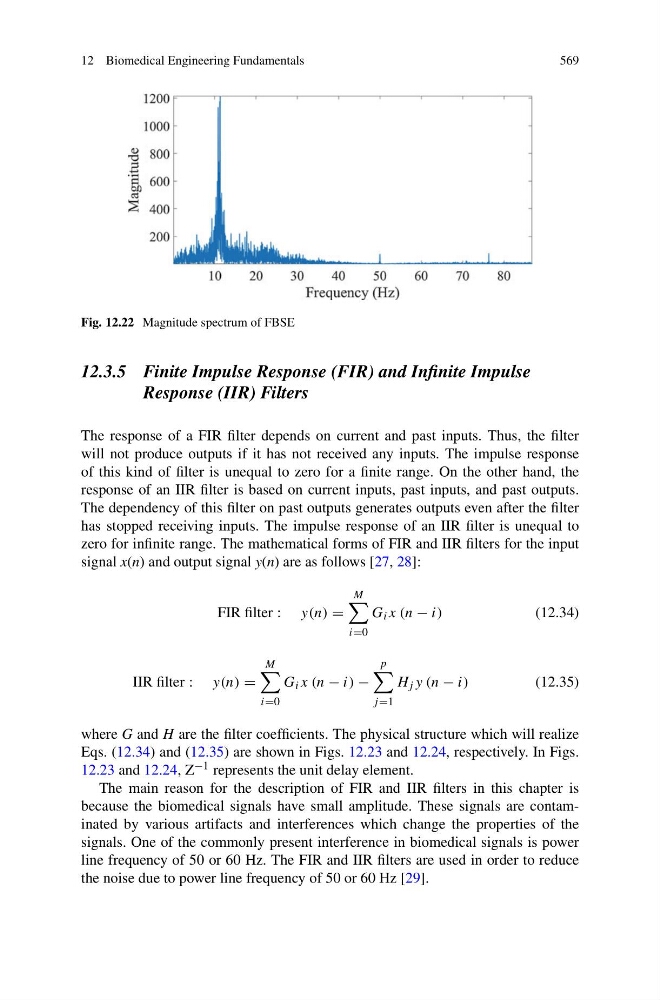
Fig. 12.22 Magnitude spectrum of FBSE
12.3.5 Finite Impulse Response (FIR) and Infinite Impulse
Response (IIR) Filters
The response of a FIR filter depends on current and past inputs. Thus, the filter
will not produce outputs if it has not received any inputs. The impulse response
of this kind of filter is unequal to zero for a finite range. On the other hand, the
response of an IIR filter is based on current inputs, past inputs, and past outputs.
The dependency of this filter on past outputs generates outputs even after the filter
has stopped receiving inputs. The impulse response of an IIR filter is unequal to
zero for infinite range. The mathematical forms of FIR and IIR filters for the input
signal x(n) and output signal y(n) are as follows [27, 28]:
FIR filter : y(n) =
M
i=0
G i x (n − i)
(12.34)
IIR filter : y(n) =
M
i=0
G i x (n − i) −
p
j =1
H j y (n − i)
(12.35)
where G and H are the filter coefficients. The physical structure which will realize
Eqs. (12.34) and (12.35) are shown in Figs. 12.23 and 12.24, respectively. In Figs.
12.23 and 12.24, Z −1 represents the unit delay element.
The main reason for the description of FIR and IIR filters in this chapter is
because the biomedical signals have small amplitude. These signals are contaminated by various artifacts and interferences which change the properties of the
signals. One of the commonly present interference in biomedical signals is power
line frequency of 50 or 60 Hz. The FIR and IIR filters are used in order to reduce
the noise due to power line frequency of 50 or 60 Hz [29].
569
Fig. 12.22 Magnitude spectrum of FBSE
12.3.5 Finite Impulse Response (FIR) and Infinite Impulse
Response (IIR) Filters
The response of a FIR filter depends on current and past inputs. Thus, the filter
will not produce outputs if it has not received any inputs. The impulse response
of this kind of filter is unequal to zero for a finite range. On the other hand, the
response of an IIR filter is based on current inputs, past inputs, and past outputs.
The dependency of this filter on past outputs generates outputs even after the filter
has stopped receiving inputs. The impulse response of an IIR filter is unequal to
zero for infinite range. The mathematical forms of FIR and IIR filters for the input
signal x(n) and output signal y(n) are as follows [27, 28]:
FIR filter : y(n) =
M
i=0
G i x (n − i)
(12.34)
IIR filter : y(n) =
M
i=0
G i x (n − i) −
p
j =1
H j y (n − i)
(12.35)
where G and H are the filter coefficients. The physical structure which will realize
Eqs. (12.34) and (12.35) are shown in Figs. 12.23 and 12.24, respectively. In Figs.
12.23 and 12.24, Z −1 represents the unit delay element.
The main reason for the description of FIR and IIR filters in this chapter is
because the biomedical signals have small amplitude. These signals are contaminated by various artifacts and interferences which change the properties of the
signals. One of the commonly present interference in biomedical signals is power
line frequency of 50 or 60 Hz. The FIR and IIR filters are used in order to reduce
the noise due to power line frequency of 50 or 60 Hz [29].