

12 Biomedical Engineering Fundamentals
555
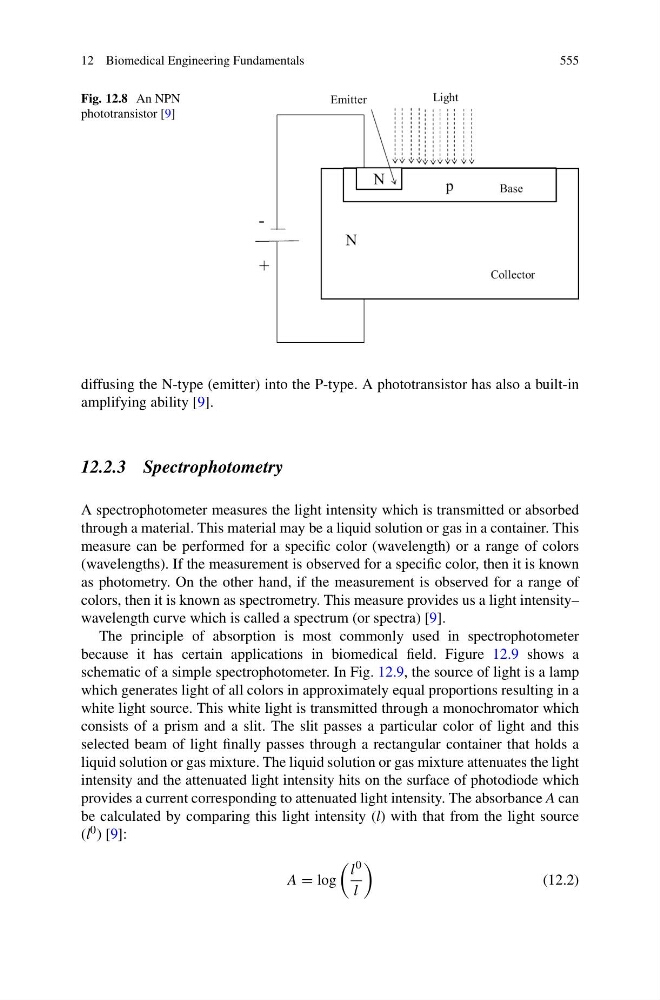
Fig. 12.8 An NPN
phototransistor [9]
diffusing the N-type (emitter) into the P-type. A phototransistor has also a built-in
amplifying ability [9].
12.2.3 Spectrophotometry
A spectrophotometer measures the light intensity which is transmitted or absorbed
through a material. This material may be a liquid solution or gas in a container. This
measure can be performed for a specific color (wavelength) or a range of colors
(wavelengths). If the measurement is observed for a specific color, then it is known
as photometry. On the other hand, if the measurement is observed for a range of
colors, then it is known as spectrometry. This measure provides us a light intensity–
wavelength curve which is called a spectrum (or spectra) [9].
The principle of absorption is most commonly used in spectrophotometer
because it has certain applications in biomedical field. Figure 12.9 shows a
schematic of a simple spectrophotometer. In Fig. 12.9, the source of light is a lamp
which generates light of all colors in approximately equal proportions resulting in a
white light source. This white light is transmitted through a monochromator which
consists of a prism and a slit. The slit passes a particular color of light and this
selected beam of light finally passes through a rectangular container that holds a
liquid solution or gas mixture. The liquid solution or gas mixture attenuates the light
intensity and the attenuated light intensity hits on the surface of photodiode which
provides a current corresponding to attenuated light intensity. The absorbance A can
be calculated by comparing this light intensity (l) with that from the light source
(l 0 ) [9]:
A = log
l 0
l
(12.2)
555
Fig. 12.8 An NPN
phototransistor [9]
diffusing the N-type (emitter) into the P-type. A phototransistor has also a built-in
amplifying ability [9].
12.2.3 Spectrophotometry
A spectrophotometer measures the light intensity which is transmitted or absorbed
through a material. This material may be a liquid solution or gas in a container. This
measure can be performed for a specific color (wavelength) or a range of colors
(wavelengths). If the measurement is observed for a specific color, then it is known
as photometry. On the other hand, if the measurement is observed for a range of
colors, then it is known as spectrometry. This measure provides us a light intensity–
wavelength curve which is called a spectrum (or spectra) [9].
The principle of absorption is most commonly used in spectrophotometer
because it has certain applications in biomedical field. Figure 12.9 shows a
schematic of a simple spectrophotometer. In Fig. 12.9, the source of light is a lamp
which generates light of all colors in approximately equal proportions resulting in a
white light source. This white light is transmitted through a monochromator which
consists of a prism and a slit. The slit passes a particular color of light and this
selected beam of light finally passes through a rectangular container that holds a
liquid solution or gas mixture. The liquid solution or gas mixture attenuates the light
intensity and the attenuated light intensity hits on the surface of photodiode which
provides a current corresponding to attenuated light intensity. The absorbance A can
be calculated by comparing this light intensity (l) with that from the light source
(l 0 ) [9]:
A = log
l 0
l
(12.2)