

12 Biomedical Engineering Fundamentals
553
12.2.2 Light Sensors
Light sensors are very important in many biosensor applications and are commonly
used in conjunction with fluorescent dyes. Light is basically a part of electromagnetic radiation which is visible to the eyes of humans, and it is known as visible
light. The word light is also used for some other electromagnetic radiations which
are not visible to the eyes of humans such as ultraviolet (UV) or infrared (IR).
The existence of light is basically in tiny energy packets which are known as
photons. The properties of waves and particles are exhibited by photons. In light,
the waves are sinusoidal and its peak-to-peak distance is called wavelength (λ). The
wavelength of light determines its color in visible light range. A light contains a
single wavelength (monochromatic) or multiple wavelengths (polychromatic). The
speed of light in vacuum is always constant and its value is 3 × 10 8 m/s [9].
The light sensors which are made out of semiconductors are photoresistor,
photodiode, and phototransistor, and the descriptions of these light sensors are as
follows [9].
12.2.2.1 Photoresistor
A photoresistor is a photoconductive cell which conducts only when it is exposed
to light. The semiconductor materials used for making photoresistor are cadmium
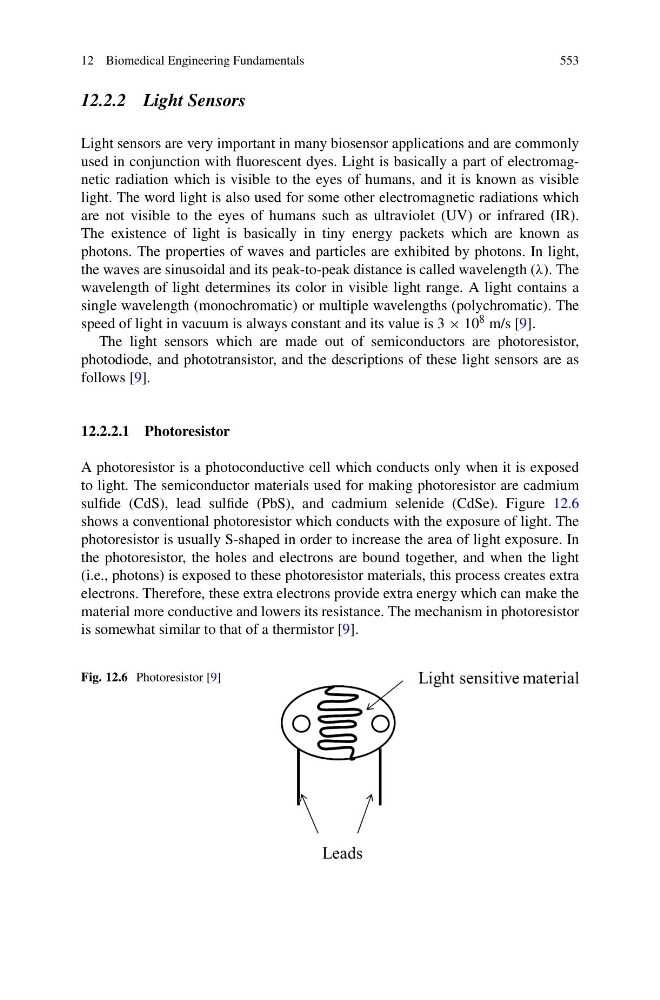
sulfide (CdS), lead sulfide (PbS), and cadmium selenide (CdSe). Figure 12.6
shows a conventional photoresistor which conducts with the exposure of light. The
photoresistor is usually S-shaped in order to increase the area of light exposure. In
the photoresistor, the holes and electrons are bound together, and when the light
(i.e., photons) is exposed to these photoresistor materials, this process creates extra
electrons. Therefore, these extra electrons provide extra energy which can make the
material more conductive and lowers its resistance. The mechanism in photoresistor
is somewhat similar to that of a thermistor [9].
Fig. 12.6 Photoresistor [9]
553
12.2.2 Light Sensors
Light sensors are very important in many biosensor applications and are commonly
used in conjunction with fluorescent dyes. Light is basically a part of electromagnetic radiation which is visible to the eyes of humans, and it is known as visible
light. The word light is also used for some other electromagnetic radiations which
are not visible to the eyes of humans such as ultraviolet (UV) or infrared (IR).
The existence of light is basically in tiny energy packets which are known as
photons. The properties of waves and particles are exhibited by photons. In light,
the waves are sinusoidal and its peak-to-peak distance is called wavelength (λ). The
wavelength of light determines its color in visible light range. A light contains a
single wavelength (monochromatic) or multiple wavelengths (polychromatic). The
speed of light in vacuum is always constant and its value is 3 × 10 8 m/s [9].
The light sensors which are made out of semiconductors are photoresistor,
photodiode, and phototransistor, and the descriptions of these light sensors are as
follows [9].
12.2.2.1 Photoresistor
A photoresistor is a photoconductive cell which conducts only when it is exposed
to light. The semiconductor materials used for making photoresistor are cadmium
sulfide (CdS), lead sulfide (PbS), and cadmium selenide (CdSe). Figure 12.6
shows a conventional photoresistor which conducts with the exposure of light. The
photoresistor is usually S-shaped in order to increase the area of light exposure. In
the photoresistor, the holes and electrons are bound together, and when the light
(i.e., photons) is exposed to these photoresistor materials, this process creates extra
electrons. Therefore, these extra electrons provide extra energy which can make the
material more conductive and lowers its resistance. The mechanism in photoresistor
is somewhat similar to that of a thermistor [9].
Fig. 12.6 Photoresistor [9]