

552
R. B. Pachori and V. Gupta
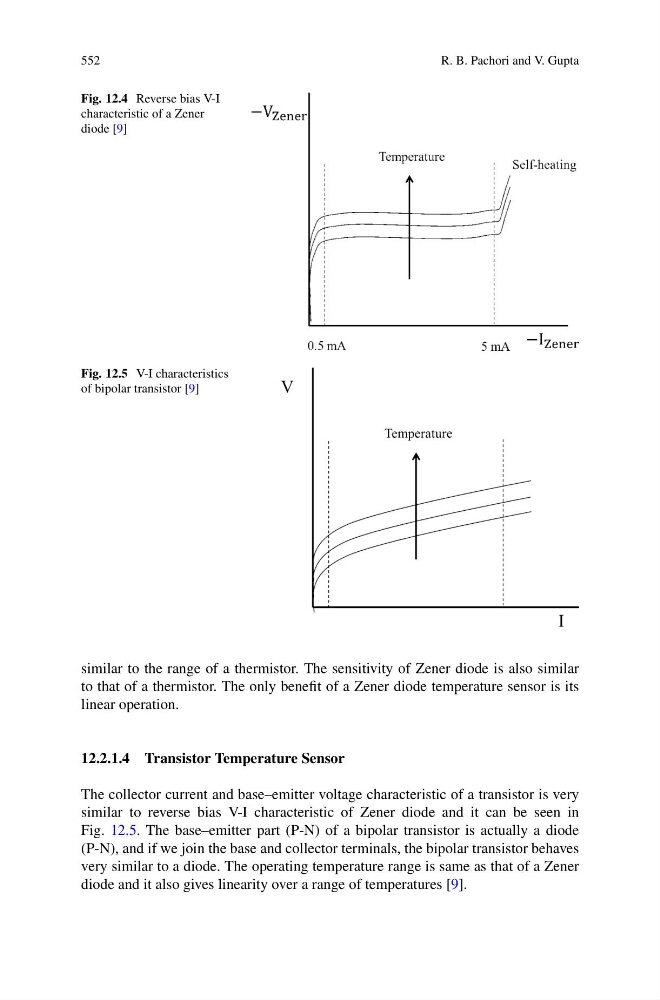
Fig. 12.4 Reverse bias V-I
characteristic of a Zener
diode [9]
Fig. 12.5 V-I characteristics
of bipolar transistor [9]
similar to the range of a thermistor. The sensitivity of Zener diode is also similar
to that of a thermistor. The only benefit of a Zener diode temperature sensor is its
linear operation.
12.2.1.4 Transistor Temperature Sensor
The collector current and base–emitter voltage characteristic of a transistor is very
similar to reverse bias V-I characteristic of Zener diode and it can be seen in
Fig. 12.5. The base–emitter part (P-N) of a bipolar transistor is actually a diode
(P-N), and if we join the base and collector terminals, the bipolar transistor behaves
very similar to a diode. The operating temperature range is same as that of a Zener
diode and it also gives linearity over a range of temperatures [9].
R. B. Pachori and V. Gupta
Fig. 12.4 Reverse bias V-I
characteristic of a Zener
diode [9]
Fig. 12.5 V-I characteristics
of bipolar transistor [9]
similar to the range of a thermistor. The sensitivity of Zener diode is also similar
to that of a thermistor. The only benefit of a Zener diode temperature sensor is its
linear operation.
12.2.1.4 Transistor Temperature Sensor
The collector current and base–emitter voltage characteristic of a transistor is very
similar to reverse bias V-I characteristic of Zener diode and it can be seen in
Fig. 12.5. The base–emitter part (P-N) of a bipolar transistor is actually a diode
(P-N), and if we join the base and collector terminals, the bipolar transistor behaves
very similar to a diode. The operating temperature range is same as that of a Zener
diode and it also gives linearity over a range of temperatures [9].