

12 Biomedical Engineering Fundamentals
551
12.2.1.2 Thermistor
The conventional resistors may also be used as temperature sensors because the voltage drop across a resistance is inversely proportional to the temperature. A special
type of resistance which is very sensitive to temperature is known as thermistor. The
relationship between temperature and resistance for thermistor can be approximated
through the use of the following curve-fitting equation as follows [9]:
1
T
= A + B ln(R) + C[ln(R)]
3
(12.1)
where T = degrees Kelvin (K), R = resistance of thermistor (), and A, B, and C
are curve-fitting constants. The abovementioned expression in (12.1) is called the
Steinhart–Hart equation.
12.2.1.3 Diode Temperature Sensor
In the category of diodes, the Zener diode is specifically used for temperature
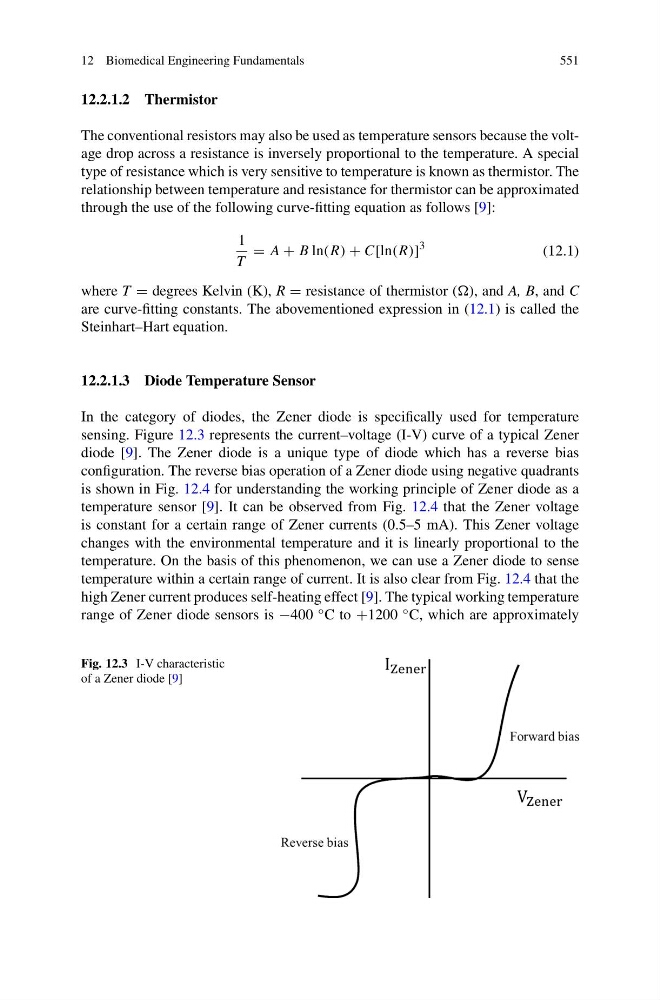
sensing. Figure 12.3 represents the current–voltage (I-V) curve of a typical Zener
diode [9]. The Zener diode is a unique type of diode which has a reverse bias
configuration. The reverse bias operation of a Zener diode using negative quadrants
is shown in Fig. 12.4 for understanding the working principle of Zener diode as a
temperature sensor [9]. It can be observed from Fig. 12.4 that the Zener voltage
is constant for a certain range of Zener currents (0.5–5 mA). This Zener voltage
changes with the environmental temperature and it is linearly proportional to the
temperature. On the basis of this phenomenon, we can use a Zener diode to sense
temperature within a certain range of current. It is also clear from Fig. 12.4 that the
high Zener current produces self-heating effect [9]. The typical working temperature
range of Zener diode sensors is −400 ◦ C to +1200 ◦ C, which are approximately
Fig. 12.3 I-V characteristic
of a Zener diode [9]
551
12.2.1.2 Thermistor
The conventional resistors may also be used as temperature sensors because the voltage drop across a resistance is inversely proportional to the temperature. A special
type of resistance which is very sensitive to temperature is known as thermistor. The
relationship between temperature and resistance for thermistor can be approximated
through the use of the following curve-fitting equation as follows [9]:
1
T
= A + B ln(R) + C[ln(R)]
3
(12.1)
where T = degrees Kelvin (K), R = resistance of thermistor (), and A, B, and C
are curve-fitting constants. The abovementioned expression in (12.1) is called the
Steinhart–Hart equation.
12.2.1.3 Diode Temperature Sensor
In the category of diodes, the Zener diode is specifically used for temperature
sensing. Figure 12.3 represents the current–voltage (I-V) curve of a typical Zener
diode [9]. The Zener diode is a unique type of diode which has a reverse bias
configuration. The reverse bias operation of a Zener diode using negative quadrants
is shown in Fig. 12.4 for understanding the working principle of Zener diode as a
temperature sensor [9]. It can be observed from Fig. 12.4 that the Zener voltage
is constant for a certain range of Zener currents (0.5–5 mA). This Zener voltage
changes with the environmental temperature and it is linearly proportional to the
temperature. On the basis of this phenomenon, we can use a Zener diode to sense
temperature within a certain range of current. It is also clear from Fig. 12.4 that the
high Zener current produces self-heating effect [9]. The typical working temperature
range of Zener diode sensors is −400 ◦ C to +1200 ◦ C, which are approximately
Fig. 12.3 I-V characteristic
of a Zener diode [9]