

550
R. B. Pachori and V. Gupta
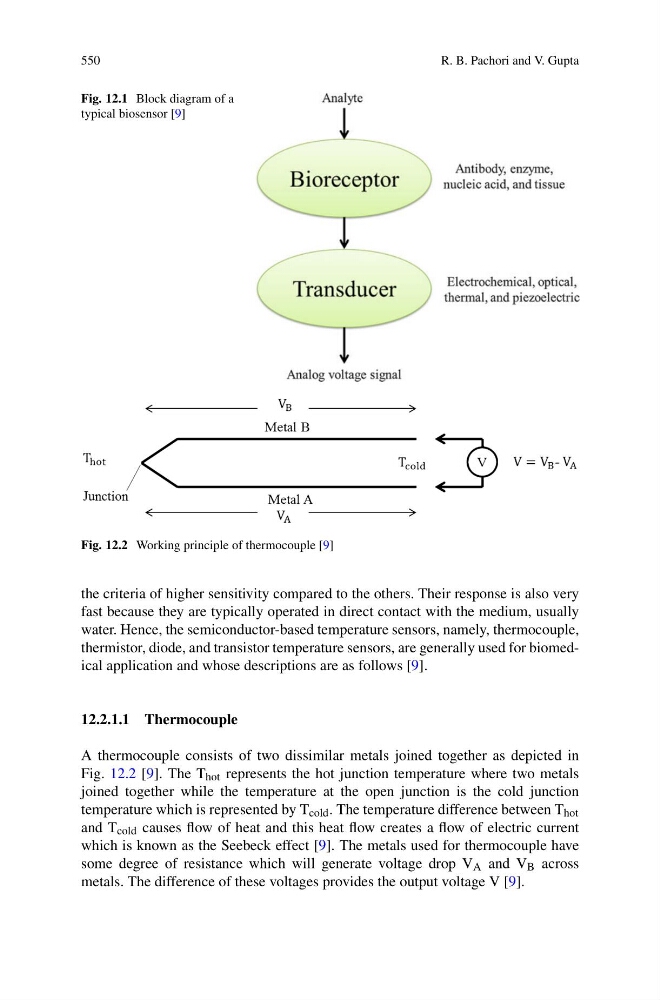
Fig. 12.1 Block diagram of a
typical biosensor [9]
Fig. 12.2 Working principle of thermocouple [9]
the criteria of higher sensitivity compared to the others. Their response is also very
fast because they are typically operated in direct contact with the medium, usually
water. Hence, the semiconductor-based temperature sensors, namely, thermocouple,
thermistor, diode, and transistor temperature sensors, are generally used for biomedical application and whose descriptions are as follows [9].
12.2.1.1 Thermocouple
A thermocouple consists of two dissimilar metals joined together as depicted in
Fig. 12.2 [9]. The T hot represents the hot junction temperature where two metals
joined together while the temperature at the open junction is the cold junction
temperature which is represented by T cold . The temperature difference between T hot
and T cold causes flow of heat and this heat flow creates a flow of electric current
which is known as the Seebeck effect [9]. The metals used for thermocouple have
some degree of resistance which will generate voltage drop V A and V B across
metals. The difference of these voltages provides the output voltage V [9].
R. B. Pachori and V. Gupta
Fig. 12.1 Block diagram of a
typical biosensor [9]
Fig. 12.2 Working principle of thermocouple [9]
the criteria of higher sensitivity compared to the others. Their response is also very
fast because they are typically operated in direct contact with the medium, usually
water. Hence, the semiconductor-based temperature sensors, namely, thermocouple,
thermistor, diode, and transistor temperature sensors, are generally used for biomedical application and whose descriptions are as follows [9].
12.2.1.1 Thermocouple
A thermocouple consists of two dissimilar metals joined together as depicted in
Fig. 12.2 [9]. The T hot represents the hot junction temperature where two metals
joined together while the temperature at the open junction is the cold junction
temperature which is represented by T cold . The temperature difference between T hot
and T cold causes flow of heat and this heat flow creates a flow of electric current
which is known as the Seebeck effect [9]. The metals used for thermocouple have
some degree of resistance which will generate voltage drop V A and V B across
metals. The difference of these voltages provides the output voltage V [9].