

414
X. Liu et al.
When Tangle gets started, it uses a coordinator to prevent malicious activities
because it does not have enough transaction nodes to conduct validation. This
coordinator will be obsolete after the IOTA network becomes more established. The
use of an initial coordinator creates the possibility of a central point of failure.
8.5 DAG Versus Blockchain
Similar to blockchains, DAGs store transactions on a distributed ledger. However,
the ledger is quite different in a blockchain than it is in a DAG. In a blockchain, the
distributed ledger is a chain of blocks which are built using transactions. Blocks are
validated and chained up in chronological order. Chained blocks are not modifiable.
A blockchain is very similar to a linked list concept in computer science. On the
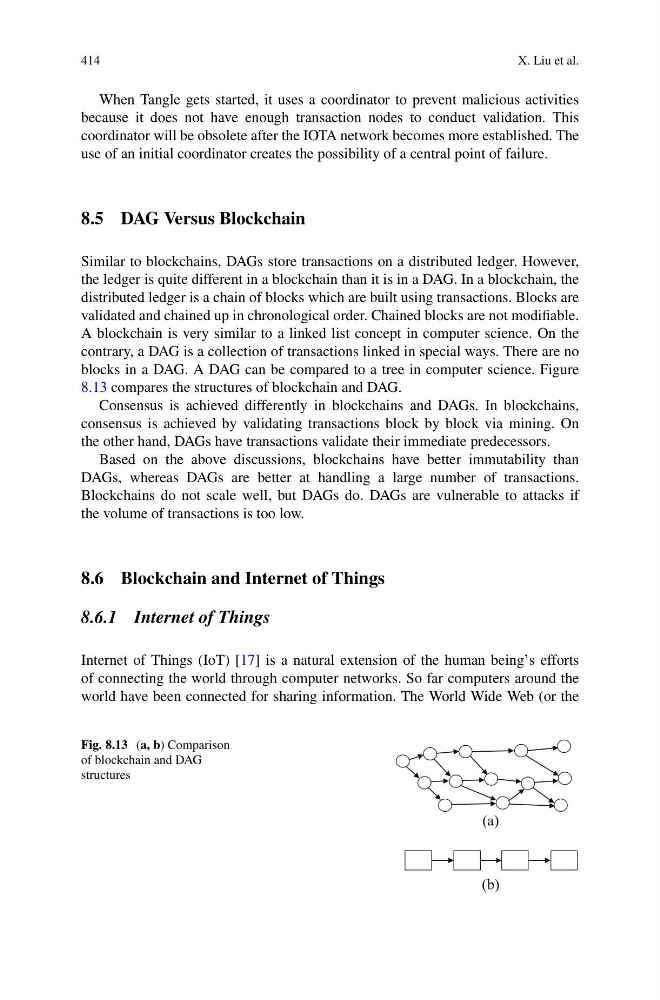
contrary, a DAG is a collection of transactions linked in special ways. There are no
blocks in a DAG. A DAG can be compared to a tree in computer science. Figure
8.13 compares the structures of blockchain and DAG.
Consensus is achieved differently in blockchains and DAGs. In blockchains,
consensus is achieved by validating transactions block by block via mining. On
the other hand, DAGs have transactions validate their immediate predecessors.
Based on the above discussions, blockchains have better immutability than
DAGs, whereas DAGs are better at handling a large number of transactions.
Blockchains do not scale well, but DAGs do. DAGs are vulnerable to attacks if
the volume of transactions is too low.
8.6 Blockchain and Internet of Things
8.6.1 Internet of Things
Internet of Things (IoT) [17] is a natural extension of the human being’s efforts
of connecting the world through computer networks. So far computers around the
world have been connected for sharing information. The World Wide Web (or the
Fig. 8.13 (a, b) Comparison
of blockchain and DAG
structures
(a)
(b)
X. Liu et al.
When Tangle gets started, it uses a coordinator to prevent malicious activities
because it does not have enough transaction nodes to conduct validation. This
coordinator will be obsolete after the IOTA network becomes more established. The
use of an initial coordinator creates the possibility of a central point of failure.
8.5 DAG Versus Blockchain
Similar to blockchains, DAGs store transactions on a distributed ledger. However,
the ledger is quite different in a blockchain than it is in a DAG. In a blockchain, the
distributed ledger is a chain of blocks which are built using transactions. Blocks are
validated and chained up in chronological order. Chained blocks are not modifiable.
A blockchain is very similar to a linked list concept in computer science. On the
contrary, a DAG is a collection of transactions linked in special ways. There are no
blocks in a DAG. A DAG can be compared to a tree in computer science. Figure
8.13 compares the structures of blockchain and DAG.
Consensus is achieved differently in blockchains and DAGs. In blockchains,
consensus is achieved by validating transactions block by block via mining. On
the other hand, DAGs have transactions validate their immediate predecessors.
Based on the above discussions, blockchains have better immutability than
DAGs, whereas DAGs are better at handling a large number of transactions.
Blockchains do not scale well, but DAGs do. DAGs are vulnerable to attacks if
the volume of transactions is too low.
8.6 Blockchain and Internet of Things
8.6.1 Internet of Things
Internet of Things (IoT) [17] is a natural extension of the human being’s efforts
of connecting the world through computer networks. So far computers around the
world have been connected for sharing information. The World Wide Web (or the
Fig. 8.13 (a, b) Comparison
of blockchain and DAG
structures
(a)
(b)