

8 Distributed Ledger Technology
413
8.4 Directed Acyclic Graph (DAG)
8.4.1 What Is a DAG
As discussed previously, DLT, or “distributed ledger technology,” has its set of
records (the ledger) held by multiple distributed nodes. For instance, the cryptocurrency Bitcoin has a blockchain which is a DLT with its ledger (transactions) stored
in multiple computers. Each new transaction added to the ledger is copied to other
computers. This ensures that multiple copies of the ledger are available.
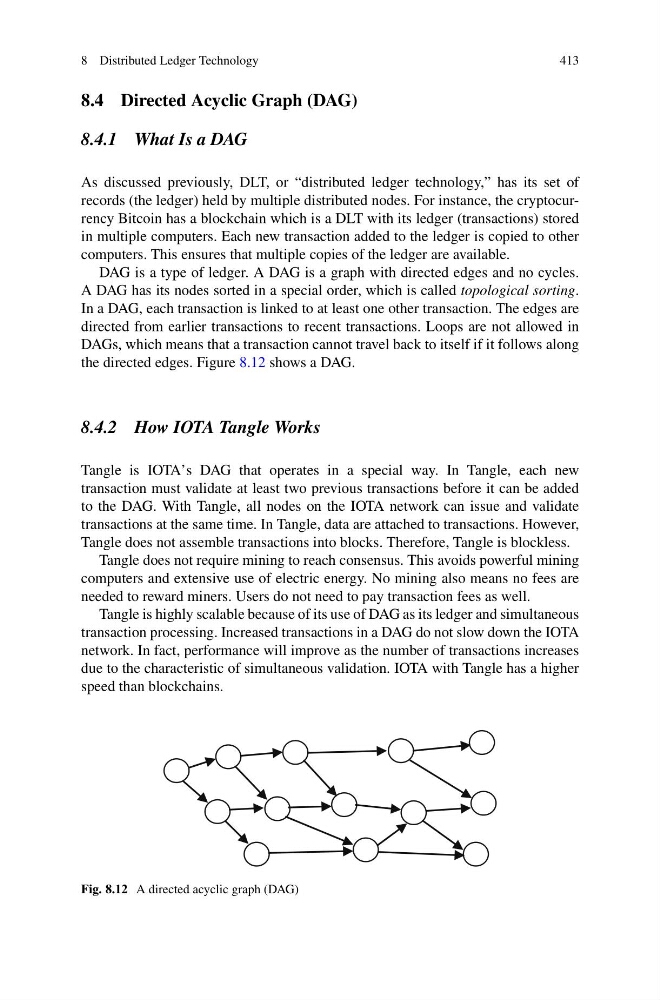
DAG is a type of ledger. A DAG is a graph with directed edges and no cycles.
A DAG has its nodes sorted in a special order, which is called topological sorting.
In a DAG, each transaction is linked to at least one other transaction. The edges are
directed from earlier transactions to recent transactions. Loops are not allowed in
DAGs, which means that a transaction cannot travel back to itself if it follows along
the directed edges. Figure 8.12 shows a DAG.
8.4.2 How IOTA Tangle Works
Tangle is IOTA’s DAG that operates in a special way. In Tangle, each new
transaction must validate at least two previous transactions before it can be added
to the DAG. With Tangle, all nodes on the IOTA network can issue and validate
transactions at the same time. In Tangle, data are attached to transactions. However,
Tangle does not assemble transactions into blocks. Therefore, Tangle is blockless.
Tangle does not require mining to reach consensus. This avoids powerful mining
computers and extensive use of electric energy. No mining also means no fees are
needed to reward miners. Users do not need to pay transaction fees as well.
Tangle is highly scalable because of its use of DAG as its ledger and simultaneous
transaction processing. Increased transactions in a DAG do not slow down the IOTA
network. In fact, performance will improve as the number of transactions increases
due to the characteristic of simultaneous validation. IOTA with Tangle has a higher
speed than blockchains.
Fig. 8.12 A directed acyclic graph (DAG)
413
8.4 Directed Acyclic Graph (DAG)
8.4.1 What Is a DAG
As discussed previously, DLT, or “distributed ledger technology,” has its set of
records (the ledger) held by multiple distributed nodes. For instance, the cryptocurrency Bitcoin has a blockchain which is a DLT with its ledger (transactions) stored
in multiple computers. Each new transaction added to the ledger is copied to other
computers. This ensures that multiple copies of the ledger are available.
DAG is a type of ledger. A DAG is a graph with directed edges and no cycles.
A DAG has its nodes sorted in a special order, which is called topological sorting.
In a DAG, each transaction is linked to at least one other transaction. The edges are
directed from earlier transactions to recent transactions. Loops are not allowed in
DAGs, which means that a transaction cannot travel back to itself if it follows along
the directed edges. Figure 8.12 shows a DAG.
8.4.2 How IOTA Tangle Works
Tangle is IOTA’s DAG that operates in a special way. In Tangle, each new
transaction must validate at least two previous transactions before it can be added
to the DAG. With Tangle, all nodes on the IOTA network can issue and validate
transactions at the same time. In Tangle, data are attached to transactions. However,
Tangle does not assemble transactions into blocks. Therefore, Tangle is blockless.
Tangle does not require mining to reach consensus. This avoids powerful mining
computers and extensive use of electric energy. No mining also means no fees are
needed to reward miners. Users do not need to pay transaction fees as well.
Tangle is highly scalable because of its use of DAG as its ledger and simultaneous
transaction processing. Increased transactions in a DAG do not slow down the IOTA
network. In fact, performance will improve as the number of transactions increases
due to the characteristic of simultaneous validation. IOTA with Tangle has a higher
speed than blockchains.
Fig. 8.12 A directed acyclic graph (DAG)