

7 Intelligent and Connected Cyber-Physical Systems: A Perspective. . .
373
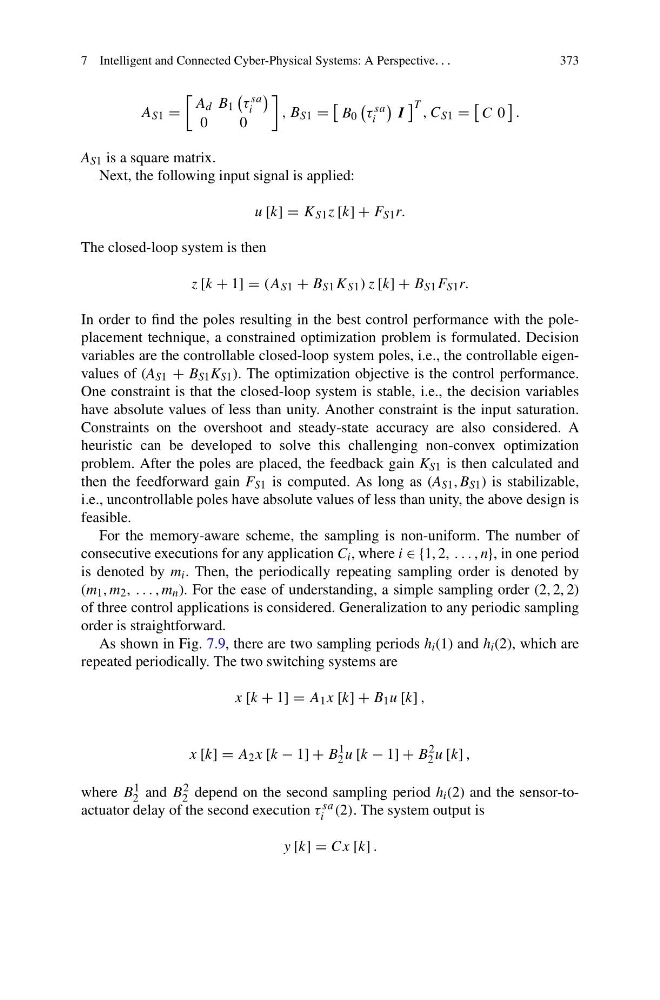
A S1 =
A d B 1
τ sa
i
0
0
, B S1 =
B 0
τ sa
i
I
T , C S1 =
C 0
.
A S1 is a square matrix.
Next, the following input signal is applied:
u [k] = K S1 z [k] + F S1 r.
The closed-loop system is then
z [k + 1] = (A S1 + B S1 K S1 ) z [k] + B S1 F S1 r.
In order to find the poles resulting in the best control performance with the poleplacement technique, a constrained optimization problem is formulated. Decision
variables are the controllable closed-loop system poles, i.e., the controllable eigenvalues of (A S1 + B S1 K S1 ). The optimization objective is the control performance.
One constraint is that the closed-loop system is stable, i.e., the decision variables
have absolute values of less than unity. Another constraint is the input saturation.
Constraints on the overshoot and steady-state accuracy are also considered. A
heuristic can be developed to solve this challenging non-convex optimization
problem. After the poles are placed, the feedback gain K S1 is then calculated and
then the feedforward gain F S1 is computed. As long as (A S1 , B S1 ) is stabilizable,
i.e., uncontrollable poles have absolute values of less than unity, the above design is
feasible.
For the memory-aware scheme, the sampling is non-uniform. The number of
consecutive executions for any application C i , where i ∈ {1, 2, . . . , n}, in one period
is denoted by m i . Then, the periodically repeating sampling order is denoted by
(m 1 , m 2 , . . . , m n ). For the ease of understanding, a simple sampling order (2, 2, 2)
of three control applications is considered. Generalization to any periodic sampling
order is straightforward.
As shown in Fig. 7.9, there are two sampling periods h i (1) and h i (2), which are
repeated periodically. The two switching systems are
x [k + 1] = A 1 x [k] + B 1 u [k] ,
x [k] = A 2 x [k − 1] + B
1
2 u [k − 1] + B
2
2 u [k] ,
where B 1
2 and B 2
2 depend on the second sampling period h i (2) and the sensor-toactuator delay of the second execution τ sa
i (2). The system output is
y [k] = Cx [k] .
373
A S1 =
A d B 1
τ sa
i
0
0
, B S1 =
B 0
τ sa
i
I
T , C S1 =
C 0
.
A S1 is a square matrix.
Next, the following input signal is applied:
u [k] = K S1 z [k] + F S1 r.
The closed-loop system is then
z [k + 1] = (A S1 + B S1 K S1 ) z [k] + B S1 F S1 r.
In order to find the poles resulting in the best control performance with the poleplacement technique, a constrained optimization problem is formulated. Decision
variables are the controllable closed-loop system poles, i.e., the controllable eigenvalues of (A S1 + B S1 K S1 ). The optimization objective is the control performance.
One constraint is that the closed-loop system is stable, i.e., the decision variables
have absolute values of less than unity. Another constraint is the input saturation.
Constraints on the overshoot and steady-state accuracy are also considered. A
heuristic can be developed to solve this challenging non-convex optimization
problem. After the poles are placed, the feedback gain K S1 is then calculated and
then the feedforward gain F S1 is computed. As long as (A S1 , B S1 ) is stabilizable,
i.e., uncontrollable poles have absolute values of less than unity, the above design is
feasible.
For the memory-aware scheme, the sampling is non-uniform. The number of
consecutive executions for any application C i , where i ∈ {1, 2, . . . , n}, in one period
is denoted by m i . Then, the periodically repeating sampling order is denoted by
(m 1 , m 2 , . . . , m n ). For the ease of understanding, a simple sampling order (2, 2, 2)
of three control applications is considered. Generalization to any periodic sampling
order is straightforward.
As shown in Fig. 7.9, there are two sampling periods h i (1) and h i (2), which are
repeated periodically. The two switching systems are
x [k + 1] = A 1 x [k] + B 1 u [k] ,
x [k] = A 2 x [k − 1] + B
1
2 u [k − 1] + B
2
2 u [k] ,
where B 1
2 and B 2
2 depend on the second sampling period h i (2) and the sensor-toactuator delay of the second execution τ sa
i (2). The system output is
y [k] = Cx [k] .