

358
W. Chang et al.
together with IoT (Internet of Things). There are different opinions on how they
relate to each other. We tend to think that IoT, while generally also involving both
cyber and physical components, emphasizes more on the connectivity as well as the
functionality enabled by such strong connectivity. CPS, on the other hand, stresses
the interactions between the cyber and physical aspects. An example that belongs to
CPS but not IoT is a vehicle without connection to the outside, neither other vehicles
nor any infrastructure.
There is a trend observed that CPS are getting better and better connected, thus
moving towards the regime of IoT. For instance, although the modern automobiles,
a typical class of CPS, commonly have modules for connection, they cannot be
classified as IoT, since such connection is not strong enough to enable significant
functionality. However, the automotive industry is moving towards connected
autonomous vehicles (CAVs), where the vehicle-to-vehicle (V2V) and vehicle-toinfrastructure (V2I) communication will completely change the way cars are driven,
together with various kinds of sensors and algorithms. This will then become part
of IoT.
Closed control loops are often found in CPS, and in each loop, there are three
main operations involving sensors, controllers, and actuators:
• Sensing: The states of the physical plants to be controlled are measured with
sensors.
• Computation: The control input is computed by the controllers based on the
measured plant states.
• Actuation: The control input is applied to the plant through actuators.
The plant dynamics is then influenced by the control input, closing the loop.
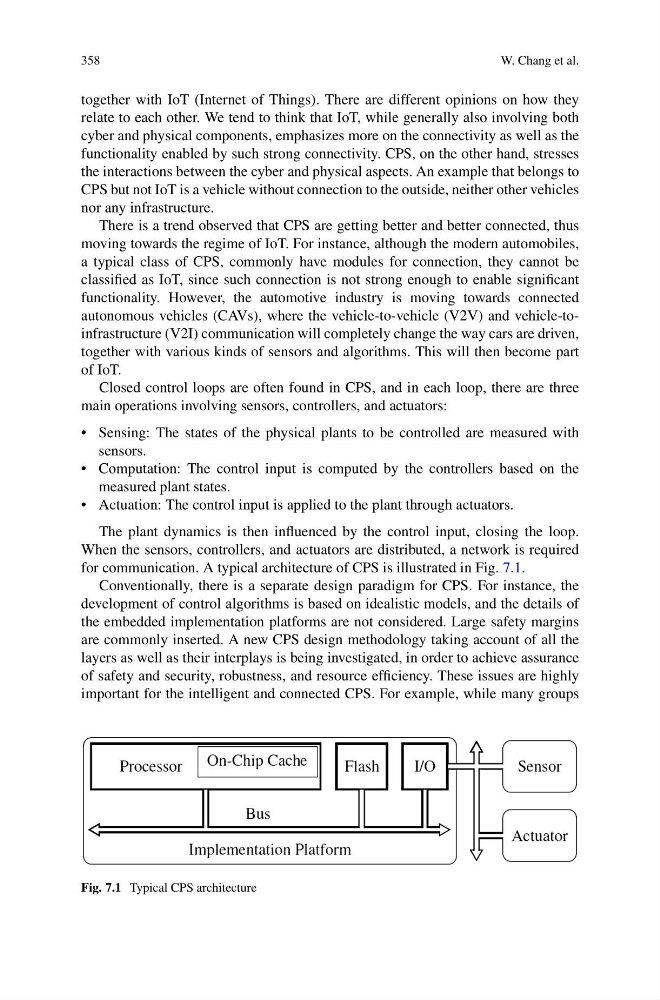
When the sensors, controllers, and actuators are distributed, a network is required
for communication. A typical architecture of CPS is illustrated in Fig. 7.1.
Conventionally, there is a separate design paradigm for CPS. For instance, the
development of control algorithms is based on idealistic models, and the details of
the embedded implementation platforms are not considered. Large safety margins
are commonly inserted. A new CPS design methodology taking account of all the
layers as well as their interplays is being investigated, in order to achieve assurance
of safety and security, robustness, and resource efficiency. These issues are highly
important for the intelligent and connected CPS. For example, while many groups
Fig. 7.1 Typical CPS architecture
W. Chang et al.
together with IoT (Internet of Things). There are different opinions on how they
relate to each other. We tend to think that IoT, while generally also involving both
cyber and physical components, emphasizes more on the connectivity as well as the
functionality enabled by such strong connectivity. CPS, on the other hand, stresses
the interactions between the cyber and physical aspects. An example that belongs to
CPS but not IoT is a vehicle without connection to the outside, neither other vehicles
nor any infrastructure.
There is a trend observed that CPS are getting better and better connected, thus
moving towards the regime of IoT. For instance, although the modern automobiles,
a typical class of CPS, commonly have modules for connection, they cannot be
classified as IoT, since such connection is not strong enough to enable significant
functionality. However, the automotive industry is moving towards connected
autonomous vehicles (CAVs), where the vehicle-to-vehicle (V2V) and vehicle-toinfrastructure (V2I) communication will completely change the way cars are driven,
together with various kinds of sensors and algorithms. This will then become part
of IoT.
Closed control loops are often found in CPS, and in each loop, there are three
main operations involving sensors, controllers, and actuators:
• Sensing: The states of the physical plants to be controlled are measured with
sensors.
• Computation: The control input is computed by the controllers based on the
measured plant states.
• Actuation: The control input is applied to the plant through actuators.
The plant dynamics is then influenced by the control input, closing the loop.
When the sensors, controllers, and actuators are distributed, a network is required
for communication. A typical architecture of CPS is illustrated in Fig. 7.1.
Conventionally, there is a separate design paradigm for CPS. For instance, the
development of control algorithms is based on idealistic models, and the details of
the embedded implementation platforms are not considered. Large safety margins
are commonly inserted. A new CPS design methodology taking account of all the
layers as well as their interplays is being investigated, in order to achieve assurance
of safety and security, robustness, and resource efficiency. These issues are highly
important for the intelligent and connected CPS. For example, while many groups
Fig. 7.1 Typical CPS architecture