

5 Machine Learning for IoT
283
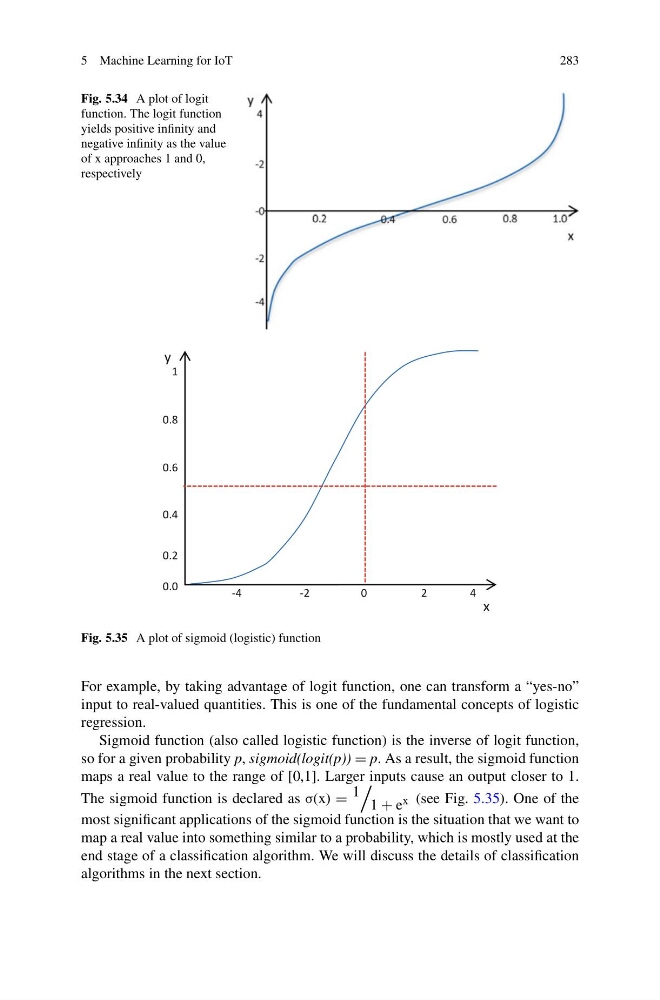
Fig. 5.34 A plot of logit
function. The logit function
yields positive infinity and
negative infinity as the value
of x approaches 1 and 0,
respectively
-4
-2
0
2
4
0.2
0.4
0.6
0.8
1
x
y
0.0
Fig. 5.35 A plot of sigmoid (logistic) function
For example, by taking advantage of logit function, one can transform a “yes-no”
input to real-valued quantities. This is one of the fundamental concepts of logistic
regression.
Sigmoid function (also called logistic function) is the inverse of logit function,
so for a given probability p, sigmoid(logit(p)) = p. As a result, the sigmoid function
maps a real value to the range of [0,1]. Larger inputs cause an output closer to 1.
The sigmoid function is declared as σ(x) = 1
1 + e x (see Fig. 5.35). One of the
most significant applications of the sigmoid function is the situation that we want to
map a real value into something similar to a probability, which is mostly used at the
end stage of a classification algorithm. We will discuss the details of classification
algorithms in the next section.
283
Fig. 5.34 A plot of logit
function. The logit function
yields positive infinity and
negative infinity as the value
of x approaches 1 and 0,
respectively
-4
-2
0
2
4
0.2
0.4
0.6
0.8
1
x
y
0.0
Fig. 5.35 A plot of sigmoid (logistic) function
For example, by taking advantage of logit function, one can transform a “yes-no”
input to real-valued quantities. This is one of the fundamental concepts of logistic
regression.
Sigmoid function (also called logistic function) is the inverse of logit function,
so for a given probability p, sigmoid(logit(p)) = p. As a result, the sigmoid function
maps a real value to the range of [0,1]. Larger inputs cause an output closer to 1.
The sigmoid function is declared as σ(x) = 1
1 + e x (see Fig. 5.35). One of the
most significant applications of the sigmoid function is the situation that we want to
map a real value into something similar to a probability, which is mostly used at the
end stage of a classification algorithm. We will discuss the details of classification
algorithms in the next section.