

3 Engineering IoT Networks
165
Localization
Application
Locator
Locator
Locator
Tag
Locator
Beacon
Locator
Beacon
Locator
Beacon
Localization
Application
a
b
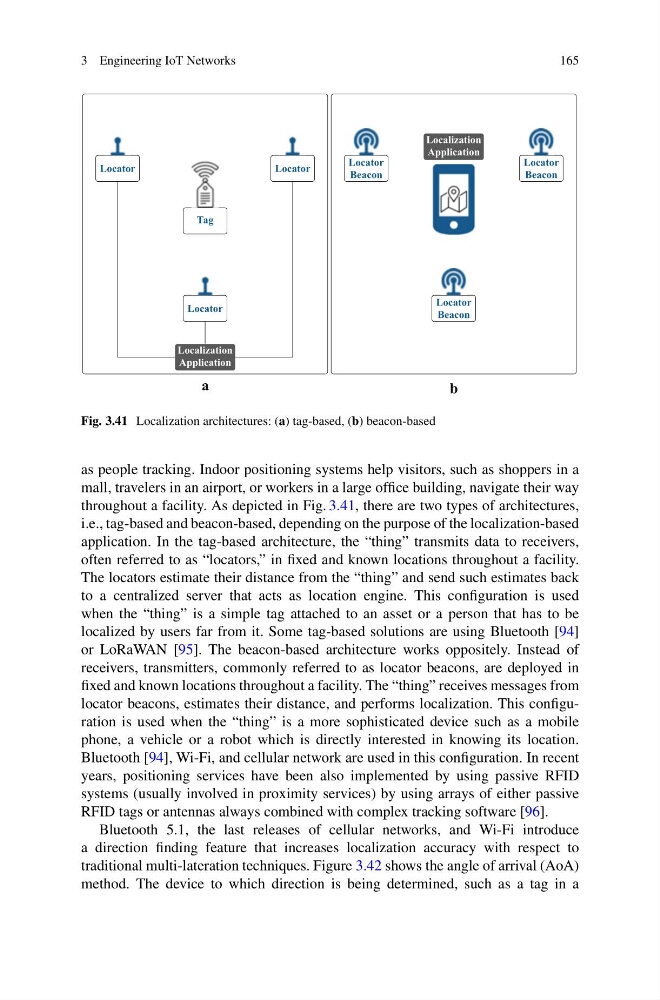
Fig. 3.41 Localization architectures: (a) tag-based, (b) beacon-based
as people tracking. Indoor positioning systems help visitors, such as shoppers in a
mall, travelers in an airport, or workers in a large office building, navigate their way
throughout a facility. As depicted in Fig. 3.41, there are two types of architectures,
i.e., tag-based and beacon-based, depending on the purpose of the localization-based
application. In the tag-based architecture, the “thing” transmits data to receivers,
often referred to as “locators,” in fixed and known locations throughout a facility.
The locators estimate their distance from the “thing” and send such estimates back
to a centralized server that acts as location engine. This configuration is used
when the “thing” is a simple tag attached to an asset or a person that has to be
localized by users far from it. Some tag-based solutions are using Bluetooth [94]
or LoRaWAN [95]. The beacon-based architecture works oppositely. Instead of
receivers, transmitters, commonly referred to as locator beacons, are deployed in
fixed and known locations throughout a facility. The “thing” receives messages from
locator beacons, estimates their distance, and performs localization. This configuration is used when the “thing” is a more sophisticated device such as a mobile
phone, a vehicle or a robot which is directly interested in knowing its location.
Bluetooth [94], Wi-Fi, and cellular network are used in this configuration. In recent
years, positioning services have been also implemented by using passive RFID
systems (usually involved in proximity services) by using arrays of either passive
RFID tags or antennas always combined with complex tracking software [96].
Bluetooth 5.1, the last releases of cellular networks, and Wi-Fi introduce
a direction finding feature that increases localization accuracy with respect to
traditional multi-lateration techniques. Figure 3.42 shows the angle of arrival (AoA)
method. The device to which direction is being determined, such as a tag in a
165
Localization
Application
Locator
Locator
Locator
Tag
Locator
Beacon
Locator
Beacon
Locator
Beacon
Localization
Application
a
b
Fig. 3.41 Localization architectures: (a) tag-based, (b) beacon-based
as people tracking. Indoor positioning systems help visitors, such as shoppers in a
mall, travelers in an airport, or workers in a large office building, navigate their way
throughout a facility. As depicted in Fig. 3.41, there are two types of architectures,
i.e., tag-based and beacon-based, depending on the purpose of the localization-based
application. In the tag-based architecture, the “thing” transmits data to receivers,
often referred to as “locators,” in fixed and known locations throughout a facility.
The locators estimate their distance from the “thing” and send such estimates back
to a centralized server that acts as location engine. This configuration is used
when the “thing” is a simple tag attached to an asset or a person that has to be
localized by users far from it. Some tag-based solutions are using Bluetooth [94]
or LoRaWAN [95]. The beacon-based architecture works oppositely. Instead of
receivers, transmitters, commonly referred to as locator beacons, are deployed in
fixed and known locations throughout a facility. The “thing” receives messages from
locator beacons, estimates their distance, and performs localization. This configuration is used when the “thing” is a more sophisticated device such as a mobile
phone, a vehicle or a robot which is directly interested in knowing its location.
Bluetooth [94], Wi-Fi, and cellular network are used in this configuration. In recent
years, positioning services have been also implemented by using passive RFID
systems (usually involved in proximity services) by using arrays of either passive
RFID tags or antennas always combined with complex tracking software [96].
Bluetooth 5.1, the last releases of cellular networks, and Wi-Fi introduce
a direction finding feature that increases localization accuracy with respect to
traditional multi-lateration techniques. Figure 3.42 shows the angle of arrival (AoA)
method. The device to which direction is being determined, such as a tag in a