

166
E. Fraccaroli and D. Quaglia
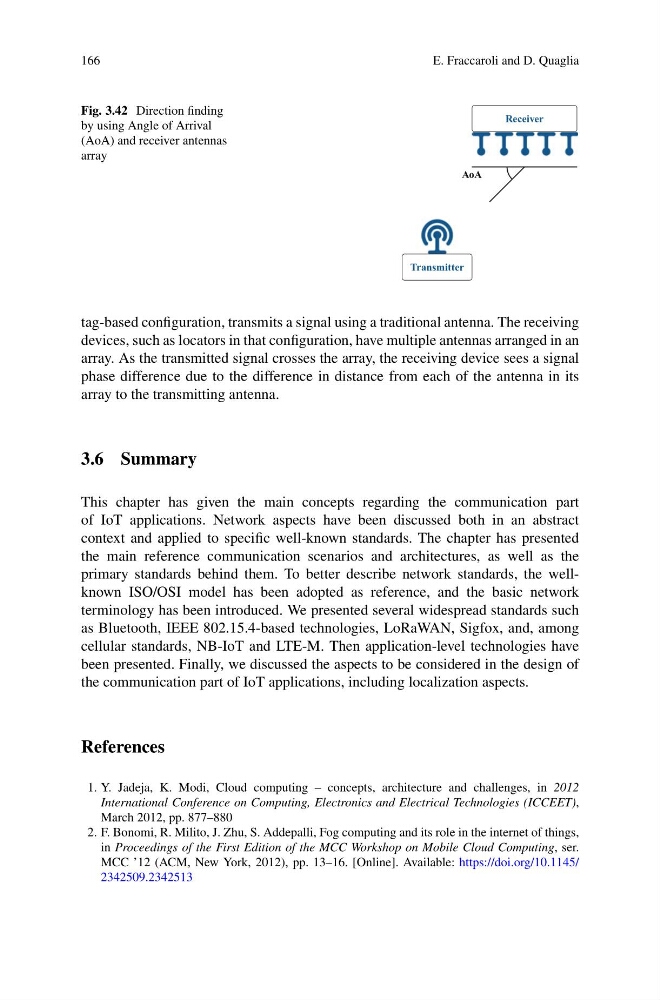
Fig. 3.42 Direction finding
by using Angle of Arrival
(AoA) and receiver antennas
array
Transmitter
Receiver
AoA
tag-based configuration, transmits a signal using a traditional antenna. The receiving
devices, such as locators in that configuration, have multiple antennas arranged in an
array. As the transmitted signal crosses the array, the receiving device sees a signal
phase difference due to the difference in distance from each of the antenna in its
array to the transmitting antenna.
3.6 Summary
This chapter has given the main concepts regarding the communication part
of IoT applications. Network aspects have been discussed both in an abstract
context and applied to specific well-known standards. The chapter has presented
the main reference communication scenarios and architectures, as well as the
primary standards behind them. To better describe network standards, the wellknown ISO/OSI model has been adopted as reference, and the basic network
terminology has been introduced. We presented several widespread standards such
as Bluetooth, IEEE 802.15.4-based technologies, LoRaWAN, Sigfox, and, among
cellular standards, NB-IoT and LTE-M. Then application-level technologies have
been presented. Finally, we discussed the aspects to be considered in the design of
the communication part of IoT applications, including localization aspects.
References
1. Y. Jadeja, K. Modi, Cloud computing – concepts, architecture and challenges, in 2012
International Conference on Computing, Electronics and Electrical Technologies (ICCEET),
March 2012, pp. 877–880
2. F. Bonomi, R. Milito, J. Zhu, S. Addepalli, Fog computing and its role in the internet of things,
in Proceedings of the First Edition of the MCC Workshop on Mobile Cloud Computing, ser.
MCC ’12 (ACM, New York, 2012), pp. 13–16. [Online]. Available: https://doi.org/10.1145/
2342509.2342513
E. Fraccaroli and D. Quaglia
Fig. 3.42 Direction finding
by using Angle of Arrival
(AoA) and receiver antennas
array
Transmitter
Receiver
AoA
tag-based configuration, transmits a signal using a traditional antenna. The receiving
devices, such as locators in that configuration, have multiple antennas arranged in an
array. As the transmitted signal crosses the array, the receiving device sees a signal
phase difference due to the difference in distance from each of the antenna in its
array to the transmitting antenna.
3.6 Summary
This chapter has given the main concepts regarding the communication part
of IoT applications. Network aspects have been discussed both in an abstract
context and applied to specific well-known standards. The chapter has presented
the main reference communication scenarios and architectures, as well as the
primary standards behind them. To better describe network standards, the wellknown ISO/OSI model has been adopted as reference, and the basic network
terminology has been introduced. We presented several widespread standards such
as Bluetooth, IEEE 802.15.4-based technologies, LoRaWAN, Sigfox, and, among
cellular standards, NB-IoT and LTE-M. Then application-level technologies have
been presented. Finally, we discussed the aspects to be considered in the design of
the communication part of IoT applications, including localization aspects.
References
1. Y. Jadeja, K. Modi, Cloud computing – concepts, architecture and challenges, in 2012
International Conference on Computing, Electronics and Electrical Technologies (ICCEET),
March 2012, pp. 877–880
2. F. Bonomi, R. Milito, J. Zhu, S. Addepalli, Fog computing and its role in the internet of things,
in Proceedings of the First Edition of the MCC Workshop on Mobile Cloud Computing, ser.
MCC ’12 (ACM, New York, 2012), pp. 13–16. [Online]. Available: https://doi.org/10.1145/
2342509.2342513