

164
E. Fraccaroli and D. Quaglia
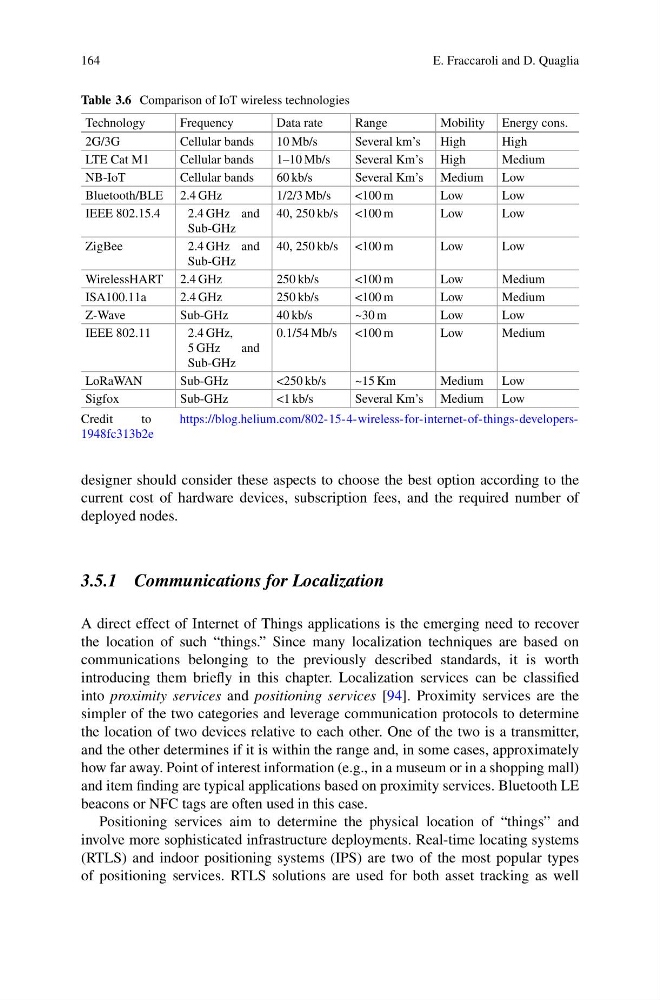
Table 3.6 Comparison of IoT wireless technologies
Technology
Frequency
Data rate
Range
Mobility Energy cons.
2G/3G
Cellular bands
10 Mb/s
Several km’s
High
High
LTE Cat M1
Cellular bands
1–10 Mb/s
Several Km’s High
Medium
NB-IoT
Cellular bands
60 kb/s
Several Km’s Medium Low
Bluetooth/BLE 2.4 GHz
1/2/3 Mb/s
<100 m
Low
Low
IEEE 802.15.4
2.4 GHz and
Sub-GHz
40, 250 kb/s <100 m
Low
Low
ZigBee
2.4 GHz and
Sub-GHz
40, 250 kb/s <100 m
Low
Low
WirelessHART 2.4 GHz
250 kb/s
<100 m
Low
Medium
ISA100.11a
2.4 GHz
250 kb/s
<100 m
Low
Medium
Z-Wave
Sub-GHz
40 kb/s
~30 m
Low
Low
IEEE 802.11
2.4 GHz,
5 GHz
and
Sub-GHz
0.1/54 Mb/s <100 m
Low
Medium
LoRaWAN
Sub-GHz
<250 kb/s
~15 Km
Medium Low
Sigfox
Sub-GHz
<1 kb/s
Several Km’s Medium Low
Credit
to
https://blog.helium.com/802-15-4-wireless-for-internet-of-things-developers1948fc313b2e
designer should consider these aspects to choose the best option according to the
current cost of hardware devices, subscription fees, and the required number of
deployed nodes.
3.5.1 Communications for Localization
A direct effect of Internet of Things applications is the emerging need to recover
the location of such “things.” Since many localization techniques are based on
communications belonging to the previously described standards, it is worth
introducing them briefly in this chapter. Localization services can be classified
into proximity services and positioning services [94]. Proximity services are the
simpler of the two categories and leverage communication protocols to determine
the location of two devices relative to each other. One of the two is a transmitter,
and the other determines if it is within the range and, in some cases, approximately
how far away. Point of interest information (e.g., in a museum or in a shopping mall)
and item finding are typical applications based on proximity services. Bluetooth LE
beacons or NFC tags are often used in this case.
Positioning services aim to determine the physical location of “things” and
involve more sophisticated infrastructure deployments. Real-time locating systems
(RTLS) and indoor positioning systems (IPS) are two of the most popular types
of positioning services. RTLS solutions are used for both asset tracking as well
E. Fraccaroli and D. Quaglia
Table 3.6 Comparison of IoT wireless technologies
Technology
Frequency
Data rate
Range
Mobility Energy cons.
2G/3G
Cellular bands
10 Mb/s
Several km’s
High
High
LTE Cat M1
Cellular bands
1–10 Mb/s
Several Km’s High
Medium
NB-IoT
Cellular bands
60 kb/s
Several Km’s Medium Low
Bluetooth/BLE 2.4 GHz
1/2/3 Mb/s
<100 m
Low
Low
IEEE 802.15.4
2.4 GHz and
Sub-GHz
40, 250 kb/s <100 m
Low
Low
ZigBee
2.4 GHz and
Sub-GHz
40, 250 kb/s <100 m
Low
Low
WirelessHART 2.4 GHz
250 kb/s
<100 m
Low
Medium
ISA100.11a
2.4 GHz
250 kb/s
<100 m
Low
Medium
Z-Wave
Sub-GHz
40 kb/s
~30 m
Low
Low
IEEE 802.11
2.4 GHz,
5 GHz
and
Sub-GHz
0.1/54 Mb/s <100 m
Low
Medium
LoRaWAN
Sub-GHz
<250 kb/s
~15 Km
Medium Low
Sigfox
Sub-GHz
<1 kb/s
Several Km’s Medium Low
Credit
to
https://blog.helium.com/802-15-4-wireless-for-internet-of-things-developers1948fc313b2e
designer should consider these aspects to choose the best option according to the
current cost of hardware devices, subscription fees, and the required number of
deployed nodes.
3.5.1 Communications for Localization
A direct effect of Internet of Things applications is the emerging need to recover
the location of such “things.” Since many localization techniques are based on
communications belonging to the previously described standards, it is worth
introducing them briefly in this chapter. Localization services can be classified
into proximity services and positioning services [94]. Proximity services are the
simpler of the two categories and leverage communication protocols to determine
the location of two devices relative to each other. One of the two is a transmitter,
and the other determines if it is within the range and, in some cases, approximately
how far away. Point of interest information (e.g., in a museum or in a shopping mall)
and item finding are typical applications based on proximity services. Bluetooth LE
beacons or NFC tags are often used in this case.
Positioning services aim to determine the physical location of “things” and
involve more sophisticated infrastructure deployments. Real-time locating systems
(RTLS) and indoor positioning systems (IPS) are two of the most popular types
of positioning services. RTLS solutions are used for both asset tracking as well