

130
E. Fraccaroli and D. Quaglia
Application
LoRaWAN
Slave
LoRaWAN
MAC
LoRa PHY Layer
(LoRaPHY)
End device
Packet Forwarding
LoRaWAN
MAC
Backhaul
Stack
LoRa PHY Layer
(LoRaGwPHY)
Gateway
Packet Forwarding
LoRaWAN
Master
Backhaul
Stack
Internet
Stack
Network Server
Application
Internet
Stack
Application Server
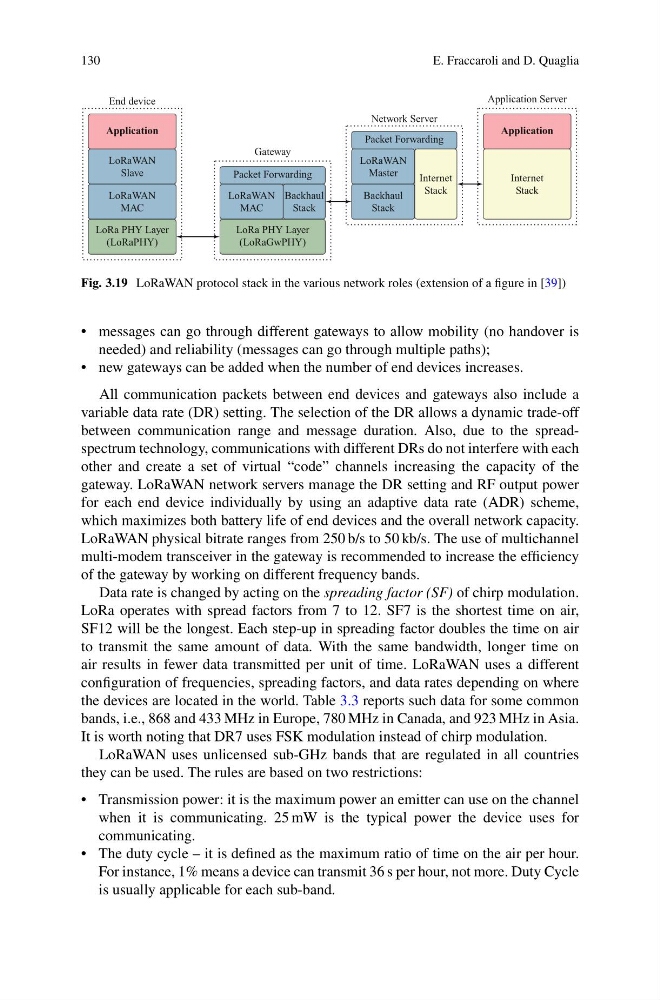
Fig. 3.19 LoRaWAN protocol stack in the various network roles (extension of a figure in [39])
• messages can go through different gateways to allow mobility (no handover is
needed) and reliability (messages can go through multiple paths);
• new gateways can be added when the number of end devices increases.
All communication packets between end devices and gateways also include a
variable data rate (DR) setting. The selection of the DR allows a dynamic trade-off
between communication range and message duration. Also, due to the spreadspectrum technology, communications with different DRs do not interfere with each
other and create a set of virtual “code” channels increasing the capacity of the
gateway. LoRaWAN network servers manage the DR setting and RF output power
for each end device individually by using an adaptive data rate (ADR) scheme,
which maximizes both battery life of end devices and the overall network capacity.
LoRaWAN physical bitrate ranges from 250 b/s to 50 kb/s. The use of multichannel
multi-modem transceiver in the gateway is recommended to increase the efficiency
of the gateway by working on different frequency bands.
Data rate is changed by acting on the spreading factor (SF) of chirp modulation.
LoRa operates with spread factors from 7 to 12. SF7 is the shortest time on air,
SF12 will be the longest. Each step-up in spreading factor doubles the time on air
to transmit the same amount of data. With the same bandwidth, longer time on
air results in fewer data transmitted per unit of time. LoRaWAN uses a different
configuration of frequencies, spreading factors, and data rates depending on where
the devices are located in the world. Table 3.3 reports such data for some common
bands, i.e., 868 and 433 MHz in Europe, 780 MHz in Canada, and 923 MHz in Asia.
It is worth noting that DR7 uses FSK modulation instead of chirp modulation.
LoRaWAN uses unlicensed sub-GHz bands that are regulated in all countries
they can be used. The rules are based on two restrictions:
• Transmission power: it is the maximum power an emitter can use on the channel
when it is communicating. 25 mW is the typical power the device uses for
communicating.
• The duty cycle – it is defined as the maximum ratio of time on the air per hour.
For instance, 1% means a device can transmit 36 s per hour, not more. Duty Cycle
is usually applicable for each sub-band.
E. Fraccaroli and D. Quaglia
Application
LoRaWAN
Slave
LoRaWAN
MAC
LoRa PHY Layer
(LoRaPHY)
End device
Packet Forwarding
LoRaWAN
MAC
Backhaul
Stack
LoRa PHY Layer
(LoRaGwPHY)
Gateway
Packet Forwarding
LoRaWAN
Master
Backhaul
Stack
Internet
Stack
Network Server
Application
Internet
Stack
Application Server
Fig. 3.19 LoRaWAN protocol stack in the various network roles (extension of a figure in [39])
• messages can go through different gateways to allow mobility (no handover is
needed) and reliability (messages can go through multiple paths);
• new gateways can be added when the number of end devices increases.
All communication packets between end devices and gateways also include a
variable data rate (DR) setting. The selection of the DR allows a dynamic trade-off
between communication range and message duration. Also, due to the spreadspectrum technology, communications with different DRs do not interfere with each
other and create a set of virtual “code” channels increasing the capacity of the
gateway. LoRaWAN network servers manage the DR setting and RF output power
for each end device individually by using an adaptive data rate (ADR) scheme,
which maximizes both battery life of end devices and the overall network capacity.
LoRaWAN physical bitrate ranges from 250 b/s to 50 kb/s. The use of multichannel
multi-modem transceiver in the gateway is recommended to increase the efficiency
of the gateway by working on different frequency bands.
Data rate is changed by acting on the spreading factor (SF) of chirp modulation.
LoRa operates with spread factors from 7 to 12. SF7 is the shortest time on air,
SF12 will be the longest. Each step-up in spreading factor doubles the time on air
to transmit the same amount of data. With the same bandwidth, longer time on
air results in fewer data transmitted per unit of time. LoRaWAN uses a different
configuration of frequencies, spreading factors, and data rates depending on where
the devices are located in the world. Table 3.3 reports such data for some common
bands, i.e., 868 and 433 MHz in Europe, 780 MHz in Canada, and 923 MHz in Asia.
It is worth noting that DR7 uses FSK modulation instead of chirp modulation.
LoRaWAN uses unlicensed sub-GHz bands that are regulated in all countries
they can be used. The rules are based on two restrictions:
• Transmission power: it is the maximum power an emitter can use on the channel
when it is communicating. 25 mW is the typical power the device uses for
communicating.
• The duty cycle – it is defined as the maximum ratio of time on the air per hour.
For instance, 1% means a device can transmit 36 s per hour, not more. Duty Cycle
is usually applicable for each sub-band.