

1 Introduction to Laser Micro-to-Nano Manufacturing
45
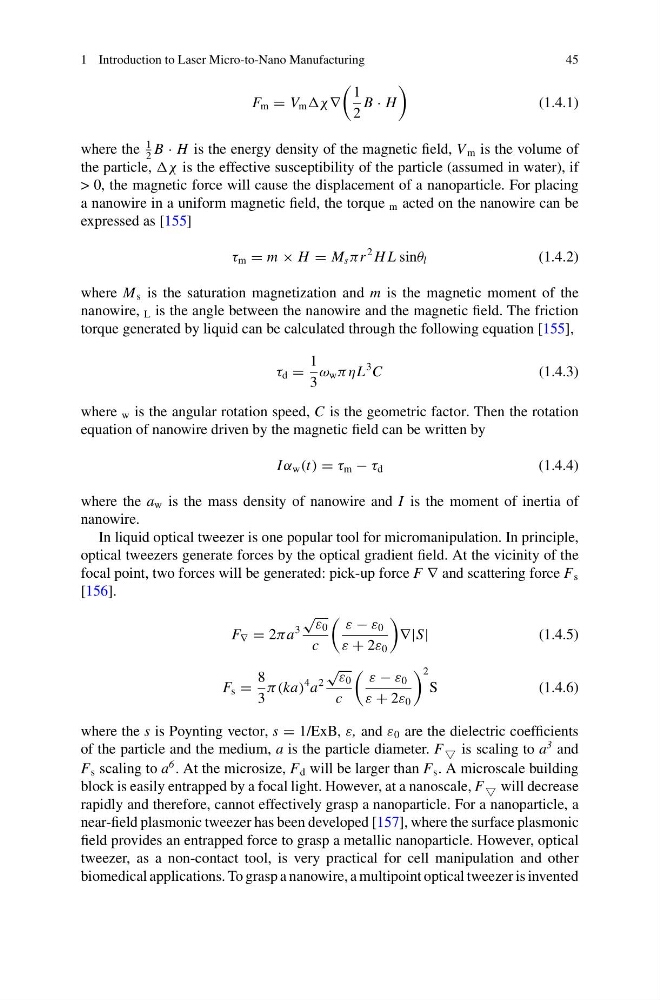
F m = V m χ ∇
1
2
B · H
(1.4.1)
where the
1
2
B · H is the energy density of the magnetic field, V m is the volume of
the particle, χ is the effective susceptibility of the particle (assumed in water), if
> 0, the magnetic force will cause the displacement of a nanoparticle. For placing
a nanowire in a uniform magnetic field, the torque m acted on the nanowire can be
expressed as [155]
τ m = m × H = M s πr
2 H L sinθ l
(1.4.2)
where M s is the saturation magnetization and m is the magnetic moment of the
nanowire, L is the angle between the nanowire and the magnetic field. The friction
torque generated by liquid can be calculated through the following equation [155],
τ d =
1
3
ω w πηL
3 C
(1.4.3)
where w is the angular rotation speed, C is the geometric factor. Then the rotation
equation of nanowire driven by the magnetic field can be written by
I α w (t) = τ m − τ d
(1.4.4)
where the a w is the mass density of nanowire and I is the moment of inertia of
nanowire.
In liquid optical tweezer is one popular tool for micromanipulation. In principle,
optical tweezers generate forces by the optical gradient field. At the vicinity of the
focal point, two forces will be generated: pick-up force F ∇ and scattering force F s
[156].
F ∇ = 2πa
3
√ ε 0
c
ε − ε 0
ε + 2ε 0
∇|S|
(1.4.5)
F s =
8
3
π (ka)
4 a
2
√
ε 0
c
ε − ε 0
ε + 2ε 0
2
S
(1.4.6)
where the s is Poynting vector, s = 1/ExB, ε, and ε 0 are the dielectric coefficients
of the particle and the medium, a is the particle diameter. F ▽ is scaling to a
3 and
F s scaling to a
6 . At the microsize, F d will be larger than F s . A microscale building
block is easily entrapped by a focal light. However, at a nanoscale, F ▽ will decrease
rapidly and therefore, cannot effectively grasp a nanoparticle. For a nanoparticle, a
near-field plasmonic tweezer has been developed [157], where the surface plasmonic
field provides an entrapped force to grasp a metallic nanoparticle. However, optical
tweezer, as a non-contact tool, is very practical for cell manipulation and other
biomedical applications. To grasp a nanowire, a multipoint optical tweezer is invented
45
F m = V m χ ∇
1
2
B · H
(1.4.1)
where the
1
2
B · H is the energy density of the magnetic field, V m is the volume of
the particle, χ is the effective susceptibility of the particle (assumed in water), if
> 0, the magnetic force will cause the displacement of a nanoparticle. For placing
a nanowire in a uniform magnetic field, the torque m acted on the nanowire can be
expressed as [155]
τ m = m × H = M s πr
2 H L sinθ l
(1.4.2)
where M s is the saturation magnetization and m is the magnetic moment of the
nanowire, L is the angle between the nanowire and the magnetic field. The friction
torque generated by liquid can be calculated through the following equation [155],
τ d =
1
3
ω w πηL
3 C
(1.4.3)
where w is the angular rotation speed, C is the geometric factor. Then the rotation
equation of nanowire driven by the magnetic field can be written by
I α w (t) = τ m − τ d
(1.4.4)
where the a w is the mass density of nanowire and I is the moment of inertia of
nanowire.
In liquid optical tweezer is one popular tool for micromanipulation. In principle,
optical tweezers generate forces by the optical gradient field. At the vicinity of the
focal point, two forces will be generated: pick-up force F ∇ and scattering force F s
[156].
F ∇ = 2πa
3
√ ε 0
c
ε − ε 0
ε + 2ε 0
∇|S|
(1.4.5)
F s =
8
3
π (ka)
4 a
2
√
ε 0
c
ε − ε 0
ε + 2ε 0
2
S
(1.4.6)
where the s is Poynting vector, s = 1/ExB, ε, and ε 0 are the dielectric coefficients
of the particle and the medium, a is the particle diameter. F ▽ is scaling to a
3 and
F s scaling to a
6 . At the microsize, F d will be larger than F s . A microscale building
block is easily entrapped by a focal light. However, at a nanoscale, F ▽ will decrease
rapidly and therefore, cannot effectively grasp a nanoparticle. For a nanoparticle, a
near-field plasmonic tweezer has been developed [157], where the surface plasmonic
field provides an entrapped force to grasp a metallic nanoparticle. However, optical
tweezer, as a non-contact tool, is very practical for cell manipulation and other
biomedical applications. To grasp a nanowire, a multipoint optical tweezer is invented