

44
A. Hu et al.
a micro-cavity ball lens combined with an inverter microscope. The photothermal
modified optical index convex lens is also formed by precisely controlling laser power
[153].
1.5 Micro-to-Nano Manipulation
The size effect and the scaling law make the nanoworld is quite different from the
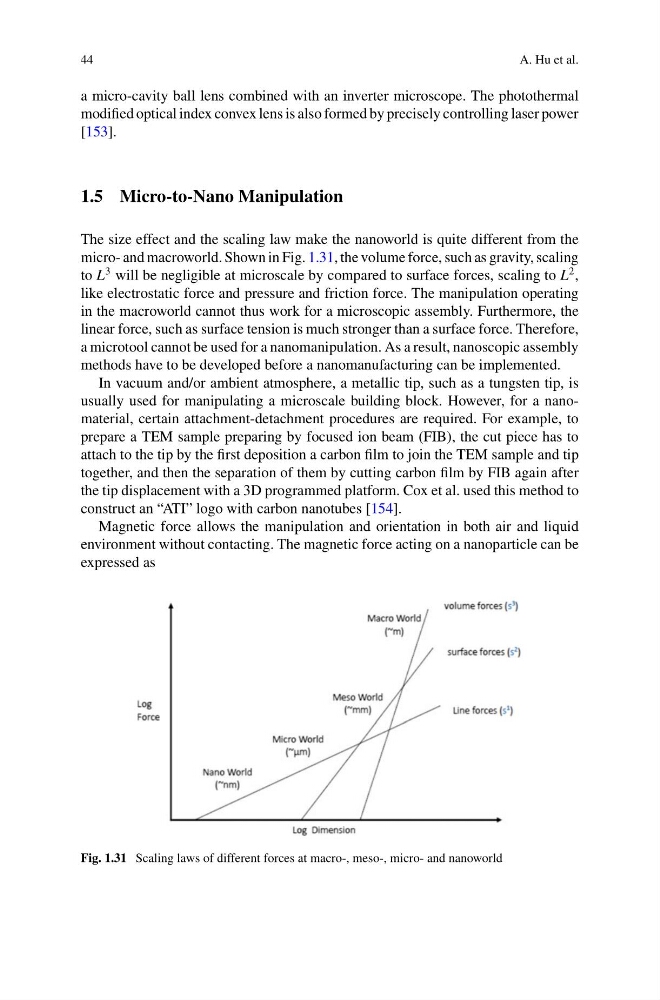
micro- and macroworld. Shown in Fig. 1.31, the volume force, such as gravity, scaling
to L
3 will be negligible at microscale by compared to surface forces, scaling to L
2 ,
like electrostatic force and pressure and friction force. The manipulation operating
in the macroworld cannot thus work for a microscopic assembly. Furthermore, the
linear force, such as surface tension is much stronger than a surface force. Therefore,
a microtool cannot be used for a nanomanipulation. As a result, nanoscopic assembly
methods have to be developed before a nanomanufacturing can be implemented.
In vacuum and/or ambient atmosphere, a metallic tip, such as a tungsten tip, is
usually used for manipulating a microscale building block. However, for a nanomaterial, certain attachment-detachment procedures are required. For example, to
prepare a TEM sample preparing by focused ion beam (FIB), the cut piece has to
attach to the tip by the first deposition a carbon film to join the TEM sample and tip
together, and then the separation of them by cutting carbon film by FIB again after
the tip displacement with a 3D programmed platform. Cox et al. used this method to
construct an “ATI” logo with carbon nanotubes [154].
Magnetic force allows the manipulation and orientation in both air and liquid
environment without contacting. The magnetic force acting on a nanoparticle can be
expressed as
Fig. 1.31 Scaling laws of different forces at macro-, meso-, micro- and nanoworld
A. Hu et al.
a micro-cavity ball lens combined with an inverter microscope. The photothermal
modified optical index convex lens is also formed by precisely controlling laser power
[153].
1.5 Micro-to-Nano Manipulation
The size effect and the scaling law make the nanoworld is quite different from the
micro- and macroworld. Shown in Fig. 1.31, the volume force, such as gravity, scaling
to L
3 will be negligible at microscale by compared to surface forces, scaling to L
2 ,
like electrostatic force and pressure and friction force. The manipulation operating
in the macroworld cannot thus work for a microscopic assembly. Furthermore, the
linear force, such as surface tension is much stronger than a surface force. Therefore,
a microtool cannot be used for a nanomanipulation. As a result, nanoscopic assembly
methods have to be developed before a nanomanufacturing can be implemented.
In vacuum and/or ambient atmosphere, a metallic tip, such as a tungsten tip, is
usually used for manipulating a microscale building block. However, for a nanomaterial, certain attachment-detachment procedures are required. For example, to
prepare a TEM sample preparing by focused ion beam (FIB), the cut piece has to
attach to the tip by the first deposition a carbon film to join the TEM sample and tip
together, and then the separation of them by cutting carbon film by FIB again after
the tip displacement with a 3D programmed platform. Cox et al. used this method to
construct an “ATI” logo with carbon nanotubes [154].
Magnetic force allows the manipulation and orientation in both air and liquid
environment without contacting. The magnetic force acting on a nanoparticle can be
expressed as
Fig. 1.31 Scaling laws of different forces at macro-, meso-, micro- and nanoworld