

38
A. Hu et al.
we expect no significant oxidation even the experiment is conducted in an ambient
atmosphere [6]. Even if thermal melting and oxidation exist, they are limited to a
very local region (near the irradiated region) less than 3 μm. This simulation result
is identical to the experiments, indicating that FS laser irradiation effect zones are
about 2.5–4 μm with different laser powers [6].
In summary, computational simulations using 1-D heat diffusion equation and
finite difference method (FDM) were performed to gain an insight into metallaser interactions with different lasers. Simulation studies on lasers have established
contrasting melting behaviors of metal under laser irradiations, which may pave the
way to use the ultrashort laser for innovative nonthermal welding of nanowires and
relevant devices development.
1.4.3 Photonic Reduction
Photonic reduction of metal salt has been developed as an effective method to form
metal nanoparticles. The morphology of metal nanoparticles can be controlled by the
various photonic parameters, such as, intensity, frequency, pulse width and polarization, etc. Generally, the photonic reduction of metal salt is realized by single-photon
and two/multiphoton absorption induced photochemical reaction.
Single-photon Reduction and Two/Multiphoton Reduction For metal salt solution, the energy of a single photon in near-ultraviolet (3.11–6 eV), visible (3.11–
1.78 eV) and infrared region (<1.78 eV) is not enough to photodecomposition of
water (>6.5 eV) leading to the production of e
− to reduce metal ions [131]. Therefore,
reducing reagent is needed for reducing reaction. As one typical reducing agent for
silver salt reduction, citrate is extensively used for the synthesis of silver nanoparticles
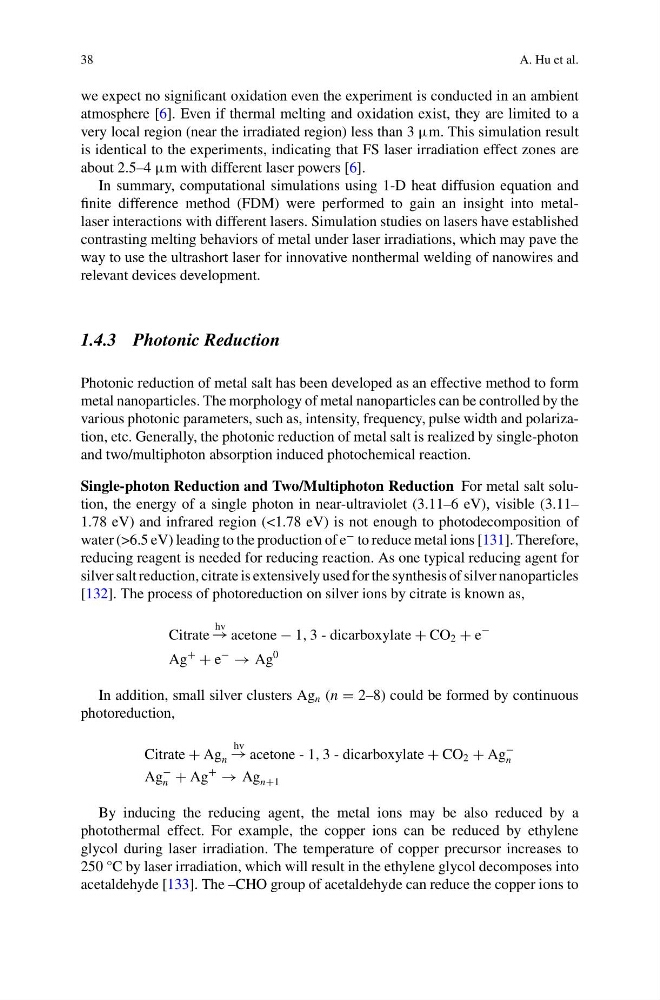
[132]. The process of photoreduction on silver ions by citrate is known as,
Citrate
hv
→ acetone − 1, 3 - dicarboxylate + CO 2 + e
−
Ag
+
+ e
−
→ Ag
0
In addition, small silver clusters Ag n (n = 2–8) could be formed by continuous
photoreduction,
Citrate + Ag n
hv
→ acetone - 1, 3 - dicarboxylate + CO 2 + Ag
−
n
Ag
−
n + Ag
+
→ Ag n+1
By inducing the reducing agent, the metal ions may be also reduced by a
photothermal effect. For example, the copper ions can be reduced by ethylene
glycol during laser irradiation. The temperature of copper precursor increases to
250 °C by laser irradiation, which will result in the ethylene glycol decomposes into
acetaldehyde [133]. The –CHO group of acetaldehyde can reduce the copper ions to
A. Hu et al.
we expect no significant oxidation even the experiment is conducted in an ambient
atmosphere [6]. Even if thermal melting and oxidation exist, they are limited to a
very local region (near the irradiated region) less than 3 μm. This simulation result
is identical to the experiments, indicating that FS laser irradiation effect zones are
about 2.5–4 μm with different laser powers [6].
In summary, computational simulations using 1-D heat diffusion equation and
finite difference method (FDM) were performed to gain an insight into metallaser interactions with different lasers. Simulation studies on lasers have established
contrasting melting behaviors of metal under laser irradiations, which may pave the
way to use the ultrashort laser for innovative nonthermal welding of nanowires and
relevant devices development.
1.4.3 Photonic Reduction
Photonic reduction of metal salt has been developed as an effective method to form
metal nanoparticles. The morphology of metal nanoparticles can be controlled by the
various photonic parameters, such as, intensity, frequency, pulse width and polarization, etc. Generally, the photonic reduction of metal salt is realized by single-photon
and two/multiphoton absorption induced photochemical reaction.
Single-photon Reduction and Two/Multiphoton Reduction For metal salt solution, the energy of a single photon in near-ultraviolet (3.11–6 eV), visible (3.11–
1.78 eV) and infrared region (<1.78 eV) is not enough to photodecomposition of
water (>6.5 eV) leading to the production of e
− to reduce metal ions [131]. Therefore,
reducing reagent is needed for reducing reaction. As one typical reducing agent for
silver salt reduction, citrate is extensively used for the synthesis of silver nanoparticles
[132]. The process of photoreduction on silver ions by citrate is known as,
Citrate
hv
→ acetone − 1, 3 - dicarboxylate + CO 2 + e
−
Ag
+
+ e
−
→ Ag
0
In addition, small silver clusters Ag n (n = 2–8) could be formed by continuous
photoreduction,
Citrate + Ag n
hv
→ acetone - 1, 3 - dicarboxylate + CO 2 + Ag
−
n
Ag
−
n + Ag
+
→ Ag n+1
By inducing the reducing agent, the metal ions may be also reduced by a
photothermal effect. For example, the copper ions can be reduced by ethylene
glycol during laser irradiation. The temperature of copper precursor increases to
250 °C by laser irradiation, which will result in the ethylene glycol decomposes into
acetaldehyde [133]. The –CHO group of acetaldehyde can reduce the copper ions to