

1 Introduction to Laser Micro-to-Nano Manufacturing
39
copper.
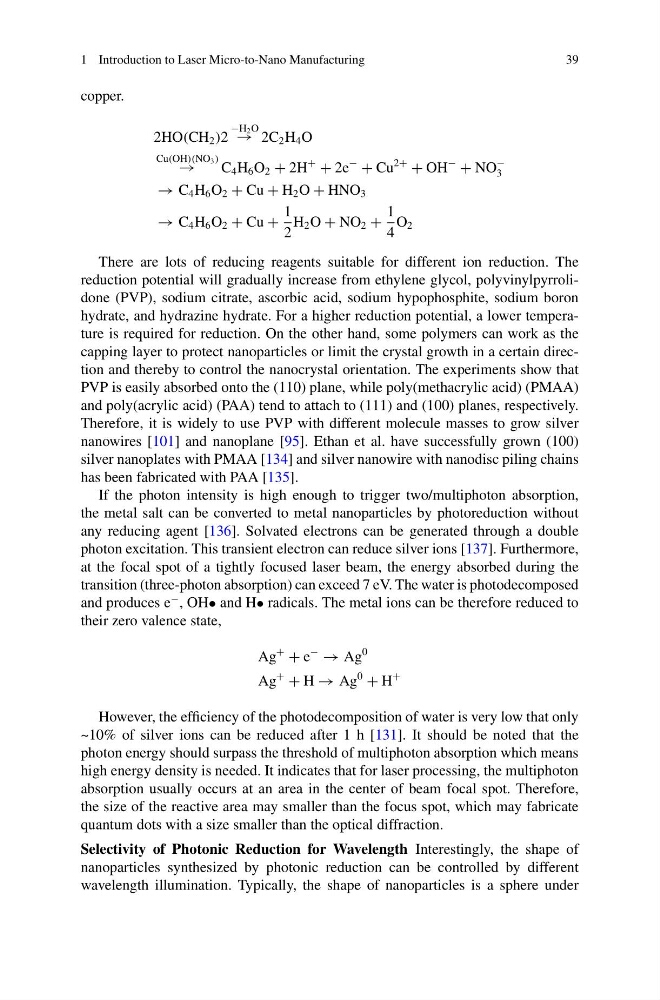
2HO(CH 2 )2
−H 2 O
→ 2C 2 H 4 O
Cu(OH)(NO 3 )
→
C 4 H 6 O 2 + 2H
+
+ 2e
−
+ Cu
2+
+ OH
−
+ NO
−
3
→ C 4 H 6 O 2 + Cu + H 2 O + HNO 3
→ C 4 H 6 O 2 + Cu +
1
2
H 2 O + NO 2 +
1
4
O 2
There are lots of reducing reagents suitable for different ion reduction. The
reduction potential will gradually increase from ethylene glycol, polyvinylpyrrolidone (PVP), sodium citrate, ascorbic acid, sodium hypophosphite, sodium boron
hydrate, and hydrazine hydrate. For a higher reduction potential, a lower temperature is required for reduction. On the other hand, some polymers can work as the
capping layer to protect nanoparticles or limit the crystal growth in a certain direction and thereby to control the nanocrystal orientation. The experiments show that
PVP is easily absorbed onto the (110) plane, while poly(methacrylic acid) (PMAA)
and poly(acrylic acid) (PAA) tend to attach to (111) and (100) planes, respectively.
Therefore, it is widely to use PVP with different molecule masses to grow silver
nanowires [101] and nanoplane [95]. Ethan et al. have successfully grown (100)
silver nanoplates with PMAA [134] and silver nanowire with nanodisc piling chains
has been fabricated with PAA [135].
If the photon intensity is high enough to trigger two/multiphoton absorption,
the metal salt can be converted to metal nanoparticles by photoreduction without
any reducing agent [136]. Solvated electrons can be generated through a double
photon excitation. This transient electron can reduce silver ions [137]. Furthermore,
at the focal spot of a tightly focused laser beam, the energy absorbed during the
transition (three-photon absorption) can exceed 7 eV. The water is photodecomposed
and produces e
− , OH• and H• radicals. The metal ions can be therefore reduced to
their zero valence state,
Ag
+
+ e
−
→ Ag
0
Ag
+
+ H → Ag
0
+ H
+
However, the efficiency of the photodecomposition of water is very low that only
~10% of silver ions can be reduced after 1 h [131]. It should be noted that the
photon energy should surpass the threshold of multiphoton absorption which means
high energy density is needed. It indicates that for laser processing, the multiphoton
absorption usually occurs at an area in the center of beam focal spot. Therefore,
the size of the reactive area may smaller than the focus spot, which may fabricate
quantum dots with a size smaller than the optical diffraction.
Selectivity of Photonic Reduction for Wavelength Interestingly, the shape of
nanoparticles synthesized by photonic reduction can be controlled by different
wavelength illumination. Typically, the shape of nanoparticles is a sphere under
39
copper.
2HO(CH 2 )2
−H 2 O
→ 2C 2 H 4 O
Cu(OH)(NO 3 )
→
C 4 H 6 O 2 + 2H
+
+ 2e
−
+ Cu
2+
+ OH
−
+ NO
−
3
→ C 4 H 6 O 2 + Cu + H 2 O + HNO 3
→ C 4 H 6 O 2 + Cu +
1
2
H 2 O + NO 2 +
1
4
O 2
There are lots of reducing reagents suitable for different ion reduction. The
reduction potential will gradually increase from ethylene glycol, polyvinylpyrrolidone (PVP), sodium citrate, ascorbic acid, sodium hypophosphite, sodium boron
hydrate, and hydrazine hydrate. For a higher reduction potential, a lower temperature is required for reduction. On the other hand, some polymers can work as the
capping layer to protect nanoparticles or limit the crystal growth in a certain direction and thereby to control the nanocrystal orientation. The experiments show that
PVP is easily absorbed onto the (110) plane, while poly(methacrylic acid) (PMAA)
and poly(acrylic acid) (PAA) tend to attach to (111) and (100) planes, respectively.
Therefore, it is widely to use PVP with different molecule masses to grow silver
nanowires [101] and nanoplane [95]. Ethan et al. have successfully grown (100)
silver nanoplates with PMAA [134] and silver nanowire with nanodisc piling chains
has been fabricated with PAA [135].
If the photon intensity is high enough to trigger two/multiphoton absorption,
the metal salt can be converted to metal nanoparticles by photoreduction without
any reducing agent [136]. Solvated electrons can be generated through a double
photon excitation. This transient electron can reduce silver ions [137]. Furthermore,
at the focal spot of a tightly focused laser beam, the energy absorbed during the
transition (three-photon absorption) can exceed 7 eV. The water is photodecomposed
and produces e
− , OH• and H• radicals. The metal ions can be therefore reduced to
their zero valence state,
Ag
+
+ e
−
→ Ag
0
Ag
+
+ H → Ag
0
+ H
+
However, the efficiency of the photodecomposition of water is very low that only
~10% of silver ions can be reduced after 1 h [131]. It should be noted that the
photon energy should surpass the threshold of multiphoton absorption which means
high energy density is needed. It indicates that for laser processing, the multiphoton
absorption usually occurs at an area in the center of beam focal spot. Therefore,
the size of the reactive area may smaller than the focus spot, which may fabricate
quantum dots with a size smaller than the optical diffraction.
Selectivity of Photonic Reduction for Wavelength Interestingly, the shape of
nanoparticles synthesized by photonic reduction can be controlled by different
wavelength illumination. Typically, the shape of nanoparticles is a sphere under