

11 Lithium-Ion Battery—3D Micro-/Nano-Structuring, Modification …
335
to reduce significantly the overall cell impedance, to enhance capacity retention at
high C-rates, and to reduce cell degradation.
11.4.3 Electrochemical Performance of 3D Silicon/carbon
Core–Shell Electrodes
In a very similar approach as described in Fig. 11.17, the passivation of silicon (Si)
anode nanomaterials and their electrochemical impact in 3D electrodes was studied
[28]. For this purpose Si nanoparticles (particle size 10–250 nm) were passivated
with a 5–7 nm thick carbon layer by applying thermal decomposition at 700 °C in an
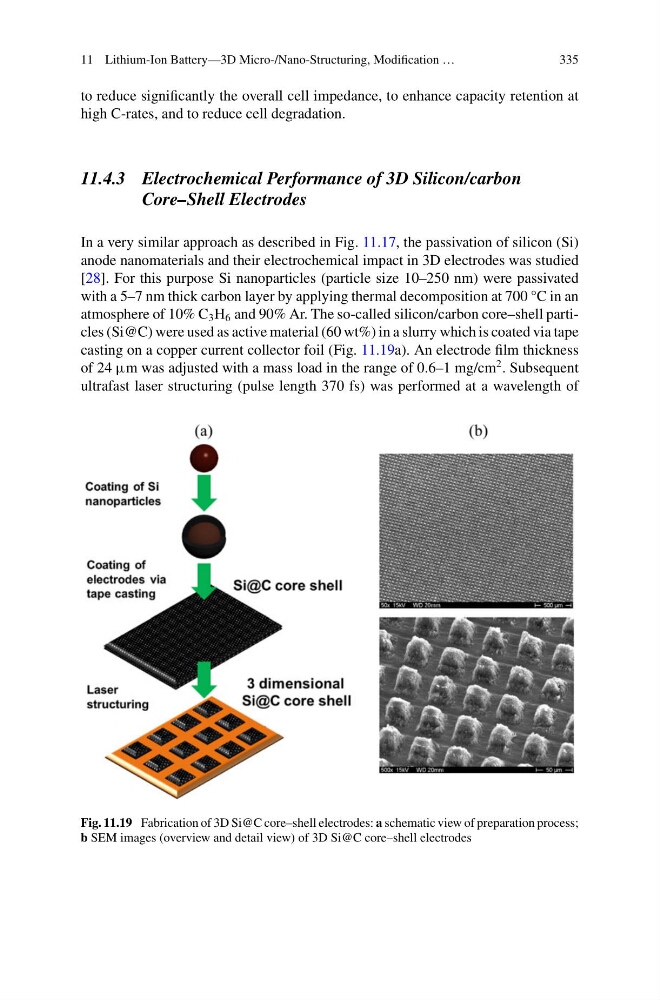
atmosphere of 10% C 3 H 6 and 90% Ar. The so-called silicon/carbon core–shell particles (Si@C) were used as active material (60 wt%) in a slurry which is coated via tape
casting on a copper current collector foil (Fig. 11.19a). An electrode film thickness
of 24 μm was adjusted with a mass load in the range of 0.6–1 mg/cm
2 . Subsequent
ultrafast laser structuring (pulse length 370 fs) was performed at a wavelength of
Fig. 11.19 Fabrication of 3D Si@C core–shell electrodes: a schematic view of preparation process;
b SEM images (overview and detail view) of 3D Si@C core–shell electrodes
335
to reduce significantly the overall cell impedance, to enhance capacity retention at
high C-rates, and to reduce cell degradation.
11.4.3 Electrochemical Performance of 3D Silicon/carbon
Core–Shell Electrodes
In a very similar approach as described in Fig. 11.17, the passivation of silicon (Si)
anode nanomaterials and their electrochemical impact in 3D electrodes was studied
[28]. For this purpose Si nanoparticles (particle size 10–250 nm) were passivated
with a 5–7 nm thick carbon layer by applying thermal decomposition at 700 °C in an
atmosphere of 10% C 3 H 6 and 90% Ar. The so-called silicon/carbon core–shell particles (Si@C) were used as active material (60 wt%) in a slurry which is coated via tape
casting on a copper current collector foil (Fig. 11.19a). An electrode film thickness
of 24 μm was adjusted with a mass load in the range of 0.6–1 mg/cm
2 . Subsequent
ultrafast laser structuring (pulse length 370 fs) was performed at a wavelength of
Fig. 11.19 Fabrication of 3D Si@C core–shell electrodes: a schematic view of preparation process;
b SEM images (overview and detail view) of 3D Si@C core–shell electrodes