

336
W. Pfleging et al.
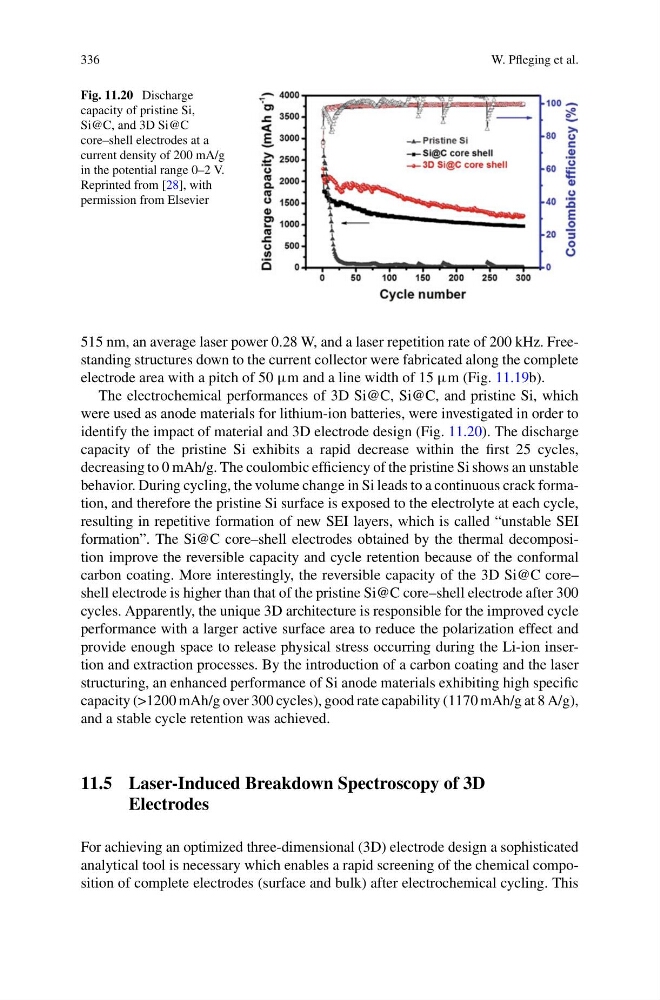
Fig. 11.20 Discharge
capacity of pristine Si,
Si@C, and 3D Si@C
core–shell electrodes at a
current density of 200 mA/g
in the potential range 0–2 V.
Reprinted from [28], with
permission from Elsevier
515 nm, an average laser power 0.28 W, and a laser repetition rate of 200 kHz. Freestanding structures down to the current collector were fabricated along the complete
electrode area with a pitch of 50 μm and a line width of 15 μm (Fig. 11.19b).
The electrochemical performances of 3D Si@C, Si@C, and pristine Si, which
were used as anode materials for lithium-ion batteries, were investigated in order to
identify the impact of material and 3D electrode design (Fig. 11.20). The discharge
capacity of the pristine Si exhibits a rapid decrease within the first 25 cycles,
decreasing to 0 mAh/g. The coulombic efficiency of the pristine Si shows an unstable
behavior. During cycling, the volume change in Si leads to a continuous crack formation, and therefore the pristine Si surface is exposed to the electrolyte at each cycle,
resulting in repetitive formation of new SEI layers, which is called “unstable SEI
formation”. The Si@C core–shell electrodes obtained by the thermal decomposition improve the reversible capacity and cycle retention because of the conformal
carbon coating. More interestingly, the reversible capacity of the 3D Si@C core–
shell electrode is higher than that of the pristine Si@C core–shell electrode after 300
cycles. Apparently, the unique 3D architecture is responsible for the improved cycle
performance with a larger active surface area to reduce the polarization effect and
provide enough space to release physical stress occurring during the Li-ion insertion and extraction processes. By the introduction of a carbon coating and the laser
structuring, an enhanced performance of Si anode materials exhibiting high specific
capacity (>1200 mAh/g over 300 cycles), good rate capability (1170 mAh/g at 8 A/g),
and a stable cycle retention was achieved.
11.5 Laser-Induced Breakdown Spectroscopy of 3D
Electrodes
For achieving an optimized three-dimensional (3D) electrode design a sophisticated
analytical tool is necessary which enables a rapid screening of the chemical composition of complete electrodes (surface and bulk) after electrochemical cycling. This
W. Pfleging et al.
Fig. 11.20 Discharge
capacity of pristine Si,
Si@C, and 3D Si@C
core–shell electrodes at a
current density of 200 mA/g
in the potential range 0–2 V.
Reprinted from [28], with
permission from Elsevier
515 nm, an average laser power 0.28 W, and a laser repetition rate of 200 kHz. Freestanding structures down to the current collector were fabricated along the complete
electrode area with a pitch of 50 μm and a line width of 15 μm (Fig. 11.19b).
The electrochemical performances of 3D Si@C, Si@C, and pristine Si, which
were used as anode materials for lithium-ion batteries, were investigated in order to
identify the impact of material and 3D electrode design (Fig. 11.20). The discharge
capacity of the pristine Si exhibits a rapid decrease within the first 25 cycles,
decreasing to 0 mAh/g. The coulombic efficiency of the pristine Si shows an unstable
behavior. During cycling, the volume change in Si leads to a continuous crack formation, and therefore the pristine Si surface is exposed to the electrolyte at each cycle,
resulting in repetitive formation of new SEI layers, which is called “unstable SEI
formation”. The Si@C core–shell electrodes obtained by the thermal decomposition improve the reversible capacity and cycle retention because of the conformal
carbon coating. More interestingly, the reversible capacity of the 3D Si@C core–
shell electrode is higher than that of the pristine Si@C core–shell electrode after 300
cycles. Apparently, the unique 3D architecture is responsible for the improved cycle
performance with a larger active surface area to reduce the polarization effect and
provide enough space to release physical stress occurring during the Li-ion insertion and extraction processes. By the introduction of a carbon coating and the laser
structuring, an enhanced performance of Si anode materials exhibiting high specific
capacity (>1200 mAh/g over 300 cycles), good rate capability (1170 mAh/g at 8 A/g),
and a stable cycle retention was achieved.
11.5 Laser-Induced Breakdown Spectroscopy of 3D
Electrodes
For achieving an optimized three-dimensional (3D) electrode design a sophisticated
analytical tool is necessary which enables a rapid screening of the chemical composition of complete electrodes (surface and bulk) after electrochemical cycling. This